Lesson 04 — Weighing an Emerging Technology: Promises and Risks
Learners build and apply a method for evaluating an emerging technology — weighing its promises and risks for humanity and the environment, neither worshipping nor fearing it. They read a balanced dossier on generative AI and a genetic tool, separate evidence from value, and reach a reasoned, hedged judgment about whether and how the technology should be developed and governed.
Objectives
Objectives
- D10.S1.10.02 Evaluate an emerging technology, such as AI or genetic tools, by weighing its promises and risks for humanity and the environment.
Essential question
How do I weigh an emerging technology — its promises and its risks — for humanity and the environment, without worshipping it or fearing it?
Key vocabulary
Materials
Standard materials
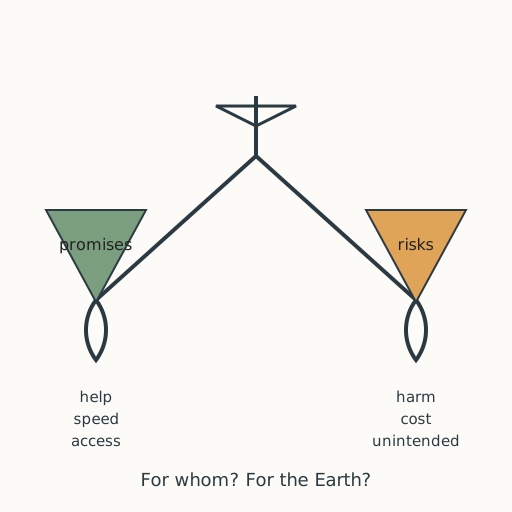
- Promises/risks scale sheet · 1 per learner A two-pan balance sheet for listing a technology's promises and risks across people and the environment
- Emerging-technology dossier · 1 per learner A sourced, balanced dossier on one emerging technology (generative AI and a genetic tool), with promises and risks named
Low-tech / no-cost
- A shared board or large paper Draw the balance sheet and list promises and risks together
- Voice and discussion Discuss the dossier aloud; no printed sheet needed
Enriched / lab & device
- Device with web access · 1 per pair Look up a current, sourced report on the technology to add to the dossier
- Two contrasting dossiers · 1 per group Compare an AI system and a genetic tool side by side on the same balance sheet
Works in different contexts
- large-group Build one whole-class balance sheet for the technology, then groups each weigh a different promise or risk and report back
- multi-age Younger learners name one hope and one worry; older learners write the full promises/risks evaluation
- self-directed A learner reads the dossier, fills the balance sheet, and writes one paragraph of reasoned judgment
- level-grouped A group ready to extend weights a promise against a risk on the same people, and argues which is heavier
- outdoor-only Choose a technology people can see outdoors — a generator, a pesticide, a drone — and weigh its promises and risks on the spot
Lesson 4 — Weighing an Emerging Technology: Promises and Risks
Summary
Learners build and apply a method for evaluating an emerging technology — weighing its promises and risks for humanity and the environment, neither worshipping it nor fearing it. They read a balanced dossier on generative AI and a genetic tool, separate evidence from value, and reach a reasoned, hedged judgment about whether and how the technology should be developed and governed.
Objectives
- Evaluate an emerging technology, such as AI or genetic tools, by weighing its promises and risks for humanity and the environment. (D10.S1.10.02)
Connection
Every powerful new tool arrives with two stories attached: the story of what it will fix, and the story of what it might break. The same language model that writes a struggling student’s first draft can flood a town with convincing lies; the same gene-editing tool that could cure a disease could also be used to alter what a future child is. Neither worship — “it will save us” — nor fear — “it will destroy us” — is a method. A method is a balance: list the promises, list the risks, ask for whom and for the Earth, and decide with your eyes open. That weighing, not a verdict, is the skill.
Materials
- Promises/risks scale sheet
- Emerging-technology dossier
Preparation
- Copy the scale sheet and the dossier.
- Retrieval: from Lessons 1–3, recall the data trail, the asymmetry of surveillance, and the gains and losses of automation. Today we assemble those threads into one weighing method.
- Prepare one worked example of listing a promise and a risk and stating for whom each is true.
Facilitator note
This lesson is written to the learner (“you”). The idea to land: a technology is judged by weighing its promises and risks for humanity and the environment — not by worshipping it or fearing it — and the weighing must ask for whom and at what cost to the Earth. This is the unit’s central stance (neither worship nor fear). The technology and environment lenses are the twin pans of the scale. The egalitarian lens: promises and risks are distributed unevenly — who gains access and who bears harm is a question of justice (S-281). The global lens: an emerging technology lands differently where infrastructure, law, and wealth differ. The ethics lens: whether a risk is acceptable is a value judgment, not a measurement. Ground the examples in sources: generative AI’s real capabilities and limits (machine translation as a concrete case, S-350; synthetic media and deepfakes, S-393), and genetic tools’ real foundations in heredity and crop genetic resources (S-177, S-178). Model the discipline of hedging — say “may,” “can,” “some evidence suggests,” not certainty. Distinguish evidence from values (philosophy §5). Preview: next lesson we turn to the media strand — how to check a claim in the flood of information these very tools produce.
Procedure
- Recall (5 min). From Lesson 3: who decided when a machine took over a job? What did that tell us about power?
- Meet the scale (10 min). Look at the scale sheet. A promise is a claimed or real benefit; a risk is a possible harm; a trade-off is what you give up for what you get; an unintended consequence is an effect nobody planned. An evaluation weighs these honestly, for people and for the planet.
- Worked example (10 min). Watch one weighing done step by step — a machine-translation tool: (a) promise (fast gist across languages, access for low-resource speakers, S-350); (b) risk (errors and flattening of nuance, dependence on a few large systems, S-350); (c) for whom (a traveler gains, a professional translator’s craft is pressured); (d) the environment (training and serving models uses energy and water).
- Guided practice (15 min). In a pair, read the dossier — generative AI and a genetic tool. Fill the scale sheet: at least two promises and two risks for each, naming for whom and any environment cost.
- Independent practice (10 min). In your journal, write your judgment in three sentences: should this technology be developed further, and under what conditions? If you only listed promises and risks without a judgment, mark “not yet.”
- Close (5 min). Share one judgment. Notice the discipline: a hedged, “under these conditions” answer is stronger than worship or fear.
Differentiation
- Support: Provide a half-filled scale sheet (one promise and one risk pre-listed) and sentence starters.
- Extension: Weight a promise against a risk for the same people (e.g., a farmer who both gains and loses), and argue which is heavier.
- Expression: Learners may record their judgment aloud, in a diagram, or have a partner read it — no step requires writing.
Assessment
- Formative (peer + self): Can the learner name promises and risks, say for whom each is true, note an environment cost, and reach a hedged judgment?
- Portfolio artifact (unit): The completed scale sheet and judgment, as the “emerging-technology evaluation” for the unit portfolio.
Home connection
With a family member, pick one new technology in your home or region. Name one promise and one risk, and ask: for whom is each true, and who would we want deciding whether to adopt it?
Resources
- On a concrete AI capability and its limits: Encyclopaedia Britannica, “Machine translation,” https://www.britannica.com/technology/machine-translation (S-350).
- On AI-generated synthetic media and the “prepared, not panicked” response: WITNESS Media Lab, “Prepare, Don’t Panic: Synthetic Media and Deepfakes,” https://lab.witness.org/projects/synthetic-media-and-deep-fakes/ (S-393).
- On the foundations of genetic tools: Encyclopaedia Britannica, “Heredity,” https://www.britannica.com/science/heredity-genetics (S-177); and FAO, Commission on Genetic Resources for Food and Agriculture, https://www.fao.org/cgrfa/en/ (S-178).
- On uneven digital benefits and who bears risk: World Bank, World Development Report 2016, https://www.worldbank.org/en/publication/wdr2016 (S-281).