Lesson 05 — The Fact-Checking Method: Trace the Evidence
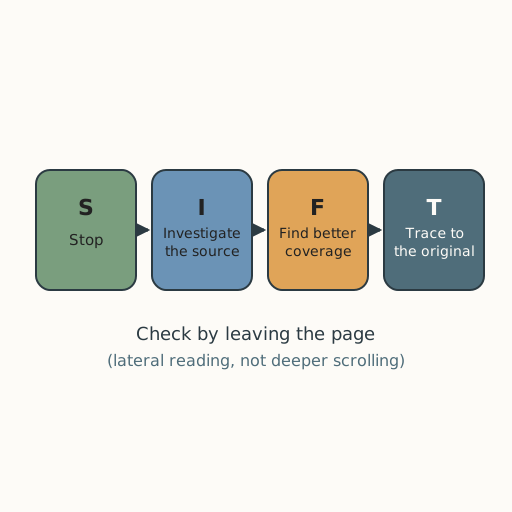
Learners meet and practice a fact-checking method — SIFT: Stop, Investigate the source, Find better coverage, and Trace to the original. They learn lateral reading (checking a source by leaving it and looking at what others say) and corroboration, then work a real claim through the method, recording where it came from and whether it holds up.
Objectives
Objectives
- D10.S2.10.01 Apply a fact-checking method to a real claim, tracing evidence and separating fact from interpretation.
Essential question
How do I check a claim by tracing it to its source, instead of trusting the way it reaches me?
Key vocabulary
Materials
Standard materials
- SIFT method card · 1 per learner A card with the four moves — Stop, Investigate the source, Find better coverage, Trace to the original — with a one-line prompt for each
- Claim tracing worksheet · 1 per learner A sheet with a claim at the top and boxes for source, original, and independent coverage
Low-tech / no-cost
- A shared board or large paper Do the four moves together on one claim written large
- Voice and memory Practice the four moves aloud on a spoken claim; no sheet needed
Enriched / lab & device
- Device with web access · 1 per pair Do lateral reading live — open a claim, investigate the source, find independent coverage
- Two contrasting claims · 1 per group One claim that survives checking and one that does not, to compare
Works in different contexts
- large-group Model the four moves whole-class on one claim, then pairs apply them to a second claim
- multi-age Younger learners practice "Stop" and "Trace"; older learners complete all four moves and the worksheet
- self-directed A learner reads the SIFT card, works a claim through the four moves, and records the worksheet
- level-grouped A group ready to extend checks a claim from a real feed and writes a short verification note
- outdoor-only Practice on a spoken claim — a rumor about the weather, a plant, or a local rule — and trace it by asking who said it and how they know
Lesson 5 — The Fact-Checking Method: Trace the Evidence
Summary
Learners meet and practice a fact-checking method — SIFT: Stop, Investigate the source, Find better coverage, and Trace to the original. They learn lateral reading (checking a source by leaving it and looking at what others say) and corroboration (seeing whether independent sources agree), then work a real claim through the method, recording where it came from and whether it holds up.
Objectives
- Apply a fact-checking method to a real claim, tracing evidence back to its source. (D10.S2.10.01)
Connection
A claim reaches you wrapped in a feeling — outrage, hope, surprise — and the feeling travels faster than the facts. Before you share it, you can ask four small questions that cost less than a minute: Wait — who is saying this? What do others say? Where did it first come from? A person who asks those questions is not cynical; they are careful. This matters everywhere people share news — a village noticeboard, a family group chat, a city feed — because a lie can travel the world while the truth is still checking its sources. The method is not about believing nothing; it is about knowing why you believe what you believe.
Materials
- SIFT method card
- Claim tracing worksheet
Preparation
- Copy the SIFT method card and the worksheet.
- Retrieval: from Grade 9, recall tracing a viral claim to its source and checking it against independent reporting (D10.S2.09.02). Today we formalize that habit into a reusable method.
- Prepare one worked example of running a claim through all four moves.
Facilitator note
This lesson is written to the learner (“you”). The idea to land: a fact-checking method is a habit, not a talent — Stop, Investigate the source, Find better coverage, Trace to the original — and it works by leaving the claim to see what others say (lateral reading) and by finding where it first came from. This is an explicit-skill lesson: model the method with a worked example, then guided practice, then independent work (S-011). The critical-thinking lens is the spine. The technology lens: the flood of information — and the AI that now generates it — is exactly why the method matters (S-393). The egalitarian lens: everyone deserves the tool to tell a source apart from a rumor, not just professionals; media literacy is a shared good (S-217). The global lens: checking practices and what counts as a trustworthy source differ across cultures and media systems — no one tradition is the default. The ethics lens: sharing an unchecked claim can harm real people, so checking is a duty, not a chore. The environment lens: false claims about the environment — a broken dam, a fire, a drought, a polluted river — spread fast and can drive real harm or delay real care, so checking them is care for the Earth too. Note the method’s roots in verification guides (S-394) and historical sourcing (S-316), and hold questions open (philosophy §11). Preview: next lesson we separate fact from interpretation on a real claim.
Procedure
- Recall (5 min). From Grade 9: think of a time a claim spread quickly. What, if anything, did you check before believing or sharing it?
- Meet the method (10 min). Look at the SIFT card. Four moves: Stop (pause before you react or share); Investigate the source (who is this, and are they in a position to know?); Find better coverage (do other, independent sources report the same thing?); Trace to the original (where did this first appear, and was it altered on the way?). Lateral reading means checking a source by leaving it — opening new tabs, not scrolling deeper into the same page.
- Worked example (10 min). Watch one claim run through all four moves step by step: a post claims a local dam has broken. Stop. Investigate: who posted it, and do they know? Find better coverage: is a news agency or the dam authority reporting it? Trace: the image in the post is actually from a flood years ago in another country. The claim fails the trace.
- Guided practice (15 min). In a pair, run a second claim through the four moves on the worksheet. Record: the source, what others say, and the original. Agree on whether it holds up.
- Independent practice (10 min). In your journal, write the four moves in your own words, with one sentence each on what they protect you from. If you listed the moves without the “what they protect you from,” mark “not yet.”
- Close (5 min). Share one move you will actually use. The method is only as good as the habit of using it.
Differentiation
- Support: Provide the four moves with the “what it protects you from” half-filled, and sentence starters.
- Extension: Check a claim from a real feed and write a short verification note citing what you found.
- Expression: Learners may speak their moves aloud, or have a partner read their reasoning — no step requires writing.
Assessment
- Formative (peer + self): Can the learner name and apply the four moves, trace a claim to its source, and say whether it holds up?
- Portfolio artifact (unit): The completed claim tracing worksheet, as the opening page of the unit’s “fact-check record” section.
Home connection
With a family member, take one claim from your shared feed or conversation and run it through the four moves together. Which move changed your mind?
Resources
- On the verification essentials (the method’s roots): First Draft, “Verifying Online Information: The Absolute Essentials,” https://web.archive.org/web/2019/https://firstdraftnews.org/latest/verifying-online-information-the-absolute-essentials/ (S-394).
- On sourcing and corroboration as teachable skills: Stanford History Education Group, historical thinking, https://sheg.stanford.edu/ (S-316).
- On media and information literacy as a shared good: UNESCO, Media and Information Literacy, https://www.unesco.org/en/media-information-literacy (S-217).
- On AI-generated synthetic media and why checking matters more than ever: WITNESS Media Lab, “Prepare, Don’t Panic: Synthetic Media and Deepfakes,” https://lab.witness.org/projects/synthetic-media-and-deep-fakes/ (S-393).