Lesson 06 — Fact and Interpretation: A Real Claim, Checked
Learners separate fact from interpretation within real claims, tracing evidence and flagging where a meaning has been attached to a fact. They verify the checkable parts, identify the interpretations, and practice the discipline of hedging — saying only what the evidence supports.
Objectives
Objectives
- D10.S2.10.01 Apply a fact-checking method to a real claim, tracing evidence and separating fact from interpretation.
Essential question
How do I separate what is fact from what is interpretation when a claim mixes the two?
Key vocabulary
Materials
Standard materials
- Fact/interpretation claim set · 1 set per group Real, sourced claims about a current issue, each with the fact and the interpretation embedded, to separate
- Two-column sheet · 1 per learner Columns labeled "fact (checkable)" and "interpretation (a meaning given to facts)"
Low-tech / no-cost
- A shared board or large paper Sort the facts and interpretations together as a group
- Voice and discussion Separate fact from interpretation aloud; no printed sheet needed
Enriched / lab & device
- Device with web access · 1 per pair Verify the factual parts of the claims live and flag which parts cannot be verified
- A claim that mixes fact and interpretation heavily · 1 per group A deliberately tangled claim to untangle and annotate
Works in different contexts
- large-group Sort one claim whole-class, then groups sort the rest and share their two-column sheets
- multi-age Younger learners circle the fact; older learners write both the fact and the interpretation
- self-directed A learner sorts the claims alone and writes one paragraph on how a fact became an interpretation
- level-grouped A group ready to extend rewrites a loaded claim so the fact and the interpretation are clearly separated
- outdoor-only Take a spoken claim about the place — "the river is polluted" — and separate what can be observed from what is concluded
Lesson 6 — Fact and Interpretation: A Real Claim, Checked
Summary
Learners separate fact from interpretation within real claims, tracing evidence and flagging where a meaning has been attached to a fact. They verify the checkable parts, identify the interpretations, and practice the discipline of hedging — saying only what the evidence supports.
Objectives
- Apply a fact-checking method to a real claim, tracing evidence and separating fact from interpretation. (D10.S2.10.01)
Connection
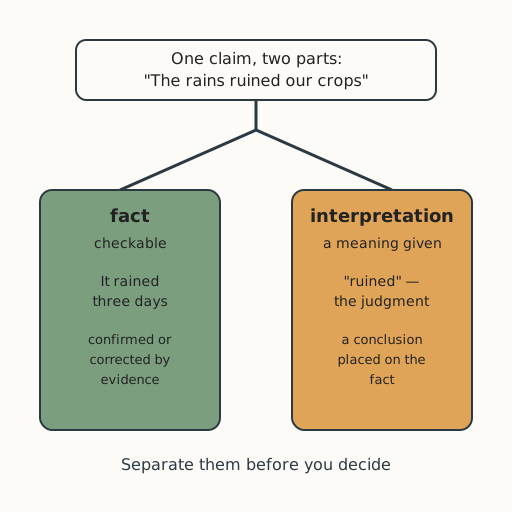
“It rained for three days” and “the rains ruined our crops” can describe the same week. The first is a fact — you can check it with a gauge and a calendar. The second is an interpretation — a meaning placed on the fact, which may be true or may ignore that the crops were already failing from disease. Much of what we read and hear is this mixture, stitched so tightly we mistake the meaning for the measurement. Separating them is not pedantry; it is how you keep your thinking honest, and how you notice when someone is smuggling a conclusion inside a fact.
Materials
- Fact/interpretation claim set
- Two-column sheet
Preparation
- Copy the claim set and the two-column sheet.
- Retrieval: from Lesson 5, recall the four SIFT moves. Today we use them to split a single claim into its checkable facts and its interpretations.
- Prepare one worked example of separating a claim into fact and interpretation.
Facilitator note
This lesson is written to the learner (“you”). The idea to land: a claim often bundles a checkable fact with an interpretation — a meaning given to that fact — and the skill is to separate them, verify the fact, and say plainly where the interpretation begins. This extends Lesson 5 from “is it true?” to “which part is true, and which part is a reading of the truth?” The critical-thinking lens is the spine. The ethics lens: honest communication names its interpretations instead of hiding them inside facts (S-442). The egalitarian lens: the habit of separating fact from interpretation protects ordinary people from being led; it is a democratic skill, not an elite one. The global lens: different media traditions blend fact and commentary differently — recognizing the blend, not imposing one style, is the aim. The technology lens: algorithmically boosted feeds reward strong interpretation over careful fact, which is why the split matters (S-482). The environment lens: environmental claims — a drought, a harvest, a river’s health — are where fact and interpretation most often tangle, so the split is a form of care for the Earth too. Use real, hedged language and distinguish evidence from values (philosophy §5). Model “the evidence shows X; whether that is good or bad is a judgment.” Preview: next lesson asks who owns the media that deliver these claims, and how that shapes what we even see.
Procedure
- Recall (5 min). From Lesson 5: name the four moves and the one you are most likely to skip.
- Meet the split (10 min). A fact is checkable — it can be confirmed or corrected with evidence. An interpretation is a meaning, judgment, or conclusion placed on facts. Evidence supports a fact; inference builds an interpretation on it. Hedging means saying only what the evidence supports (“the data suggest,” not “this proves”).
- Worked example (10 min). Watch one claim split step by step: “Because the factory cut jobs, the town is dying.” (a) Fact: the factory cut a specific number of jobs — checkable. (b) Fact: the town’s population changed by a checkable amount. (c) Interpretation: “the town is dying” — a meaning placed on those facts, which may be contested (new work, different causes).
- Guided practice (15 min). In a group, sort the claim set into the two-column sheet: fact (checkable) on one side, interpretation (a meaning given) on the other. For each fact, name the evidence that would check it; for each interpretation, name the value or judgment it carries.
- Independent practice (10 min). In your journal, rewrite one claim so the fact and the interpretation are visibly separated, and hedge the interpretation. If you only circled words without rewriting, mark “not yet.”
- Close (5 min). Share one rewrite. The discipline: the fact stays; the interpretation is named as yours, not smuggled in.
Differentiation
- Support: Provide one pre-split claim and sentence starters (“The fact is __; the interpretation is __”).
- Extension: Find a real loaded claim and rewrite it in neutral terms, then in clearly-labeled opinion.
- Expression: Learners may speak the separation aloud or have a partner read their rewrite — no step requires writing.
Assessment
- Formative (peer + self): Can the learner separate fact from interpretation in a claim, name the evidence that would check the fact, and hedge the interpretation?
- Portfolio artifact (unit): The two-column sheet and one rewrite, added to the “fact-check record” section.
Home connection
With a family member, take one sentence from the news or a group chat and sort it: which words are checkable facts, and which are a meaning placed on them?
Resources
- On the five core questions of media literacy (who created this, what is omitted, who benefits): Center for Media Literacy, Five Core Concepts and Key Questions, https://www.medialit.org/ (S-442).
- On how personalized feeds reward the strong and the certain over the careful: Eli Pariser, The Filter Bubble (2011) (S-482).
- On the verification method applied in Lesson 5: First Draft, “Verifying Online Information,” https://web.archive.org/web/2019/https://firstdraftnews.org/latest/verifying-online-information-the-absolute-essentials/ (S-394).