Lesson 07 — Who Owns the News? Media Ownership
Learners analyze who owns the media people consume and how concentrated ownership can shape what is reported and what is left out. They map outlets to owners, compare a concentrated market with a plural one, and weigh the risks to a public's right to know against the realities of funding journalism.
Objectives
Objectives
- D10.S2.10.02 Analyze who owns the media people consume and how concentrated ownership can shape what is reported and left out.
Essential question
Who owns the media people consume, and how can concentrated ownership shape what is reported and what is left out?
Key vocabulary
Materials
Standard materials
- Ownership map sheet · 1 per learner A blank map for drawing which outlets trace back to which owners, in a learner's own country or region
- Media ownership case · 1 per learner A short, sourced account of concentrated and diverse media ownership in two different places
Low-tech / no-cost
- A shared board or large paper Draw the ownership map together, tracing outlets to owners
- Voice and discussion Discuss the case aloud; no printed sheet needed
Enriched / lab & device
- Device with web access · 1 per pair Look up who owns a few real outlets the learners actually use, and trace the chains
- Two contrasting ownership cases with data · 1 per group One concentrated market and one plural market, to compare and discuss
Works in different contexts
- large-group Trace one market's ownership whole-class, then groups map a second market and compare
- multi-age Younger learners name who makes the news they see; older learners map ownership chains and analyze concentration
- self-directed A learner reads the case, draws the ownership map, and writes one paragraph on concentration and plurality
- level-grouped A group ready to extend compares concentration in two countries and argues how it shapes reporting
- outdoor-only Discuss who controls the loudest voices in a shared space — a market, a town crier, a noticeboard — and what that does to what is heard
Lesson 7 — Who Owns the News? Media Ownership
Summary
Learners analyze who owns the media people consume and how concentrated ownership can shape what is reported and what is left out. They map outlets to owners, compare a concentrated market with a plural one, and weigh the risks to a public’s right to know against the realities of funding journalism.
Objectives
- Analyze who owns the media people consume and how concentrated ownership can shape what is reported and left out. (D10.S2.10.02)
Connection
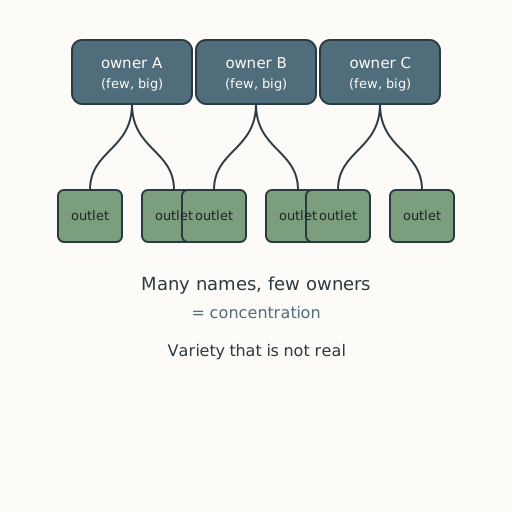
When you read the news, you are reading someone’s choices — an editor’s, a publisher’s, and behind them an owner’s. If a hundred different-looking outlets are all owned by the same few companies, the variety is an illusion: the same hands decide what is worth covering and what is quietly dropped. That is what concentration means — many names, few owners. The opposite is plurality — many independent voices. Who owns the news shapes what a public can know, and what it never hears about at all. This is not a conspiracy theory; it is how any gate works, whether the gate is a newspaper, a radio tower, or a feed.
Materials
- Ownership map sheet
- Media ownership case
Preparation
- Copy the ownership map sheet and the case.
- Retrieval: from Lessons 5–6, recall how to trace a claim and separate fact from interpretation. Today we ask a step before the claim: who decided what you would even see to check?
- Prepare one worked example of tracing outlets to owners.
Facilitator note
This lesson is written to the learner (“you”). The idea to land: media ownership can be concentrated — many outlets, few owners — and that concentration shapes what is reported and left out, because owners set priorities and resources; plurality of independent voices is what protects a public’s right to know. Keep the analysis structural, not conspiratorial: owners influence through staffing, budgets, and editorial direction, not usually by direct command. The egalitarian lens: whose stories get told and whose are dropped tracks power — the voices that own the megaphone are heard; the rest are not (S-442, S-417). The global lens: media systems differ — public-service broadcasting, community radio, and press-freedom arrangements vary widely, and none is the human default (S-217). The technology lens: digital platforms have become the new gatekeepers, and their ownership and algorithms shape the feed (S-481, S-482). The ethics lens: journalism has a duty to inform fairly, and ownership that narrows that duty is an ethical problem. The environment lens: media ownership also shapes which stories are told — including environmental stories that threaten powerful interests. Distinguish evidence (who owns what) from values (what a fair media system should look like) (philosophy §5). Preview: next lesson analyzes what gets reported and what gets left out, as a portfolio artifact.
Procedure
- Recall (5 min). From Lesson 6: what is the difference between a fact and an interpretation? Why does the distinction protect your thinking?
- Meet ownership (10 min). Media ownership is who owns the outlets that gather and publish news. Concentration is many outlets under few owners. Plurality is many independent voices. Independent media are owned separately from government and from large chains; public service media are funded by the public and answer to it. The owner of a gate is a gatekeeper — deciding, by budget and priority, what passes through.
- Worked example (10 min). Watch one market traced step by step: three newspapers, two radio stations, and a TV channel that all look different — but two of the papers, one station, and the channel share a single owner. (a) What gets covered well (the owner’s interests); (b) what gets dropped (stories that embarrass the owner); (c) what plurality would look like instead.
- Guided practice (15 min). In a group, read the case — one concentrated market and one plural market. Draw the ownership map for each: which outlets trace to which owners. Discuss one story each market would likely report and one it would likely drop.
- Independent practice (10 min). In your journal, write: who owns the media you actually use, and what might that ownership leave out? If you only named owners without saying what is left out, mark “not yet.”
- Close (5 min). Share one “left out” example. The question is not whether media should exist, but whether many independent voices — not a few owners — decide what a public knows.
Differentiation
- Support: Provide a half-drawn ownership map (some outlets pre-traced) and sentence starters.
- Extension: Compare concentration in two countries and argue how each shapes reporting, citing one real example.
- Expression: Learners may draw the map and have a partner read their reasoning — no step requires writing.
Assessment
- Formative (peer + self): Can the learner trace outlets to owners, say how concentration shapes what is reported and left out, and name what plurality would add?
- Portfolio artifact (unit): The ownership map with one “left out” example, as the opening page of the “media ownership analysis” section.
Home connection
With a family member, list the news you both get. Try to name who owns each source. Ask: whose stories do we never see, and how would we find them?
Resources
- On the five core questions of media literacy (who created this, who benefits, what is omitted): Center for Media Literacy, Five Core Concepts and Key Questions, https://www.medialit.org/ (S-442).
- On media and information literacy across systems: UNESCO, Media and Information Literacy, https://www.unesco.org/en/media-information-literacy (S-217).
- On platforms as gatekeepers and how their algorithms shape the feed: Encyclopaedia Britannica, “Social media,” https://www.britannica.com/topic/social-media (S-481); and Eli Pariser, The Filter Bubble (2011) (S-482).
- On the danger of a single story (whose stories get told): Chimamanda Ngozi Adichie, “The Danger of a Single Story,” https://www.ted.com/talks/chimamanda_ngozi_adichie_the_danger_of_a_single_story (S-417).