Lesson 01 — All of Me: The Whole Person I Am Becoming
Learners return to their considered position on what defines them and widen it into a celebration of the whole person — values, story, choices, relationships, body, and dreams — naming the parts that external labels cannot touch. This opens the year-end capstone portfolio.
Objectives
Objectives
- D01.S2.10.02 Develop a considered position on what defines them, independent of external labels and expectations.
Essential question
What is my considered position on what defines me — and how do I celebrate the whole person, not just the label?
Key vocabulary
Materials
Standard materials
- Whole-person map (SVG) · 1 per learner or projected The whole-person graphic — my values, story, choices, relationships, body, dreams
- Portfolio folder or journal · 1 per learner Where the year's closing artifacts will gather
Low-tech / no-cost
- A large sheet of paper and a pen Draw the whole-person map by hand — a figure in the middle, your own six parts around it
- Voice and memory Speak the six parts aloud to a partner; no writing needed
Enriched / lab & device
- A photo, recording, or slide about yourself · 1 per learner To anchor the whole-person map in something real from your own life
Works in different contexts
- large-group Build one shared whole-person map on a board, then learners make their own; pairs share one part they are proud of
- multi-age Younger learners name three parts; older learners name all six and add the part they are still deciding
- self-directed A learner draws the map alone, then reads it back and circles the part that feels most true this year
- level-grouped A ready group adds the counter-consideration — a label they were once given and why it does not define them
- outdoor-only Find six natural objects that stand in for six parts of you, arrange them in a circle, and explain each to a partner
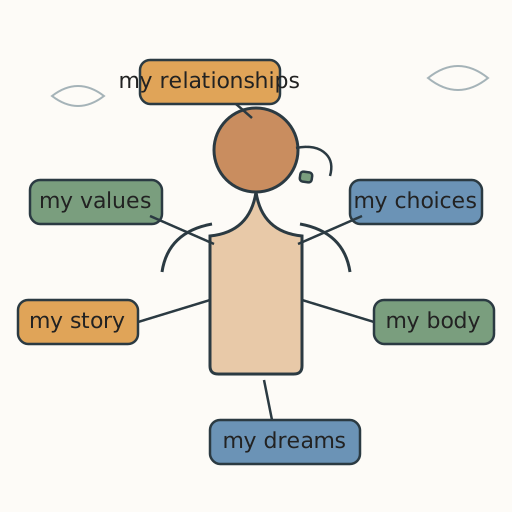
Lesson 1 — All of Me: The Whole Person I Am Becoming
Summary
Learners retrieve the considered position they built earlier this year — what defines them, independent of external labels — and expand it into a whole-person map of six parts: values, story, choices, relationships, body, and dreams. The lesson is a homecoming and a celebration, not a test. It opens the closing portfolio that will gather the unit’s artifacts.
Objectives
- Restate and celebrate a considered position on what defines me, independent of external labels and expectations, as a whole person with many parts. (D01.S2.10.02)
Connection
Think of the last time someone reduced you to one word — “the athlete,” “the quiet one,” “the one from that family.” A label is a single, flat card; a person is a whole room of things at once. You already know this from your own life: the same person who cooks a meal for others also plays music, worries about a friend, and dreams about the sea. This lesson gathers that whole room back into one map, so we can look at you — all of you — and celebrate it.
Materials
- Whole-person map (SVG)
- Portfolio folder or journal
Preparation
- Retrieval cue: from earlier this year (Unit 1), each learner wrote a considered position — a statement of what defines them, in their own words, independent of labels. Today we widen it, not rewrite it.
- Print or project the whole-person map; prepare the six part-names.
Facilitator note
This lesson is written to the learner (“you”). The idea to land, warmly and without pressure: a considered position is not a single label but a whole person made of many parts — values, story, choices, relationships, body, and dreams — and none of them is defined by an outside label. Identity is a developing story, not a finished fact (Erikson, S-155); thinking of it as parts that can shift by context is the mature, accurate view (this is the spiral of D01.S2 across grades). Research on “possible selves” (Markus & Nurius, S-399) reminds us the self includes imagined futures, which is why “dreams” belongs on the map.
Hold the ethics lens: treating a person as a whole is a way of respecting them. The egalitarian lens: labels flatten everyone, but they land hardest on people who are already stereotyped — naming the parts labels cannot touch is an act of dignity. The global lens: what counts as “the right parts” differs across cultures; let learners choose their own six, and honor that difference. The technology lens can appear as an optional reflection: feeds and profiles ask us to shrink into a single image — the whole-person map pushes back. Distinguish evidence from values: identity as a developing, many-parted story is descriptive; “every whole person deserves to be seen” is a value we hold together.
Model once (worked example, S-011), then let learners build their own. Keep the tone celebratory. This is the first artifact of the closing portfolio.
Procedure
- Recall (7 min). Earlier this year you wrote a considered position — a short statement of what defines you, in your own words, independent of labels. Without looking, say or jot two things you remember putting in it. Then check: what did you get right, and what would you add now?
- Meet the whole-person map (8 min). Look at the graphic. Each part — values, story, choices, relationships, body, dreams — is a piece of the whole you. A label grabs only one piece and pretends it is all of you. Which part does a label most often miss?
- Build your map (20 min). Draw a small figure in the middle and your own six parts around it (you may rename any part). For each part, write one true sentence — a value you hold, a chapter of your story, a choice you are proud of, a person who matters, a thing your body can do, a dream you are growing. Add a seventh, blank part and label it “still deciding” — because a whole person keeps becoming.
- Share one part (8 min). With a partner, share the part you are proudest of, and listen to theirs. Notice: their map is not a copy of yours, and that is the point.
- Close (7 min). In one sentence, finish: “I am more than any label because…” Write it at the top of your map. This is the first page of your closing portfolio.
Differentiation
- Support: Offer a pre-drawn map with the six part-names already placed; the learner writes one word in each.
- Access (blind / low vision): Describe the whole-person map aloud — a figure surrounded by six labeled parts, with empty expectation bubbles floating outside without touching — and offer a tactile version built from six found objects placed in a circle around a central stone.
- Alternative expression (non-writing, non-oral): Build the map with six found objects and point to each as a partner or pre-printed label names it; the closing line may be a chosen symbol or drawing instead of a written sentence.
- Extension: Add a “counter-consideration” note — one label you have been given, and a sentence on why it does not define the whole of you.
Assessment
- Formative (self + peer): Can the learner name several parts of themselves and explain why a single label cannot contain the whole person?
- Portfolio artifact (unit): The whole-person map, with the closing sentence “I am more than any label because…”, as the first page of the closing portfolio.
Home connection
Show your whole-person map to someone who has known you a long time. Ask them to add one part of you they have seen that you did not write down — then decide whether it belongs on your map.
Resources
- On identity as a developing, lifelong process (not a finished fact): Erikson, Childhood and Society (1950) (S-155).
- On “possible selves” — the selves we imagine becoming: Markus & Nurius (1986), American Psychologist 41(9), 954–969 (S-399).
- On worked examples and guided practice for new skills: Kirschner, Sweller & Clark (2006), https://doi.org/10.1207/s15326985ep4102_1 (S-011).