Lesson 07 — All of Us: Celebration, Community, and the Living Earth
Learners gather the year's closing artifacts into one portfolio and one celebration — their considered position, their Grade-11 learning plan, their place in the web of communities, and their commitment to care — and look ahead to Grade 11 with hope and agency, celebrating the whole person, the caring community, and the living Earth.
Objectives
Objectives
- D01.S2.10.02 Develop a considered position on what defines them, independent of external labels and expectations.
- D01.S3.10.01 Direct their own learning by choosing goals, resources, and ways to check their own progress.
- D02.S3.10.02 Explain how local communities connect to regional, national, and global ones.
- D02.S4.10.02 Examine examples of cooperative economies and mutual-aid networks across the world.
Essential question
How do I gather my year — my considered position, my learning plan, my place in the web, and my commitment to care — into one celebration, and carry it forward?
Key vocabulary
Materials
Standard materials
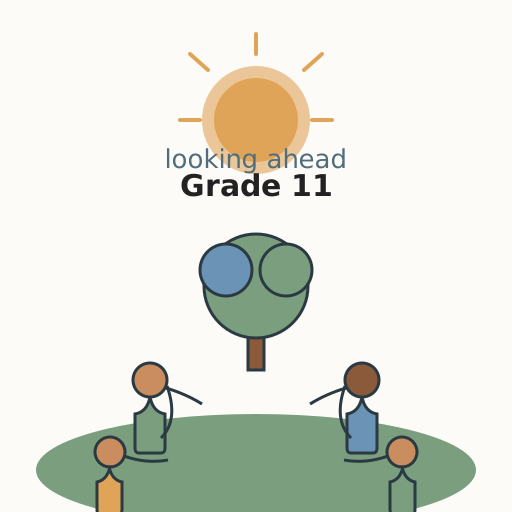
- Celebration graphic (SVG) · 1 per learner or projected A diverse circle of people around a living tree, with a rising sun and 'Grade 11' ahead
- The closing portfolio (all unit artifacts) · 1 per learner Whole-person map, story, learning plan, community chain, cooperative and mutual-aid pages
Low-tech / no-cost
- The assembled portfolio papers Lay all five artifacts out in a circle, walk it, and speak one line about each
- Voice and a circle of people Celebrate aloud — each person shares one artifact and one thing they are grateful for
Enriched / lab & device
- A short presentation, reading, or recording · 1 per learner Share one artifact with the group or record a closing message for the digital portfolio
Works in different contexts
- large-group Hold a gallery — learners set out their artifacts, walk the room, and leave one appreciative note on at least two others' work
- multi-age Younger learners share one artifact; older learners also name one commitment they will carry into Grade 11
- self-directed A learner arranges their portfolio, writes a closing letter to their future self, and reads it aloud once
- level-grouped A ready group adds a "one thing I will act on this summer" pledge, with a first small step
- outdoor-only Gather around a real tree or growing thing, place one stone or leaf for each thing you are grateful for, and share one line into the circle
Lesson 7 — All of Us: Celebration, Community, and the Living Earth
Summary
The capstone closes by gathering every artifact of the week — the whole-person map, the carried-forward story, the Grade-11 learning plan, the local-to-global chain, and the cooperative-and-mutual-aid pages — into one portfolio and one celebration. Learners share, appreciate one another, and name a commitment they will carry into Grade 11, celebrating the whole person, the caring community they have built, and the living Earth. This is the unit’s summative moment — warm, agentic, and hopeful, never a test.
Objectives
- Gather and celebrate my considered position, my self-directed learning plan, my place in nested communities, and my commitment to cooperation and mutual aid as a co-author of my education, looking ahead to Grade 11. (D01.S2.10.02, D01.S3.10.01, D02.S3.10.02, D02.S4.10.02)
Connection
A year is not a score; it is a story you have been writing, a web you have been woven into, and a set of hands you have reached toward. When people finish a harvest, a build, or a long journey, they do not just stop — they gather, name what was made, thank the hands that helped, and look toward the next field. That is what this lesson is: a gathering at the end of a year, to see the whole cloth you have made and to step, together, toward the next one.
Materials
- Celebration graphic (SVG)
- The closing portfolio (all unit artifacts)
Preparation
- Gather each learner’s five artifacts from Lessons 1–6. Arrange a circle for sharing.
- Retrieval/spacing: this lesson is a spaced retrieval pass across the whole unit (and the year) — recalling the artifacts now, once more, strengthens them for the future (Dunlosky et al., S-039).
Facilitator note
This lesson is written to the learner (“you”). The idea to land: the year’s work gathers into one whole — a person, a plan, a place in the web, and a commitment to care — and that whole is worth celebrating. This is the summative close, but the tone is celebration, not grading. Assessment here is a portfolio and a shared performance, in the spirit of the philosophy (assessment serves the learner; success is collective — philosophy §§8–9).
Hold the four lenses visibly. Ethics: naming a commitment — a promise to act with care — is an ethical act, and it is kept small and doable. Egalitarianism: the celebration honors every learner’s artifact as equally worthy; no one’s story outranks another’s. Global/anthropological: gathering at a year’s end to thank and look ahead is a human pattern across cultures — let learners bring their own traditions of marking endings and beginnings. Technology/environment: the living Earth is in the circle itself — the tree, the growing thing, the weather that carried the year — and stewardship is one of the commitments learners may name. Distinguish evidence from values: “recalling and celebrating work strengthens memory and meaning” is descriptive (Dunlosky et al., S-039); “every person’s story is worth celebrating” is a value we hold.
Keep it spacious and warm. Let quiet learners share in writing or not at all; presence is enough.
Procedure
- Gather (8 min). Set your five artifacts out in a circle — whole-person map, carried-forward story, learning plan, community chain, and cooperative-and-mutual-aid pages. Walk the circle slowly and look at what you made this year.
- Recall and name (10 min). For each artifact, say one line to yourself: one thing it taught you about yourself, your learning, your community, or how people care for one another. This final recall is what fixes the year in memory.
- Appreciate one another (12 min). In a circle (or a gallery, or online), each person shares one artifact or one line — and leaves one true, specific appreciation for at least one other person’s work. Appreciation, not ranking.
- Name a commitment (12 min). Look at the celebration graphic: the circle around the living tree, the sun rising toward Grade 11. Write one small commitment you will carry into Grade 11 — to yourself, to a community, or to the Earth — and one first step. It can be tiny; a seed is enough.
- Celebrate and look ahead (8 min). Read your commitment once, quietly or aloud. Then, together or alone, mark the year’s end in a way that fits you — a shared meal, a song, a moment of quiet, a hand on a shoulder — and step toward Grade 11.
Differentiation
- Support: Provide a sentence starter for the commitment (“In Grade 11 I will…, and my first step is…”); accept a spoken, drawn, or shown commitment (an object or gesture may stand in for words).
- Access (blind / low vision): Describe the celebration graphic aloud — a diverse circle around a living tree, a rising sun reaching toward “Grade 11” — and invite the learner to place a stone or leaf for each thing they are grateful for, as in the outdoor variant.
- Extension: Write a short letter to your future self, sealed or saved, to open at the start of Grade 11.
Assessment
- Summative (portfolio + performance): The completed closing portfolio — five artifacts plus the commitment — shared and appreciated in the celebration circle.
- Self-assessment: A short reflection — “What I am proudest of this year, and what I will carry forward.” Mastery is individual; the celebration is collective.
Home connection
Bring your portfolio home and share it with your family or community in whatever way fits — a reading, a quiet look together, a meal. Let them add one appreciation, too.
Resources
- On spaced retrieval strengthening memory and meaning: Dunlosky et al. (2013), Psychological Science in the Public Interest 14(1) (S-039).
- On cooperative learning and collective success as a structure for the celebration: Slavin, Cooperative Learning (1995) (S-147); Johnson & Johnson, social interdependence theory (S-233).