Lesson 03 — Fear and Grief in Common
Learners distinguish two harder collective emotions — fear and grief — by how each moves through a group: fear can rush into rumor, panic, and scapegoating, while grief asks to be shared and witnessed through mourning and remembrance. They practice reading both with care and add a reflection to the portfolio.
Objectives
Objectives
- D01.S1.11.01 Articulate the emotional climate of a group or society and how collective emotions such as hope, fear, and grief arise.
Essential question
How do collective fear and collective grief arise, and how are they held?
Key vocabulary
Materials
Standard materials
- Journal · 1 per learner
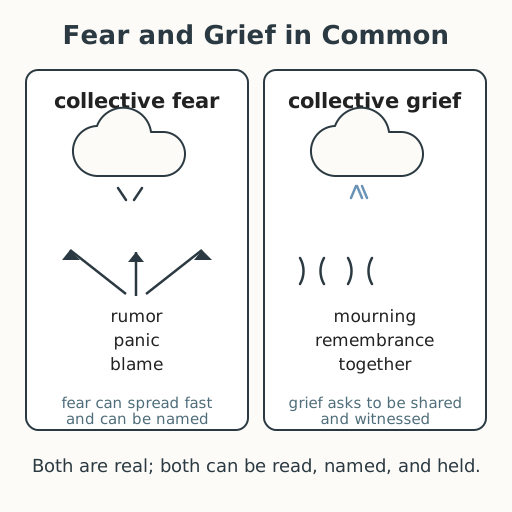
- Fear-and-grief chart (print or draw) · 1 per pair Two columns contrasting how fear and grief move through a group
Low-tech / no-cost
- Voice and a shared space Discuss the two columns aloud; no chart needed
- Two found objects One sharp (fear: rumor, blame), one soft (grief: mourning, remembrance)
Enriched / lab & device
- A documentary clip of a memorial or remembrance practice · 1 To observe how a community holds grief together; choose an age-appropriate excerpt
Works in different contexts
- large-group Fill the two columns as a whole class from many examples; keep the tone measured and caring
- multi-age Younger learners name what a family does to remember; older learners analyze the fear column (rumor, blame) with the in-group lens
- self-directed A learner writes two short reflections: one on how fear spread in a real event, one on how grief was held
- level-grouped A ready group debates: can fear be held as carefully as grief, and what does that require of leaders and groups?
- outdoor-only Visit or recall a place of remembrance (a grave, a memorial tree, a shrine) and discuss how a place holds a shared feeling
Lesson 3 — Fear and Grief in Common
Summary
Learners take apart two harder collective emotions. Collective fear can rush through a group as rumor, panic, and — at its worst — blame turned against an out-group. Collective grief moves differently: it asks to be shared and witnessed, through mourning and remembrance. Learners practice reading both with care and honesty, and they add a written reflection to the portfolio.
Objectives
- Articulate the emotional climate of a group or society and how collective emotions such as hope, fear, and grief arise. (D01.S1.11.01)
Connection
When a rumor spreads that there is not enough of something — fuel, water, medicine — a crowd can turn fearful in an hour, and that fear can find a target. When a community loses someone or something it loves, the feeling that follows is different: grief slows people down and gathers them together, around candles, songs, shared stories. Fear and grief are both common — held by many at once — but they move through a group in very different ways. Reading the difference matters, because each asks something different of us.
Materials
- Your journal
- A fear-and-grief chart (two columns)
Preparation
- Draw or print the two-column chart (see the asset).
- Retrieval (spaced): from Lessons 1–2, what is an emotional climate, and what four-part shape did we find behind collective hope? Today we add fear and grief.
Facilitator note
This lesson is written to the learner (“you”). The idea to land: collective fear and collective grief are both shared feelings, but they move differently — fear can accelerate into rumor, panic, and scapegoating; grief slows and gathers, asking to be witnessed. Reading the difference is a skill of care. Teach with a worked example (S-011), then let learners apply it — but keep the topic emotionally safe.
The social-emotional lens: both are emotions read in a group’s behavior (CASEL, S-001). The ethics lens: fear can become scapegoating — turning shared fear into blame against a group — and naming that is an ethical act; grief, held well, is an act of care. The egalitarian lens: research shows we naturally favor our own group and can blame an out-group even when the assignment is arbitrary (Tajfel’s minimal-group work, S-232) — which is exactly why a group in fear must be careful about where the blame points. Also, compassion tends to shrink as numbers grow: people feel far more for one named victim than for a statistic (the identifiable-victim effect and psychic numbing, Slovic, S-414) — a documented limit to hold in mind when we try to care about large, distant grief. The global lens: remembrance practices differ across cultures and faiths — vigils, altars, days of silence, spoken names — and none is above another; each is a way of holding grief in common. The technology & environment lens: fear and grief now travel on screens at speed and scale (a frightening rumor, a shared image of loss), and the living world carries its own griefs — a burned forest, a vanished species, a flooded home — that communities mourn together.
Emotional safety is non-negotiable here. Fear and grief are heavy. Keep examples general and avoid graphic detail; do not require anyone to share personal loss. Offer opt-outs and a moment of quiet. Always pair the heavy with the possible: reading a climate is a skill, and holding grief in common is something humans have always done — that is agency, not despair (development rubric, grades 9–12).
Procedure
- Recall (5 min). What shape did we find behind collective hope? (shared history → shared conditions → a real opening → shared hope.) Today: fear and grief.
- Meet the two (15 min). Worked example, side by side.
- Collective fear — a shortage is rumored. Shared history (a past scarcity) and shared conditions (a real shortage) meet uncertainty, and fear spreads fast: rumor, then panic, then blame — “who is taking what is ours?” The fear is real; the blame may be aimed at the wrong people.
- Collective grief — a community loses a place it loved. The feeling does not rush; it slows. People gather to mourn, to remember, to be together. Grief asks to be witnessed, not solved. Copy the two columns into your journal, in your own words.
- Read a real example (20 min). Choose one real example for each column — a time fear spread through a group, and a time grief was held in common (a vigil, a memorial, a shared song, a day of silence). For each, write: what did the group share? what did the feeling do — rush or gather? who was included, and who was blamed or left out? Then answer the care question: what would reading this climate honestly ask of a leader or a friend?
- Hold it together (10 min). With a partner or alone, write one sentence on the difference that matters: fear can blame; grief can gather. Which one asks for caution, and which one asks for company?
- Close (5 min). Add today’s two-column page to your portfolio. Take a slow breath. If this felt heavy, notice that and step outside or to water for a moment — reading heavy climates is real work, and so is resting after it.
Differentiation
- Mode (expression): Writing is one way, not the only way — respond by speaking, pointing to a word card, arranging found objects, drawing, or gesturing; a response that uses neither writing nor speaking is still a full response.
- Support: Provide the two worked examples as fill-in frames, and offer sentence starters for the care question.
- Extension: Research one real remembrance practice from another culture and write what it teaches about holding grief in common (verify details with community members).
Assessment
- Formative (observation): Can the learner contrast how fear and grief move through a group (rush/blame vs. gather/witness), without flattening either?
- Portfolio: The two-column reflection, gathered toward D01.S1.11.01.
Home connection
Ask a trusted adult how their family or community remembers — a ritual, a place, a story — and what that practice does for the people who share it.
Resources
- CASEL, Fundamentals of Social and Emotional Learning: https://casel.org/fundamentals-of-sel/ (S-001).
- Tajfel (1970/1971) — minimal-group experiments and in-group favoritism (S-232).
- Slovic (2007) — the identifiable-victim effect and psychic numbing (S-414).
- On worked examples and guided practice: Kirschner, Sweller & Clark (2006), https://doi.org/10.1207/s15326985ep4102_1 (S-011).