Lesson 04 — My Emotional Development: Then and Now
Learners turn inward to reflect on their own emotional development over time, naming specific areas of strength and areas of growth. They draw on emotional-literacy skills from earlier grades and write a then/now/next reflection for the portfolio.
Objectives
Objectives
- D01.S1.11.02 Reflect on their own emotional development over time and name areas of strength and growth.
Essential question
How has my emotional life grown over time, and where am I strong and still growing?
Key vocabulary
Materials
Standard materials
- Journal · 1 per learner
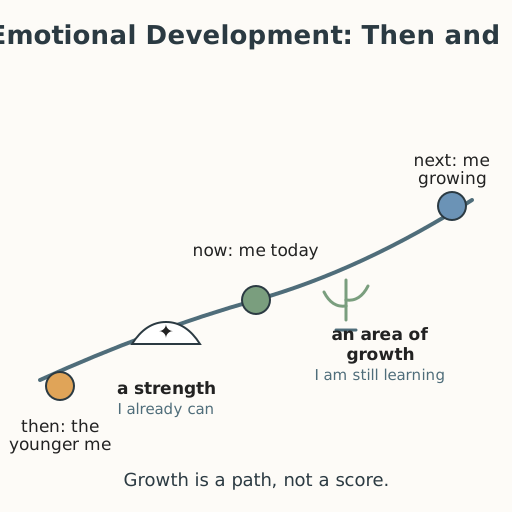
- Then/Now/Next map (print or draw) · 1 per learner A rising path with "then," "now," and "next," plus spots for one strength and one growth area
Low-tech / no-cost
- A line drawn in the ground Stand at "then," walk to "now," and look toward "next" as you name the change
- Voice Tell the story aloud to a partner instead of writing
Enriched / lab & device
- A private voice memo or notes app · 1 per learner To record the reflection aloud and replay it to hear one's own growth
Works in different contexts
- large-group Share in pairs, not to the whole room; then one volunteer shares a strength, and the group receives it without comparison
- multi-age Younger learners compare a feeling from last year to today; older learners write the full then/now/next reflection
- self-directed A learner writes the reflection privately, using the map as a guide, and self-checks for one strength and one growth area
- level-grouped Group by writing comfort; a ready group adds *evidence* — a remembered moment that shows each change
- outdoor-only Walk a real path to mark then, now, and next, naming the change at each step
Lesson 4 — My Emotional Development: Then and Now
Summary
Learners reflect on how their emotional life has grown over time — not to grade it, but to name it. They identify one real area of strength and one honest area of growth, and they write a then/now/next reflection that becomes a portfolio artifact. The lesson is a celebration of a self in the making, never a test.
Objectives
- Reflect on their own emotional development over time and name areas of strength and growth. (D01.S1.11.02)
Connection
Think of a time, years ago, when a big feeling swallowed you whole — and notice how you meet that same feeling today. Maybe you still feel it just as strongly, but now you can name it faster, breathe through it, or ask for help sooner. You have been growing as an emotional person this whole time, whether or not anyone measured it. Stopping to see that growth — and to see where you are still growing — is how you become the author of your own inner life.
Materials
- Your journal
- A then/now/next map (see the asset)
Preparation
- Print or draw the then/now/next map.
- Retrieval (spaced): from earlier grades, recall the skill of emotional granularity — having precise words for feelings — and the RULER practice of labeling emotions precisely (S-015). You will use that precision today on your own story.
Facilitator note
This lesson is written to the learner (“you”). The idea to land: emotional development is real, ongoing, and nameable — a learner can name a strength and a growth area without judgment, because “not yet” is information, never a verdict. Model the reflection with a worked example of your own (S-011), then release learners to write privately.
The social-emotional lens is the core: this is self-awareness applied over time (CASEL, S-001), using the precise-labeling skill from RULER (S-015) and the idea that a richer emotion vocabulary enables finer feeling and better regulation (Barrett’s “emotional granularity,” S-401 — offered as one well-supported account, not a creed). The ethics lens: naming our own growth honestly — strengths without arrogance, gaps without shame — is a discipline of truthfulness toward oneself. The egalitarian lens: growth looks different for everyone and depends on the support a person had; no one’s pace is a measure of their worth, and we never rank one learner’s story against another’s. The global lens: what counts as emotional maturity, and which feelings are shown or hidden, is shaped by culture — so honor your own context rather than measuring yourself against a single standard. The technology & environment lens: notice how screens and environments have shaped your emotional life (what a feed does to your mood, what a quiet place does to your body) — those are part of your story too.
Emotional safety is the whole point. This is private, vulnerable work. Never require sharing; “pass” is complete. Frame the reflection as celebration plus curiosity, never as a score. Remind learners that a growth area is not a defect — it is a direction.
Procedure
- Recall and anchor (5 min). In your journal, list three precise feeling words you know now that you might not have known as a young child (for example: grief, awe, resentment, relief). That word-list is itself evidence of growth.
- Meet the map (10 min). Look at the then/now/next map: a rising path with three points — then (the younger you), now (you today), and next (the you still growing). Worked example (your facilitator’s, or this one): Then I felt anger as one big blur; now I can often feel it coming and name what it is about; next I want to pause one second longer before I speak.
- Find a strength (15 min). Think of a moment, recent or far back, that shows an emotional strength you now have — staying calm when it mattered, noticing someone else’s feeling, asking for help, bouncing back. Write it as a sentence that names the strength and the evidence: “I can ___; I know because ___.”
- Find a growth area (15 min). Now, with the same kindness, name one place you are still growing — a feeling that still floods you, a habit you want to shift. Write it the same way, without blame: “I am still learning to ___; I notice ___.”
- Close (5 min). Add the map and the two sentences to your portfolio. Read them once more and notice: strengths and growth areas are two sides of the same honest look at yourself. Neither is a verdict.
Differentiation
- Mode (expression): Writing is one way, not the only way — respond by speaking, pointing to a word card, arranging found objects, drawing, or gesturing; a response that uses neither writing nor speaking is still a full response.
- Support: Offer sentence frames (“I used to ___, but now I ___”; “I am still learning to ___”) and one filled example to copy.
- Extension: Write the “next” step as a small, specific intention — one thing to practice this week — and date it.
Assessment
- Formative (self): Does the reflection name at least one strength and one growth area, each with a scrap of evidence, in a kind (non-blaming) voice?
- Portfolio: The then/now/next map, gathered toward D01.S1.11.02.
Home connection
Ask a trusted adult or older sibling what they have noticed change in you over the years — a way you handle things now that you didn’t before. Receive it as information, not a score.
Resources
- CASEL, Fundamentals of Social and Emotional Learning (self-awareness): https://casel.org/fundamentals-of-sel/ (S-001).
- Yale Center for Emotional Intelligence, RULER Approach: https://www.rulerapproach.org/ (S-015).
- Barrett (2017), How Emotions Are Made (emotional granularity — one account among several, held as a tool, not a creed) (S-401).
- On worked examples and guided practice: Kirschner, Sweller & Clark (2006), https://doi.org/10.1207/s15326985ep4102_1 (S-011).