Lesson 05 — Naming My Values
Learners name the values they actually hold — not the ones they are told to hold — and learn the crucial distinction between a value (what matters, what we ought to do) and a fact (how things are). They begin a values-and-purpose statement for the portfolio.
Objectives
Objectives
- D01.S2.11.01 Articulate their developing values, purpose, and sense of what a meaningful life looks like for them.
Essential question
What do I actually value, and how do I know — and how is a value different from a fact?
Key vocabulary
Materials
Standard materials
- Journal · 1 per learner
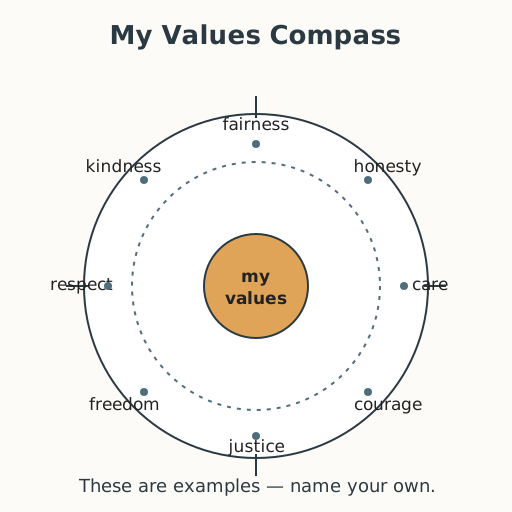
- Values compass (print or draw) · 1 per learner A compass with example values; blank points for the learner's own
Low-tech / no-cost
- Voice and memory Recall a moment you chose something costly because it mattered; name the value inside it
- Stones or leaves to stand for values Lay them out and pick the few you would carry furthest
Enriched / lab & device
- A values-sorting card app or shared board · 1 per learner To rank and re-rank candidate values and see the trade-offs visually
Works in different contexts
- large-group Do a whole-class "stand if this matters to you" sort, then let each learner write their own short list privately
- multi-age Younger learners name one value from a story; older learners write a full value statement with a lived example
- self-directed A learner works the compass alone, writes three values with evidence, and self-checks the fact/value distinction
- level-grouped Group by comfort with abstraction; a ready group tests whether a stated value survives a hard counter-example
- outdoor-only Collect small objects to stand for values; arranging them in order is the sort
Lesson 5 — Naming My Values
Summary
Learners name the values they actually hold, using their own lived choices as evidence rather than adopting a ready-made list. They learn the difference between a value (what matters; what we ought to do) and a fact (how things are), and they draft the first part of a values-and-purpose statement.
Objectives
- Articulate their developing values, purpose, and sense of what a meaningful life looks like for them. (D01.S2.11.01)
Connection
You can tell what a person values not by what they say they care about, but by what they spend — their time, their money, their attention, their courage. The friend who stays up to help someone is spending sleep on care; the neighbor who fixes the shared well is spending labor on fairness. Values are the things you are willing to pay for with your life, in small and large coins. Naming them — your own, not borrowed — is where a meaningful life begins to take shape.
Materials
- Your journal
- A values compass (see the asset)
Preparation
- Print or draw the values compass; leave its points blank or partially blank.
- Retrieval (spaced): from Lesson 4, you named a strength and a growth area with evidence. Today you use the same evidence-habit on your values.
Facilitator note
This lesson is written to the learner (“you”). The idea to land: a value is a commitment about what matters and what we ought to do, discovered from what a person actually spends — and it is categorically different from a fact, which is how things are. Teach the fact/value distinction explicitly with a worked example (S-011), then let learners name their own values.
The ethics lens is the center: values are the stuff of ethics, and the lesson’s key move is philosophical — distinguishing “is” from “ought” (the fact/value distinction), a distinction learners will need all year and beyond. The egalitarian lens: every learner’s values are honored; no value here is ranked above another, and no learner is told what to value — the curriculum teaches how to think about values, never what to value (philosophy §11). The global lens: different cultures and traditions name and weigh values differently — honor, filial duty, freedom, care, hospitality — and none is a single correct list; the compass examples are only examples. The technology & environment lens: what we actually spend our attention and money on is now shaped by technology (feeds, ads, convenience) and by our relationship to the living world (what we consume, what we protect) — those spending patterns are honest evidence of our values, worth reading with clear eyes.
Emotional safety. Values are personal but not as tender as identity; still, never require a learner to defend a value against a hostile peer. The task is to name and understand, not to debate or rank each other’s values. “Pass” and “I’m still figuring this out” are complete answers.
Procedure
- Recall (5 min). What did you learn yesterday about naming your growth with evidence? Today you turn evidence toward a new question: what do I value?
- Split the world in two (15 min). A fact is a claim about how things are: “the reservoir is low.” A value is a claim about what matters or what we ought to do: “we should share the water fairly.” Facts can be checked with evidence; values are chosen, defended, and lived. Worked example: sort these five — the river is polluted; polluters should clean it up; many people lack clean water; everyone deserves clean water; the well is empty in summer. Which are facts, which are values, and how can you tell? Write the two piles in your journal.
- Find your values from your life (20 min). Do not start from a list. Start from your spending. Recall three moments when you paid for something with your time, attention, comfort, or courage: a time you helped, stood up, waited, practiced, protected, or refused. For each, ask: what mattered enough to pay that price? Name the value inside each moment (care, fairness, truth, courage, loyalty, freedom…). Write the value and the moment that shows it.
- Draft the compass (10 min). On your values compass, write your two or three strongest values at the points. Then, under each, one short line: what living by it looks like for you.
- Close (5 min). Read your compass once more. This is the first page of your values-and-purpose statement — not finished, just begun. Put it in your portfolio.
Differentiation
- Mode (expression): Writing is one way, not the only way — respond by speaking, pointing to a word card, arranging found objects, drawing, or gesturing; a response that uses neither writing nor speaking is still a full response.
- Support: Offer the three “spending” prompts as sentence starters and a short bank of value words to choose from after naming a moment.
- Extension: Test one value against a hard case — a situation where it conflicts with another value you hold — and write one sentence about how you would weigh them.
Assessment
- Formative (self): Can the learner name at least two values, each grounded in a lived moment, and separate a fact from a value in the sort?
- Portfolio: The values compass, gathered toward D01.S2.11.01.
Home connection
Watch for one small thing a person at home spends today — time, effort, attention — and ask yourself (or them) what value it shows. Share your compass if you wish.
Resources
- CASEL, Fundamentals of Social and Emotional Learning (responsible decision-making): https://casel.org/fundamentals-of-sel/ (S-001).
- On worked examples and guided practice: Kirschner, Sweller & Clark (2006), https://doi.org/10.1207/s15326985ep4102_1 (S-011).