Lesson 08 — What I Owe to People Unlike Me
Learners face the question of what they owe to people unlike themselves. They learn that empathy is real but partial — it runs strongest toward the near and familiar — and that reasoned compassion, solidarity, and mutual aid can carry care further. They write a statement of where their care goes and why.
Objectives
Objectives
- D01.S2.11.02 Reflect on their place in a global, interconnected world and what they owe to people unlike themselves.
Essential question
What do I owe to people unlike myself — and how do I choose where my care goes?
Key vocabulary
Materials
Standard materials
- Journal · 1 per learner
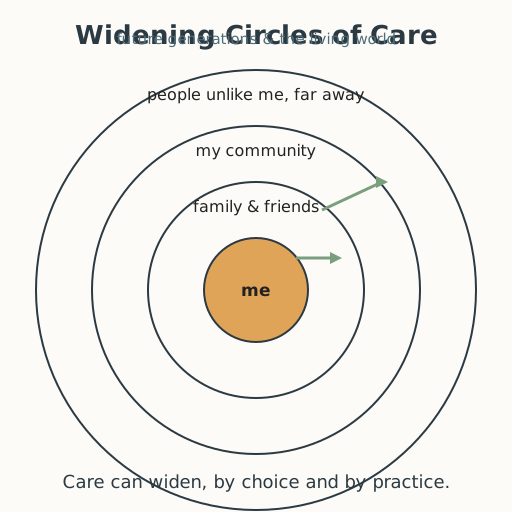
- Widening-circles diagram (print or draw) · 1 per learner Concentric circles from "me" to "future generations and the living world"
Low-tech / no-cost
- A pebble dropped in water Watch the rings widen; each ring is a wider circle of care
- Voice Discuss the circles aloud; no chart needed
Enriched / lab & device
- A short profile of a mutual-aid or solidarity effort across a distance · 1 A real example of people helping people unlike themselves, chosen with care
Works in different contexts
- large-group Discuss the circles whole-class, then each learner writes their own "where my care goes" statement privately
- multi-age Younger learners name who they already care for; older learners weigh empathy's limits against reasoned compassion
- self-directed A learner works the circles alone and writes a one-page statement on what they owe distant others
- level-grouped A ready group debates: is feeling for someone necessary to help them, or is a reasoned commitment enough?
- outdoor-only Drop a pebble in water and watch the rings, then map your own widening circles in the ground
Lesson 8 — What I Owe to People Unlike Me
Summary
Learners widen their circle of care. They learn an honest truth — empathy is real but partial: it runs strongest toward the near, the familiar, and the single named face — and that reasoned compassion, solidarity, and mutual aid can carry care farther than feeling alone can. They write a statement of what they owe to people unlike themselves, and why.
Objectives
- Reflect on their place in a global, interconnected world and what they owe to people unlike themselves. (D01.S2.11.02)
Connection
It is easy to care about your own family — their faces are in front of you. It is harder to care about someone you will never meet, in a place you will never see, whose life is nothing like yours. Yet your food, your climate, and your future are tied to exactly those people. The question this lesson asks is one of the oldest and hardest questions humans have: how wide is my care, and can I choose to widen it? Feeling is one way to care — but it is not the only way, and it is not always the widest.
Materials
- Your journal
- A widening-circles diagram (see the asset)
Preparation
- Print or draw the widening-circles diagram.
- Retrieval (spaced): from Lesson 7, recall one thread that ties you to distant others. Today we ask what that thread owes.
Facilitator note
This lesson is written to the learner (“you”). The idea to land: empathy is real but partial — strongest toward the near and the named — so widening care toward distant, unlike others requires reasoned compassion and solidarity, not only feeling. Teach the empathy/compassion distinction with a worked example (S-011); hold the value question open, never as a single right answer.
The ethics lens: “what do I owe distant others?” is a core question of ethics, and the lesson invites learners to reason about it rather than be told the answer. The egalitarian lens: empathy’s documented limits are themselves a form of inequality — feeling is not distributed fairly, so relying on feeling alone would leave distant others uncared-for; reasoned commitment is a more reliable equalizer. The global lens: mutual aid and solidarity are practices found across cultures and times (the harambee, gotong royong, minga, and barn-raising traditions documented in earlier units), and they show that care can be structured and chosen, not only felt. The technology lens: screens both help and hinder — they can bring a distant face close enough to feel for, and they can flood us until we numb (the psychic-numbing research, Slovic, S-414). The environment lens: the circle can widen past humans — to future generations and the living world — a widening many traditions already treat as owed, not optional.
Emotional safety. “What do I owe?” can feel like a demand for guilt or sacrifice. Frame it as agency and choice: the question is how wide a learner chooses to care, and there is no correct size of circle to report. No forced disclosure of personal beliefs; “I am still working this out” is a complete answer.
Procedure
- Recall (5 min). What thread ties you to people far away? Hold it in mind.
- Meet the circle (10 min). A moral circle is the set of beings whose needs count in your choices. Everyone’s circle has a near center — family, friends — and a far edge — strangers, distant others, future generations, other species. The question is where, and how far, you choose to draw it.
- Feel, then reason (15 min). Two truths, side by side.
- Empathy — feeling with another — is real but partial. Research shows it runs strongest toward those who look like us and toward one named face, and it weakens as numbers grow (Bloom, S-413; Slovic’s identifiable-victim effect and psychic numbing, S-414). Feeling alone will not carry care to millions.
- Compassion — the reasoned wish to reduce suffering — and solidarity — acting with others across distance — do not depend on feeling in the same way. You can commit to fair treatment of a person you will never meet. Worked example: a campaign that keeps a fair wage in a supply chain cares about people no one will ever see; it runs on commitment and structure, not on tears. Write the distinction in your own words.
- Choose your care (20 min). On the widening-circles diagram, mark where your care already reaches, and where you want it to reach next. Then write a short statement: Here is what I think I owe to people unlike myself, here is why, and here is one concrete thing I could do. It may be small — that is fine; small, chosen, sustained care outruns large, fleeting feeling.
- Close (5 min). Put the circles and the statement in your portfolio. Remember: the circle widens by choice and practice, not by guilt.
Differentiation
- Mode (expression): Writing is one way, not the only way — respond by speaking, pointing to a word card, arranging found objects, drawing, or gesturing; a response that uses neither writing nor speaking is still a full response.
- Support: Offer a starter set of “one concrete thing” examples (fair-trade choice, listening, sharing a skill, speaking up) and sentence frames.
- Extension: Analyze a real solidarity or mutual-aid effort and name where it runs on feeling and where on structure.
Assessment
- Formative (self): Does the statement name what the learner owes distant others, give a reason, and include one concrete, chosen action?
- Portfolio: The widening-circles statement, gathered toward D01.S2.11.02.
Home connection
Ask someone at home: “Is there a person or place you help even though you’ll never meet them?” Listen for whether their care runs on feeling or on commitment.
Resources
- Bloom (2016), Against Empathy (empathy is narrow and biased; reasoned compassion is a more reliable guide) (S-413).
- Slovic (2007), the identifiable-victim effect and psychic numbing (S-414).
- Batson (1987), empathic concern vs. personal distress (S-230).
- On worked examples and guided practice: Kirschner, Sweller & Clark (2006), https://doi.org/10.1207/s15326985ep4102_1 (S-011).