Lesson 03 — Compound Interest and Debt: Series in Finance
Learners read compound interest as a geometric sequence, compute the future value of a saving with A = P(1 + r)^t, and read the true cost of a loan — whose repayments form a series — so that interest is understood as a force that helps savers and can burden borrowers. They practice fair-shares financial literacy, not shame or ranking.
Objectives
Objectives
- D05.S1.11.01 Model and solve real problems with sequences and series, and interpret their meaning in financial or environmental contexts.
Essential question
How does compound interest grow a saving or a debt, and how do I read the true cost of a loan as a geometric series?
Key vocabulary
Materials
Standard materials
- Finance problem sheet · 1 per learner Worked and practice problems for compound interest, loan totals, and reading real offers
- Math journal · 1 per learner
Low-tech / no-cost
- Paper and counters Model a 10% interest year by hand on a pile of counters to feel compounding
- A real or pictured loan/savings notice Any household notice, ad, or community-credit sheet to read the rate and total
Enriched / lab & device
- Calculator or spreadsheet · 1 per learner or pair To compare compounding schedules and compute a loan's total repayment
Works in different contexts
- large-group Compute one savings and one loan example whole-class, then learners compare two offers in pairs
- multi-age Younger learners grow a saving by repeated multiplication; older learners derive the future-value formula and compute loan totals
- self-directed A learner follows the worked examples, then solves the practice set and checks each future value by substitution
- level-grouped Group by comfort with exponents; a ready group compares monthly vs annual compounding over 10 years
- outdoor-only Use market examples — a trader's loan, a shared harvest sold now vs saved — and compute the interest by hand
Lesson 3 — Compound Interest and Debt: Series in Finance
Summary
Learners connect Lesson 1’s geometric sequences to money: compound interest grows a saving by a fixed factor each period, so the balance follows A = P(1 + r)^t; a loan’s repayments form a series whose total can far exceed the amount borrowed. They compute future values and loan totals, and practice reading real offers — financial literacy framed as a fair-shares skill for everyone, never a ranking.
Objectives
- Model savings and debt with sequences and series, compute compound future value and total loan repayment, and interpret what the rate and time mean in financial contexts. (D05.S1.11.01)
Connection
The same rule that makes a small saving grow — multiplying by 1 + r again and again — is the rule that makes a debt grow when you do not pay it down. Interest is a tool with two faces: it can build a saver’s future or tighten a borrower’s present. Money has taken many forms across history (S-028); interest and credit are old human inventions, and reading them clearly is a modern survival skill — not a test of who is “good with numbers.”
Materials
- Finance problem sheet
- Math journal
Preparation
- Copy or draw the problem sheet.
- Retrieval: from Lessons 1–2, the geometric sequence aₙ = a₁·r^(n−1) and the geometric series sum.
- Prepare worked examples for compound interest and for a loan’s total repayment.
Facilitator note
This lesson is written to the learner (“you”). The ideas to land: compound interest is a geometric sequence with factor (1 + r), so A = P(1 + r)^t; a loan is the same factor working against a borrower, and the total repaid is a series, often much larger than the principal. Teach the two faces explicitly — saver (the factor builds) and borrower (the factor compounds against you) — with worked examples and guided practice (S-011).
The ethics lens: lenders set rates; borrowers should be able to see the true cost plainly — honesty in a loan offer is an ethical question, not just a math one. The egalitarianism lens: compound interest widens the gap between those who can save and those who must borrow; fair-shares financial literacy means everyone learns to read a rate, not only those who already have money. The intellectual lens: one formula (A = P(1 + r)^t) is read forward (saving) and backward (debt). The critical-thinking lens: learners compare two offers and ask “which total is smaller, and why?” — and check every answer by substitution. Distinguish evidence (the arithmetic) from values (that everyone deserves clear information about credit). Preview: Lesson 4 applies the same series to environmental accumulation.
Procedure
- Recall (5 min). From Lesson 1, what is the factor for 5% growth? For 5% decay? Today the growth is money.
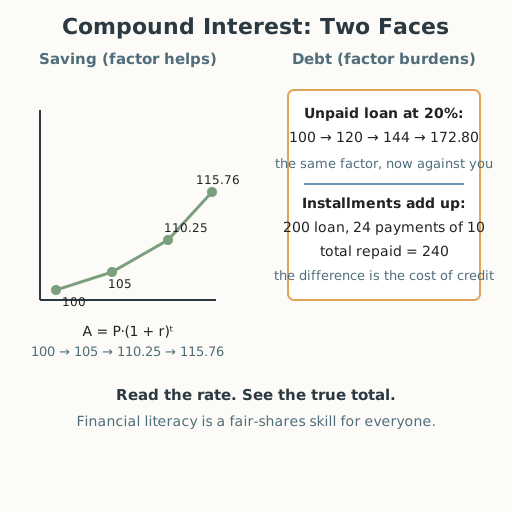
- Compound interest: the saver (15 min). A saving of P earns rate r each period, so each year the balance multiplies by (1 + r). Worked example: P = 100, r = 5% (0.05), t = 3 years → A = 100(1.05)³ = 100·1.157625 ≈ 115.76. It is the geometric sequence 100, 105, 110.25, 115.76…, so it is compounding — interest on interest.
- The true cost of debt: the borrower (15 min). A loan works the same factor against you. If a loan of 100 is not repaid, at 20% a year it becomes 100(1.20)³ ≈ 172.80 after three years. When a loan is repaid in installments, the repayments form a series — and the total repaid (installments summed) is often far larger than the amount borrowed. Worked example: 24 monthly payments of 10 for a 200 loan = 240 repaid — that difference is the cost of credit.
- Read a real offer (10 min). Look at a savings or loan notice. Find the rate, the time, and the total. Ask: what does this actually cost, or actually earn, in full? Compare two offers and name which is smaller and why.
- Guided practice (8 min). With a partner: (a) 200 saved at 4% for 5 years; (b) a 500 loan at 15% a year left unpaid for 2 years; (c) which of two offers — a small rate over many years or a larger rate over few — costs more in total? Check each by substitution.
- Close (2 min). Say in your own words why the same factor helps the saver and burdens the borrower.
Differentiation
- Support: Compute year-by-year balances first (100 → 105 → 110.25), then match to the formula.
- Extension: Compare monthly vs annual compounding (A = P(1 + r/12)^(12t)) and explain which grows faster and why.
Assessment
- Formative (peer + self): Can the learner compute a compound future value, read a loan’s total repayment as a series, and compare two offers, with a substitution check?
- Portfolio artifact (unit): The completed finance sheet with the offer comparison, added to the number toolkit.
Home connection
Find a real rate at home — a savings notice, a phone plan, a loan a family member mentions. Compute what it becomes in one year and in five, and write one sentence about whether the total surprises you.
Resources
- On worked examples and guided practice: Kirschner, Sweller & Clark (2006), https://doi.org/10.1207/s15326985ep4102_1 (S-011).
- On money’s many historical forms and the history of credit: Davies, A History of Money (S-028).