Lesson 04 — Environmental Accumulation: Series in the Living World
Learners model environmental buildup and cleanup with sequences and series: a doubling algae bloom or a growing emission total as a sum, and a halving pollutant as a decay series. They read cumulative totals — not just single-year numbers — and connect who emits to who is affected, as a question of environmental justice.
Objectives
Objectives
- D05.S1.11.01 Model and solve real problems with sequences and series, and interpret their meaning in financial or environmental contexts.
Essential question
How do sequences and series model the way pollution, populations, and resources accumulate or fade in the living world?
Key vocabulary
Materials
Standard materials
- Environment problem sheet · 1 per learner Worked and practice problems for cumulative emissions, population series, and decay
- Math journal · 1 per learner
Low-tech / no-cost
- Water, cups, and drops of ink or dye Dilute a drop half-and-half repeatedly to feel a halving decay series
- Counters or seeds Build a doubling algae bloom by hand and add the cumulative total
Enriched / lab & device
- Calculator or spreadsheet · 1 per learner or pair To sum a long series and graph accumulation over time
Works in different contexts
- large-group Solve one accumulation example whole-class, then learners work in pairs on a mixed set (growth vs decay, sum vs term)
- multi-age Younger learners compute a few terms of a bloom by hand; older learners sum the series and interpret the total in context
- self-directed A learner follows the worked examples, then solves the practice set and checks totals by direct addition
- level-grouped Group by comfort with sigma notation; a ready group models a pollutant that grows, then decays, as two series in sequence
- outdoor-only Use real local quantities — rainfall over a season, a pond's algae, a firewood pile being halved — and record the series
Lesson 4 — Environmental Accumulation: Series in the Living World
Summary
Learners put Lessons 1–2’s series to work in the living world: a doubling algae bloom or a growing emission total is a sum, and a halving pollutant is a decay series. They compute cumulative totals — not just single-year numbers — and ask who emits and who is affected, reading environmental data as a question of justice.
Objectives
- Model environmental accumulation and decay with sequences and series, interpret cumulative totals in context, and connect the mathematics to who bears environmental burdens. (D05.S1.11.01)
Connection
A single year’s emission, a single week’s algae, a single dose of pollution are small. The trouble is that they do not vanish — they accumulate, one term added to the next, the way a debt or a saving accumulates. To see the real picture you add the series, not just read the latest term: the total carbon in the air, the total algae in the lake, the total waste in the river. And who added it is often not the same as who breathes it.
Materials
- Environment problem sheet
- Math journal
Preparation
- Copy or draw the problem sheet.
- Retrieval: from Lesson 2, the geometric series sum; from Grade 10, half-life and doubling (D05.S1.10.01).
- Prepare worked examples for accumulation (sum) and decay (halving series).
Facilitator note
This lesson is written to the learner (“you”). The idea to land: environmental change is often a series, not a single number — a bloom or an emission total is a sum, and a pollutant that halves each period is a decay series. Teach the two directions explicitly — accumulate (sum the terms) and decay (each term halves) — with worked examples and guided practice (S-011).
The environment lens: half-life and doubling are the real language of pollution, blooms, and cleanup. The egalitarianism lens: the places that emitted the most greenhouse gases over two centuries are often not the places that feel the worst impacts (S-006, S-005) — environmental justice is a data question, and learners are entitled to read it. The intellectual lens: the same series formula that counts wealth counts carbon. The critical-thinking lens: learners check totals by addition and ask “cumulative or annual?” before trusting a claim. Distinguish the arithmetic (the totals) from the values (that the burdens ought to be shared fairly). Preview: this closes the S1 sequence/series thread; Lesson 5 turns to vectors.
Procedure
- Recall (5 min). From Lesson 2, how do I sum a geometric series? From Grade 10, what is a half-life?
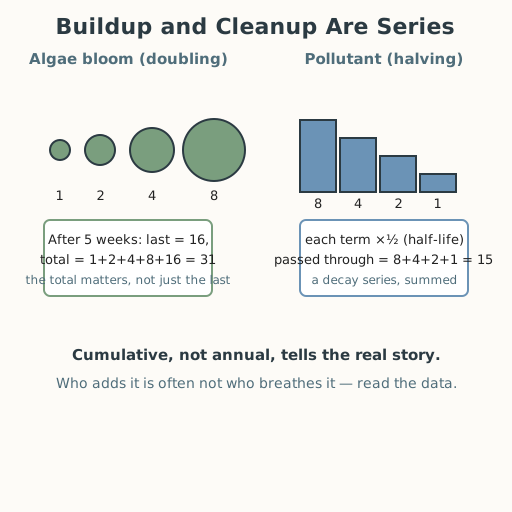
- Accumulation: the bloom (15 min). A lake’s algae doubles each week, starting at 1 patch: 1, 2, 4, 8, … After 5 weeks the latest patch is 16, but the cumulative total is 1 + 2 + 4 + 8 + 16 = 31 patches. Worked example: sum the series with Sₙ = a₁(1 − rⁿ)/(1 − r) = 1(1 − 32)/(1 − 2) = 31. The total, not the last term, is what matters for a lake’s health.
- Accumulation: emissions (10 min). If a region emits 10, 12, 14.4, … growing 20% a year, the total over 4 years is 10 + 12 + 14.4 + 17.28 = 53.68. The cumulative total drives warming, not any single year (S-005). Write it in sigma notation.
- Decay: the halving pollutant (12 min). A pollutant halves each period: 8, 4, 2, 1, ½, …. Each term is the last times ½. The total still present falls, but the total that passed through a place is the sum. Worked example: total through four periods = 8 + 4 + 2 + 1 = 15.
- Guided practice (8 min). With a partner: (a) a bloom triples weekly from 2 — find the total after 4 weeks; (b) a pollutant halves from 64 — find the amount after 6 periods and the total that passed through; (c) state whether a headline number is annual or cumulative, and why that changes the story.
- Close (5 min). Say why “add the series” matters for the planet, and name one question about who emits vs who is affected.
Differentiation
- Support: Compute a few terms by hand first, then add them; use whole-number ratios.
- Extension: Model a quantity that grows for a while, then decays — two series in sequence — and sum both.
Assessment
- Formative (peer + self): Can the learner model an environmental process as a series, compute a cumulative total, and distinguish annual from cumulative in a claim?
- Portfolio artifact (unit): The environment sheet with the cumulative-vs-annual judgment, added to the number toolkit.
Home connection
Find one thing that accumulates near home — leaves in a gutter, water in a barrel, rubbish in a bin over a week. Estimate whether it grows by a fixed amount or a fixed factor, and total it over a few steps.
Resources
- On worked examples and guided practice: Kirschner, Sweller & Clark (2006), https://doi.org/10.1207/s15326985ep4102_1 (S-011).
- On who emits vs who is affected and cumulative emissions: Our World in Data (S-006); IPCC (S-005).