Lesson 05 — Vectors: Size and Direction
Learners represent quantities with both size and direction as vectors, resolve them into components, find magnitude with the Pythagorean theorem, and add them tip-to- tail to solve navigation and force problems. They meet wayfinding as an ancient, living anticipation of vector reasoning.
Objectives
Objectives
- D05.S1.11.02 Use vectors and matrices to represent and manipulate quantities with both size and direction or with several dimensions.
Essential question
How do I represent a quantity that has both size and direction, and add vectors to solve real navigation and force problems?
Key vocabulary
Materials
Standard materials
- Vector problem sheet · 1 per learner Worked and practice problems for components, magnitude, and adding vectors
- Math journal · 1 per learner
- Graph paper · 1 sheet per learner
Low-tech / no-cost
- Stick or ruler and a direction marker Draw arrows on the ground or paper to add displacements tip-to-tail by hand
- A simple compass or the Sun's position To attach a real direction to a walk or a wind
Enriched / lab & device
- Calculator · 1 per learner or pair To compute components and magnitudes with sine and cosine
- Navigation or map app (optional) · 1 per group To read a real displacement as a vector (bearing + distance)
Works in different contexts
- large-group Draw one boat-and-current addition whole-class on the board, then learners solve a second in pairs
- multi-age Younger learners add arrows tip-to-tail on graph paper; older learners compute components and magnitude with trigonometry
- self-directed A learner follows the worked examples, then solves the practice set and checks each resultant by redrawing
- level-grouped Group by comfort with right-triangle trigonometry from Grade 10; a ready group adds three vectors or resolves a force into components
- outdoor-only Walk two legs of a real journey (e.g., 10 paces east, 6 paces north), then measure the shortcut back to feel the resultant
Lesson 5 — Vectors: Size and Direction
Summary
Learners meet the vector: a quantity with both magnitude (size) and direction. They resolve vectors into components, find magnitude with the Pythagorean theorem, and add vectors tip-to-tail to find a resultant — solving real navigation and force problems. They meet Pacific wayfinding as a living anticipation of the same idea.
Objectives
- Represent quantities with size and direction as vectors, resolve and combine them, and interpret a resultant in navigation and force contexts. (D05.S1.11.02)
Connection
“How far?” is only half a question. “How far, and in which direction?” is the full one. A walk of 4 km east is not the same as 4 km north, and a boat’s engine pushing one way while the current pushes another lands somewhere in between. Anything with a size and a direction — a journey, a wind, a push — is a vector, and the arrow is the honest picture of it.
Materials
- Vector problem sheet
- Graph paper
- Math journal
Preparation
- Copy or draw the problem sheet.
- Retrieval: from Grade 10, the Pythagorean theorem and right-triangle trigonometry (D05.S3.10.01).
- Prepare worked examples for components, magnitude, and tip-to-tail addition.
Facilitator note
This lesson is written to the learner (“you”). The ideas to land: a vector has magnitude and direction; its components are its east/north (or x/y) parts; its magnitude is √(x² + y²); vectors add tip-to-tail to give a resultant. Teach the two moves explicitly — resolve (break into components) and combine (add tip-to- tail) — with worked examples and guided practice (S-011).
The intellectual lens: a vector keeps two facts together (size + direction) that a single number cannot. The global lens: Polynesian navigators have crossed the open Pacific for centuries by reading direction and magnitude in stars, swells, and currents — a real, living anticipation of vector reasoning (S-055). The critical-thinking lens: learners check a computed resultant by redrawing it to scale. The technology lens: every navigation device, weather model, and game engine represents motion as vectors — reading the arrow is reading the machine’s language. Preview: Lesson 6 generalizes to matrices, which hold many numbers at once.
Procedure
- Recall (5 min). From Grade 10, how do I find the length of the hypotenuse? Today the “hypotenuse” is a journey’s shortcut.
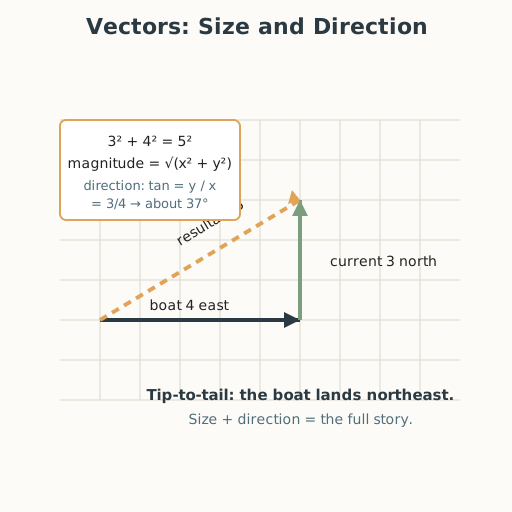
- Meet the vector (12 min). A vector has magnitude and direction, drawn as an arrow. Its components are its horizontal and vertical parts. Worked example: a walk of 4 km east and 3 km north has components (4, 3); its magnitude is √(4² + 3²) = 5 km, and its direction is the angle whose tangent is 3/4 (about 37° north of east).
- Adding vectors: tip-to-tail (12 min). To add two vectors, place the tail of the second at the tip of the first; the resultant runs from the first tail to the last tip. Worked example: a boat steams east at 4 m/s while a current pushes north at 3 m/s. The resultant is (4, 3), magnitude 5 m/s, direction 37° north of east — the boat actually travels northeast, faster than either part alone.
- Scalar multiples (8 min). Multiplying a vector by a scalar stretches it without changing direction: 2·(4, 3) = (8, 6). A negative scalar reverses it.
- Guided practice (12 min). With a partner: (a) resolve a 10-unit vector at 30° into components; (b) add a wind of 6 west to a plane’s 8 north and find the resultant’s magnitude and direction; (c) state why “5 km” alone is not enough to describe a journey. Check by redrawing.
- Close (6 min). Say why a vector needs both parts, and name one place you use direction + size in daily life.
Differentiation
- Support: Add arrows on graph paper first, counting squares, before computing components.
- Extension: Add three vectors, or resolve a force into components along a slope.
Assessment
- Formative (peer + self): Can the learner resolve a vector into components, find its magnitude and direction, and add two vectors tip-to-tail, verified by a redraw?
- Portfolio artifact (unit): The vector sheet with the boat-and-current solution, added to the number toolkit.
Home connection
Walk a real two-leg journey near home (e.g., 10 paces east, 6 north) and find the straight shortcut back. Measure it and compare to √(10² + 6²).
Resources
- On worked examples and guided practice: Kirschner, Sweller & Clark (2006), https://doi.org/10.1207/s15326985ep4102_1 (S-011).
- On Polynesian wayfinding as direction-and-magnitude navigation: Polynesian Voyaging Society (S-055).