Lesson 06 — Matrices: Many Dimensions at Once
Learners meet the matrix as a table that holds many numbers at once, name its rows, columns, and dimensions, and add, scale, and multiply matrices — reading real tables (rosters, timetables, price lists) as matrices and combining several dimensions of information in one step. They meet the Lo Shu square as an early array-like object.
Objectives
Objectives
- D05.S1.11.02 Use vectors and matrices to represent and manipulate quantities with both size and direction or with several dimensions.
Essential question
How does a matrix hold many numbers at once, and how do I add and multiply matrices to combine several dimensions of information?
Key vocabulary
Materials
Standard materials
- Matrix problem sheet · 1 per learner Worked and practice problems for adding, scaling, and multiplying matrices
- Math journal · 1 per learner
Low-tech / no-cost
- Grid paper and counters Lay counters in a grid to see rows and columns, and slide two grids together for addition
- A real table (timetable, price list, roster) Any table is a matrix waiting to be named by its rows and columns
Enriched / lab & device
- Spreadsheet · 1 per learner or pair A spreadsheet is a living matrix; practice naming cells and summing rows/columns
- Calculator · 1 per learner
Works in different contexts
- large-group Build one matrix addition and one multiplication whole-class, then learners work in pairs on a mixed set
- multi-age Younger learners add and scale matrices by counting; older learners multiply and interpret the result in context
- self-directed A learner follows the worked examples, then solves the practice set and checks dimensions before each multiplication
- level-grouped Group by comfort with dot products; a ready group composes two transformations (e.g., rotate then scale) as matrix multiplication
- outdoor-only Use a real roster or a field layout drawn in chalk as a matrix, and add two layouts cell by cell
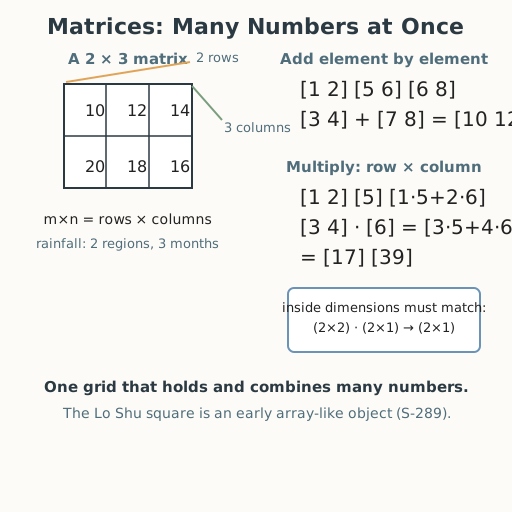
Lesson 6 — Matrices: Many Dimensions at Once
Summary
Learners meet the matrix — a rectangular table of numbers that holds many quantities at once. They name its rows, columns, and dimensions, then add, scale, and multiply matrices, reading real tables (rosters, timetables, price lists) as matrices. They meet the Lo Shu square as an early array-like object from China, part of a shared global history.
Objectives
- Represent multi-dimensional quantities as matrices, perform matrix addition, scalar multiplication, and multiplication, and interpret the results in real contexts. (D05.S1.11.02)
Connection
A single number says “how much”; a table says “how much, of what, for whom, and when” — all at once. A bus timetable, a price list, a class roster, a spreadsheet of rainfall by month and region: each is a matrix, a grid of numbers. When you combine two tables — prices with quantities, schedules with routes — you are multiplying matrices, the way a machine combines many pieces of information in one step.
Materials
- Matrix problem sheet
- Math journal
Preparation
- Copy or draw the problem sheet.
- Retrieval: from Lesson 5, vectors and components (a vector is a one-column matrix).
- Prepare worked examples for naming dimensions, addition, scaling, and multiplication.
Facilitator note
This lesson is written to the learner (“you”). The ideas to land: a matrix has rows × columns (an m×n matrix has m rows, n columns); addition and scalar multiplication work element by element; multiplication combines rows of the first with columns of the second, so the inside dimensions must match. Teach the moves explicitly — name (dimensions), combine by element (add/scale), and row-times- column (multiply) — with worked examples and guided practice (S-011).
The intellectual lens: a matrix is a single object that holds many numbers; its power is doing many operations at once. The global lens: the Lo Shu square — a 3×3 arrangement whose rows, columns, and diagonals all sum to 15 — is an ancient Chinese array-like object, one root of a global story (S-496, S-429). The technology lens: matrices are the working language of computer graphics, search, and machine learning — the grid that a screen or a model actually computes. The egalitarianism lens: a census table, a voting tally, a resource grid — matrices let everyone’s row be counted on the same footing; reading them is a shared-skill, not a ranking ritual. Preview: Lesson 7 turns to trigonometric functions.
Procedure
- Recall (5 min). From Lesson 5, a vector is a column of numbers. A matrix is a whole table of them.
- Meet the matrix (12 min). A matrix is a rectangular array; an m×n matrix has
m rows and n columns. Each number is an element. Worked example: a 2×3 matrix
of rainfall (two regions, three months):
Row 1 is region A; column 2 is the second month.[ 10 12 14 20 18 16 ] - Add and scale (10 min). Add matrices element by element (same dimensions); multiply every element by a scalar. Worked example: adding two 2×3 price grids doubles the table into one combined grid; scaling by 2 doubles every price.
- Multiply: row times column (15 min). Matrix multiplication combines the rows of
the first with the columns of the second; the inside dimensions must match
(an m×n times an n×p gives an m×p). Worked example:
Read it as two orders (1 of item X and 2 of item Y; 3 and 4) hit by prices (5 and 6): the totals are 17 and 39.[1 2] [5] [1·5 + 2·6] [17] [3 4] · [6] = [3·5 + 4·6] = [39] - Guided practice (10 min). With a partner: (a) name the dimensions of a 3×2 roster; (b) add two 2×2 grids; (c) multiply a 2×2 by a 2×1 and read the answer as totals. Check dimensions before each multiplication.
- Close (3 min). Say why a matrix beats many separate numbers, and name one real table in your life.
Differentiation
- Support: Add and scale matrices by counting counters in a grid before doing any multiplication.
- Extension: Compose two transformations (rotate a point, then scale it) as a matrix product and apply it to a vector.
Assessment
- Formative (peer + self): Can the learner name matrix dimensions, add and scale matrices, and multiply two matrices with a dimension check, reading the result in context?
- Portfolio artifact (unit): The matrix sheet with the order-and-price multiplication, added to the number toolkit.
Home connection
Find a real table at home — a timetable, a price list, a roster — and name its rows, columns, and dimensions. Add or scale it, and write one sentence about what the new numbers mean.
Resources
- On worked examples and guided practice: Kirschner, Sweller & Clark (2006), https://doi.org/10.1207/s15326985ep4102_1 (S-011).
- On the Lo Shu square and the shared history of arrays: Wikipedia — Luoshu (Lo Shu) Square (S-496); Boyer & Merzbach, A History of Mathematics (S-429).