Lesson 07 — Trigonometric Functions as Waves
Learners read sine and cosine as periodic functions and name the four features that shape a wave — amplitude, period/frequency, midline, and phase shift — from both an equation and a graph. They meet the Indian origin of the word "sine" as part of the shared, global history of trigonometry.
Objectives
Objectives
- D05.S2.11.01 Model periodic phenomena with trigonometric functions and interpret amplitude, frequency, and shift in context.
Essential question
How do sine and cosine become periodic functions, and what do amplitude, frequency, and shift mean in a real wave?
Key vocabulary
Materials
Standard materials
- Wave problem sheet · 1 per learner Worked and practice problems for reading amplitude, frequency, and shift from equations and graphs
- Math journal · 1 per learner
- Graph paper · 1 sheet per learner
Low-tech / no-cost
- A rope or string Wiggle one end to make a visible wave and point to its height (amplitude) and spacing (period)
- Body movement Swing an arm like a pendulum; the swing's height and speed are amplitude and frequency
Enriched / lab & device
- Graphing calculator or plotting software · 1 per learner or pair To change A, B, C, D and watch the wave change live
Works in different contexts
- large-group Sketch one wave whole-class and label its four features, then learners read a second wave in pairs
- multi-age Younger learners trace a wave and mark its height and repeat distance; older learners compute amplitude, period, and shift from the equation
- self-directed A learner follows the worked examples, then reads the practice set and checks each feature against the graph
- level-grouped Group by comfort with function transformations; a ready group writes an equation from a given wave
- outdoor-only Watch a real periodic motion — a swinging rope, a bobber on water, a pendulum — and name its amplitude and frequency
Lesson 7 — Trigonometric Functions as Waves
Summary
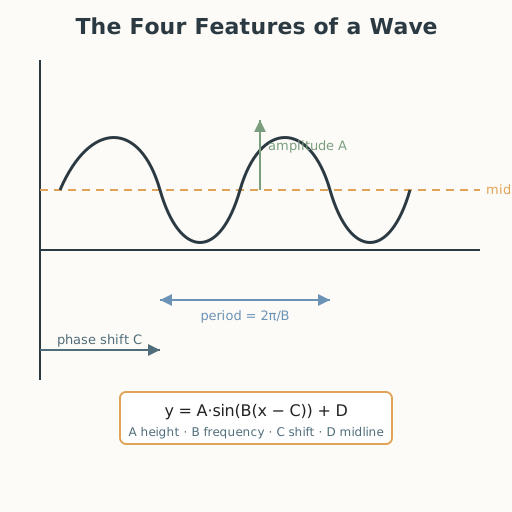
Learners meet sine and cosine as periodic functions — functions that repeat — and name the four features that shape a wave: amplitude, period/frequency, midline, and phase shift. They read each feature from both an equation (y = A·sin(B(x − C)) + D) and a graph, and meet the Indian origin of the word “sine.”
Objectives
- Model periodic phenomena with sine and cosine, and interpret amplitude, frequency (period), and shift in an equation and a graph. (D05.S2.11.01)
Connection
Many things in the world go around and come back: your heartbeat, the tides, the seasons, a swing, a sound’s vibration, the daylight over a year. All of them repeat — they are periodic. The sine and cosine functions are the language for that repetition: one shape that rises, falls, and returns, which you can stretch taller, squeeze faster, slide up, or shift along to match whatever is repeating in front of you.
Materials
- Wave problem sheet
- Graph paper
- Math journal
Preparation
- Copy or draw the problem sheet.
- Retrieval: from Grade 10, right-triangle sine and cosine as ratios (D05.S3.10.01). Today they become functions of an angle that keep on repeating.
- Prepare worked examples for reading amplitude, period, midline, and shift.
Facilitator note
This lesson is written to the learner (“you”). The ideas to land: in y = A·sin(B(x − C)) + D, A is amplitude (height from midline), the period is 2π/B (and frequency is its reciprocal), C is phase shift (left/right), and D is the midline (up/down). Teach the four features one at a time, each with a graph, then combine them (S-011).
The intellectual lens: four numbers (A, B, C, D) control a whole repeating shape — a small alphabet for a huge family of waves. The global lens: the word “sine” comes from a mistranslation of the Sanskrit jya (chord/half-chord) through Arabic jiba to Latin sinus — trigonometry grew in India and the Islamic world, not one place (S-240, S-429). The critical-thinking lens: learners check each feature by marking it on the graph. The environment lens: day length, tides, and seasonal temperature are real periodic signals — reading their amplitude and frequency is reading the planet’s rhythm. Preview: Lesson 8 fits these features to real data.
Procedure
- Recall (5 min). From Grade 10, what is sin θ in a right triangle? Today θ keeps growing, and the ratio becomes a repeating wave.
- Meet the wave (10 min). Plot y = sin x. It rises to 1, falls to −1, and repeats every 2π. That is a periodic function. The midline is the center line (here y = 0); amplitude is the height from midline to peak (here 1); the period is the length of one full cycle (here 2π); frequency is how many cycles fit in a unit of time (1/period).
- The four features (15 min). In y = A·sin(B(x − C)) + D:
- A (amplitude): y = 3·sin x is three times as tall (amplitude 3).
- B (period): y = sin(2x) finishes a cycle in π, not 2π — period 2π/2 = π, so it is twice as frequent.
- C (phase shift): y = sin(x − π/2) is shifted right by π/2.
- D (midline): y = sin x + 2 rides on the line y = 2. Worked example: y = 2·sin(3(x − π/4)) + 1 has amplitude 2, period 2π/3, phase shift π/4 right, midline y = 1.
- Guided practice (12 min). With a partner, read each feature from: (a) y = 4·sin(2x) − 1 (b) y = sin(x/2) + 3 (c) a drawn wave whose peaks are at 5 and −1 and which repeats every 4 units. Mark amplitude, midline, and period on each.
- Independent practice (5 min). In your journal, sketch one wave and label its amplitude, midline, and period.
- Close (8 min). In your own words, say what each of A, B, C, D does, and name one real thing that repeats.
Differentiation
- Support: Change only one feature at a time (amplitude alone, then midline alone) and trace the wave with a finger.
- Extension: Write the equation of a wave from a graph given its peak, trough, and period, including a phase shift.
Assessment
- Formative (peer + self): Can the learner state the amplitude, period/frequency, midline, and phase shift of a sine or cosine function from an equation and a graph?
- Portfolio artifact (unit): The labeled wave sketch, added to the pattern toolkit.
Home connection
Find one repeating thing at home — a ceiling fan’s spin, a pendulum, a dripping tap at steady intervals — and describe its “amplitude” and “frequency” in your own words.
Resources
- On worked examples and guided practice: Kirschner, Sweller & Clark (2006), https://doi.org/10.1207/s15326985ep4102_1 (S-011).
- On the Indian origin of the word “sine” and trigonometry’s global history: MacTutor History of Mathematics Archive (S-240); Boyer & Merzbach, A History of Mathematics (S-429); OpenStax, Algebra and Trigonometry (S-435).