Lesson 01 — What Health Care Is, and Why Access Matters
Learners widen the word "health care" beyond a doctor's visit to five kinds of care — prevention, primary/treatment, emergency, rehabilitation, and palliative/comfort — with mental health running through all of them. They notice that access to these is not even around the world or even within one place, and they begin the unit's central question: planning for their own care as they step toward adulthood.
Objectives
Objectives
- D03.S4.11.01 Plan for their own health-care needs, including how to access care, advocate for themselves, and navigate health systems.
Essential question
What counts as health care, and why does who can get it matter for me?
Key vocabulary
Materials
Standard materials
- Types-of-care organizer · 1 per learner A five-column chart (prevent, treat, emergency, rehabilitate, comfort) to sort examples into
- Health journal · 1 per learner
Low-tech / no-cost
- Example slips on paper Everyday health moments (a vaccine, a sprained ankle, a yearly check-up, a counseling session, physiotherapy) to sort by hand
- Paper and pencil To sketch the five types and write a reflection
Enriched / lab & device
- One-page WHO overview of health systems or adolescent health · 1 per group A short global reference to anchor the "health is bigger than a clinic" idea
Works in different contexts
- large-group Brainstorm examples whole-class onto the five columns, then pairs each write one personal example per column
- multi-age Younger learners name who they see when they are unwell; older learners sort examples into the five types and argue about edge cases
- self-directed A learner sorts the example slips alone, then writes two examples of care they have seen or used and names its type
- level-grouped Group by reading comfort; a ready group also debates whether mental-health care is a sixth type or a thread through all five
- outdoor-only Walk the group through the five types as five stations outdoors; at each, name one real example from daily life
Lesson 1 — What Health Care Is, and Why Access Matters
Summary
Learners widen the word health care beyond a doctor’s visit to five kinds of care — prevention, primary/treatment, emergency, rehabilitation, and palliative/comfort — with mental health running through all of them. They notice that access to these is not even across the world, or even within one place, and they begin the unit’s central question: planning for their own care as they step toward adulthood.
Objectives
- Describe the main types of health care and why being able to reach them matters. (D03.S4.11.01)
Connection
“Health care” is easy to picture as one room with one doctor. But care is actually many ordinary moments: the vaccine that kept you well as a child, the check-up that caught something early, the cold you managed at home, the physiotherapy that helped a joint recover, the conversation that steadied a worried mind. Some of these you can reach in minutes; others take money, transport, or luck. Naming the types of care — and noticing who can actually reach them — is the first step in planning your own.
Materials
- Types-of-care organizer
- Health journal
Preparation
- Copy or draw the five-column organizer; prepare example slips.
- Retrieval: from Grade 10 (D03.S4.10.02), evaluating health information; from this year’s Body, Wellness & Movement unit, mind-body practices. Today we widen “care.”
- Prepare a short, plain definition of each type so examples can be sorted quickly.
Facilitator note
This lesson is written to the learner (“you”). The ideas to land: health care has five broad kinds — prevent, treat (primary), emergency, rehabilitate, comfort (palliative) — and mental health weaves through all of them, not beside them (WHO as general authority, S-003). Then the egalitarian turn: access to these kinds is uneven — shaped by income, place, and policy — so “who can get care” is a fairness question, not a personal failing (UNDP inequality data, S-283). Hold the five types as a useful scaffold, not a fixed taxonomy; learners may argue about edge cases, and that argument is the learning.
The ethics lens: who deserves care is a question of right and wrong, opened not closed. The egalitarianism lens: access is distributed unevenly; naming that is the unit’s first move toward fairness. The global lens: every country, and every community, organizes these five kinds differently; none is the default. The intellectual lens: sorting examples into kinds is categorization — a thinking skill used across subjects. Preview: Lesson 2 asks the fairness question head-on.
Procedure
- Recall (5 min). Think of a time you or someone you know got help with health — big or small. What kind of help was it?
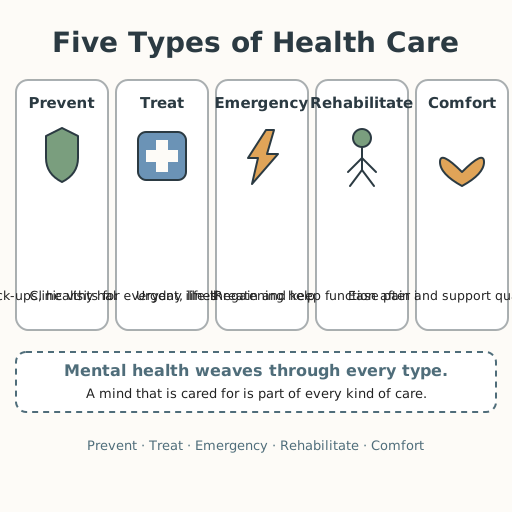
- Meet the five types (12 min). Health care is more than one room. Sort the example slips into five kinds: prevent (vaccines, check-ups, healthy habits), treat (clinic visits for everyday illness), emergency (urgent, life-threatening help), rehabilitate (regaining function after illness or injury), and comfort (easing pain and supporting quality of life). Notice that mental health runs through all five — a mind that is cared for is part of every kind of care (S-003).
- Argue an edge case (8 min). With a partner, place one tricky example: is a counseling session “treat,” “prevent,” or its own thing? Is a yearly dental visit “prevent”? Argue, then agree on a place and be ready to say why.
- Notice access (12 min). The same five kinds are not equally reachable for everyone. Income, where you live, and how a country organizes care all change who can get which kind, and how fast (S-283). Think of your own place: which kind is easiest to reach for you? Which is hardest, and for whom?
- Write it (10 min). In your health journal, write the five types and one real example of each from your own life or community, and one sentence on which kind you would most want to make easier to reach — and why.
- Close (4 min). Say, in your own words, why “health care” is bigger than a doctor’s visit — and why who can reach it matters.
Differentiation
- Support: Sort only the clearest slips and name the five types with one word each, leaving the edge-case debate aside.
- Extension: Investigate how one type of care (e.g., rehabilitation or palliative) is provided in two different places and compare what makes access easier or harder.
Assessment
- Formative (peer + self): Can the learner name the five types, sort examples with reasons, and connect access to a fairness question?
- Portfolio artifact (unit): The completed five-types organizer with the written reflection, opened in the health journal.
Home connection
Ask someone at home about one time they needed care — preventive, treatment, emergency, rehabilitation, or comfort — and what it took to reach it. Write one sentence about what was easy and one about what was hard.
Resources
- On health as broader than a single visit (general authority): World Health Organization (S-003).
- On uneven access shaped by income, place, and policy (general data authority): UNDP Human Development Reports (S-283).
- On worked examples and guided practice for a new sorting skill: Kirschner, Sweller & Clark (2006) (S-011).