Lesson 02 — Health, Need, and Fairness
Learners meet three answers to "how should care be shared fairly?" — equal shares, by need, and by ability to pay — and see that the question has no single right answer. They use the capabilities idea (what a person can actually do and be) to judge each rule, and they name the real barriers — income, place, and policy — that stand between people and care.
Objectives
Objectives
- D03.S4.11.01 Plan for their own health-care needs, including how to access care, advocate for themselves, and navigate health systems.
Essential question
What would it mean to share health care fairly — and what shapes whether I can get it?
Key vocabulary
Materials
Standard materials
- Fairness-scenario cards · 1 set per group Three rules for distributing a scarce resource (equal, by need, by ability to pay) with a short scenario
- Health journal · 1 per learner
Low-tech / no-cost
- Counters or pebbles Stand in for a scarce medicine supply so the three rules can be acted out physically
- Paper and pencil To write a "what each rule lets a person do and be" reflection
Enriched / lab & device
- A short excerpt on the capabilities approach · 1 per group Sen's idea that freedom means what a person can actually do and be, applied to health
Works in different contexts
- large-group Act out the three rules whole-class with counters, then small groups each defend one rule and the class weighs them
- multi-age Younger learners sort who gets the medicine under each rule; older learners argue which rule is fairest and when
- self-directed A learner works the scenario alone, writes which rule they would choose and why, and names one counterargument
- level-grouped Group by discussion readiness; a ready group weighs a harder case (a rule that looks fair but leaves someone out)
- outdoor-only Use natural tokens (stones, leaves) for medicine doses and physically move them to the figures in the open
Lesson 2 — Health, Need, and Fairness
Summary
Learners meet three answers to “how should care be shared fairly?” — equal shares, by need, and by ability to pay — and see that the question has no single right answer. They use the capabilities idea — what a person can actually do and be — to judge each rule, and they name the real access barriers that stand between people and care.
Objectives
- Compare ideas of how care should be distributed fairly, and explain what shapes whether a person can actually get it. (D03.S4.11.01)
Connection
A clinic has one dose of medicine left and three people waiting — one slightly unwell, one very sick, one who can pay the most. Whom do you help? Say “everyone” and you have not solved the shortage; the question is how to choose when you cannot choose everyone. The way a family, a clinic, or a whole country answers that question — equal shares, by need, by money — decides who gets well and who waits. And behind every answer sits a second question: what does getting care actually let a person do and be?
Materials
- Fairness-scenario cards
- Health journal
Preparation
- Copy the scenario cards; gather counters or pebbles.
- Retrieval: from Lesson 1, the five types of care and the idea that access is uneven. Today we ask what fair access would even mean.
- Prepare a plain-language version of the capabilities idea (Sen) and of “justice has more than one answer” (Rawls, distributive justice).
Facilitator note
This lesson is written to the learner (“you”). The ideas to land: there is no single answer to “what is fair?” — equal treatment, need, and desert (here, ability to pay) are three long-standing, competing answers in the theory of distributive justice (S-388, S-459). Then the capabilities test: judge a rule by what it lets a person actually do and be — freedom as real capability, not just formal right (S-460). Finally the dignity anchor: every person is born equal in dignity and rights (S-149, Article 1). Hold the value question open (philosophy §11); the lesson’s job is to help learners reason, not to decree that one rule is correct.
The ethics lens: this is the lesson’s center — reasoning about right and wrong in distribution. The egalitarianism lens: who benefits and who is left out under each rule is the egalitarian question. The global lens: different societies weigh these rules differently; none is the universal default. The critical-thinking lens: learners give reasons and face a counterargument for whichever rule they choose. Preview: Lesson 3 turns from principles to practice — mapping where care actually lives in a learner’s own place.
Procedure
- Recall (5 min). From Lesson 1: what are the five types of care, and what makes reaching them uneven? Today: what would fair reaching look like?
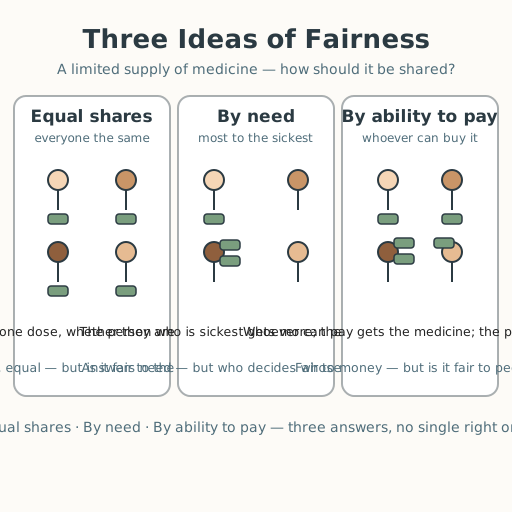
- Meet the dilemma (8 min). One dose left, three people waiting. Act it out with counters. Name three rules: equal shares (everyone the same), by need (most to the sickest), by ability to pay (whoever can buy it). Notice that these three are long-standing answers to the same question, and thinkers still disagree about them (S-388, S-459).
- Weigh the rules (12 min). For each rule, ask the capabilities question: what does it let each person actually do and be — go to school, work, care for family, recover? Freedom here means real capability, not just the right on paper (S-460). Which rule widens real capability for the most people? Which narrows it, and for whom?
- The dignity floor (6 min). Whatever rule a society chooses, the starting point is that every person is born equal in dignity and rights (S-149). Argue: can a rule that leaves someone unable to get care be reconciled with that starting point?
- Name the barriers (10 min). Fair rules aside, real barriers — income, distance, policy, who is listened to — stand between people and care (S-283). List the barriers you can see in your own place, and mark which are about money, which about place, which about how a system is run.
- Write your judgment (10 min). In your health journal: which rule would you choose if you had to, and why? Name one strong reason someone could disagree, and answer it.
- Close (4 min). Say why “everyone should get care” and “how we actually share care” are two different statements — one a value, one a fact.
Differentiation
- Support: Act out only the clearest rule (equal vs need) with counters, and say whom each helps and whom it leaves out.
- Extension: Design a “mixed rule” (e.g., need first, but a dignity floor of basic care for all) and defend it against both the equal-shares and ability-to-pay positions.
Assessment
- Formative (peer + self): Can the learner explain the three rules, judge one with the capabilities question, and answer a counterargument fairly?
- Portfolio artifact (unit): The written judgment with its answered counterargument.
Home connection
Ask someone at home how they think scarce care should be shared — equal, by need, or by ability to pay — and why. Write one sentence of agreement and one respectful difference.
Resources
- On competing ideas of distributive justice (equal treatment vs need vs desert): Stanford Encyclopedia of Philosophy, “Distributive Justice” (S-388); Rawls, A Theory of Justice (S-459).
- On freedom as real capability (what a person can do and be): Sen, Development as Freedom (S-460).
- On human dignity as the shared starting point: UN Universal Declaration of Human Rights, Article 1 (S-149).
- On uneven access shaped by income, place, and policy: UNDP Human Development Reports (S-283).