Lesson 10 — Designing Support With, Not For — My Health-Care Plan
The capstone: learners assemble the unit's two artifacts — a personal health-care plan (access, self-advocacy, navigating systems) and a respectful support design — governed by the principle "nothing about us without us." They distinguish support designed *with* someone from charity handed *down*, name how overlapping identities shape care, and meet mutual aid as support among equals.
Objectives
Objectives
- D03.S4.11.01 Plan for their own health-care needs, including how to access care, advocate for themselves, and navigate health systems.
- D03.S4.11.02 Explain how chronic conditions and disabilities affect daily life and design respectful support for themselves and others.
Essential question
How do I turn everything I have learned into a real plan for my own care and support I design *with* others, not *for* them?
Key vocabulary
Materials
Standard materials
- Health-care plan template · 1 per learner Sections for my care needs, my local doors, my questions, my rights, and my support design
- Support-design worksheet · 1 per learner Ask / listen / decide together / adapt, applied to a real support situation
Low-tech / no-cost
- Paper and pencil Build the plan and the support design by hand
- Sticky notes or scraps For the ask/listen/decide/adapt steps in a peer review
Enriched / lab & device
- A worked example of a completed plan (fictional, generic) · 1 per group To model the structure before learners write their own
Works in different contexts
- large-group Model one plan section whole-class, then learners draft independently and peer-review in pairs before sharing a single line each
- multi-age Younger learners complete the care-needs and doors sections; older learners write the full plan and a support design
- self-directed A learner drafts their plan and support design alone, then uses the assessment checklist to self-check completeness
- level-grouped Group by writing confidence; a ready group also drafts a mutual-aid support design and names how accountability is shared
- outdoor-only Write the plan on cards in an outdoor circle; share the support design aloud as a give-and-take among equals
Lesson 10 — Designing Support With, Not For — My Health-Care Plan
Summary
The capstone: learners assemble the unit’s two artifacts — a personal health-care plan (access, self-advocacy, navigating systems) and a respectful support design — governed by the principle “nothing about us without us.” They distinguish support designed with someone from charity handed down, name how overlapping identities shape care, and meet mutual aid as support among equals.
Objectives
- Produce a personal health-care plan covering access, self-advocacy, and navigating systems. (D03.S4.11.01)
- Design respectful support for oneself and others that is created with the person. (D03.S4.11.02)
Connection
A plan is what turns good intentions into action: knowing where to go, what to say, what you are owed, and whom to support and how. And the best support is not a favor handed down from above but a plan made with the person who lives the reality — the difference between building a ramp you assume is right and asking the person who will use it where it should go. This lesson gathers both: your own plan, and a support you design with someone, not for them.
Materials
- Health-care plan template
- Support-design worksheet
Preparation
- Copy the plan template and support-design worksheet.
- Retrieval: the whole unit — types of care (L1), fairness (L2), mapping the system (L3), urgency (L4), rights (L5), self-advocacy (L6), reading claims (L7), chronic conditions (L8), disability and barriers (L9). Today it all becomes a plan.
- Prepare a fictional, generic worked example so the structure is clear before learners write their own.
Facilitator note
This lesson is written to the learner (“you”). The ideas to land: the unit closes by assembling its two artifacts — a personal health-care plan (access, advocacy, navigation) and a support design — under the principle “nothing about us without us”: support is made with the person, never imposed on them. Three anchors: charity and mutual aid are different — charity hands things down and keeps the giver’s power, while mutual aid meets needs as equals who share both the giving and the deciding (S-345); mutual aid and communal-work traditions are widespread human practice (S-163, S-164). And overlapping identities (culture, gender, ability, class) shape a person’s care together, not separately — intersectionality (S-334) — so a support design must ask, not assume. The value core — dignity, care, not ranking — is philosophy §12.
The ethics lens: how we support others is ethics in action. The egalitarianism lens: support as equals, not charity from above. The community lens: mutual aid is built in community, not imposed by institutions. This is a summative artifact for the unit; keep it private and optional to share, and let learners who are still building revise rather than be ranked (S-096, “not yet”). Preview: the plan hands off to Grade 12’s independent health management.
Procedure
- Recall (8 min). Rapid pass through the unit: five types of care; three ideas of fairness; your local doors into care; the urgency ladder; your three rights; your question list; the five questions for a health claim; a day with a condition; the social model of disability. Say one line each, without notes (retrieval practice).
- Assemble your plan (15 min). Fill the health-care plan template: my care needs (from your health-information card, kept private); my local doors (your Lesson 3 map and Lesson 4 ladder); my questions and rights (Lessons 5–7); and my next step (one real action you will take this month).
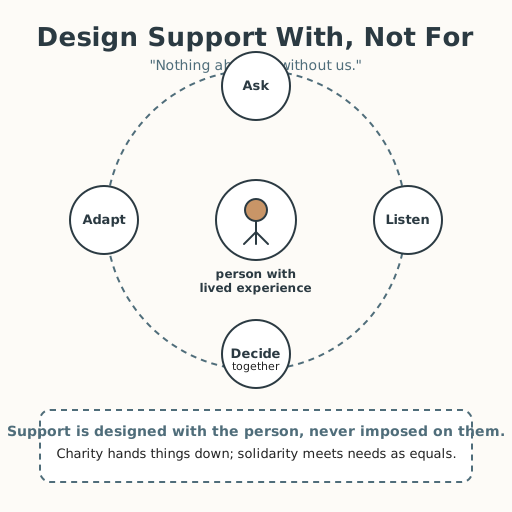
- The principle (8 min). “Nothing about us without us”: support for a person is designed with them — ask, listen, decide together, adapt — never imposed. Name the difference between charity (a one-way gift where the giver keeps the power) and mutual aid (people meeting needs as equals, sharing both the giving and the deciding) (S-345). Mutual aid and communal work — harambee, gotong royong, mink’a, barn-raising — are ordinary human practice across cultures (S-163, S-164).
- Design a support (15 min). On the worksheet, choose one support situation — for yourself or another person. Apply the four steps: ask what is actually needed, listen to the answer, decide together, and adapt as needs change. If the person’s situation involves more than one identity (culture, gender, ability, class), those shape the support together — ask rather than assume (S-334).
- Peer review (7 min). Trade plans with a partner (share only what you choose). Give one “this is clear,” one “help me understand,” and one “have you considered?” (S-238). Revise your own.
- Close (2 min). Write the one line you want to remember from this whole unit, and say it aloud.
Differentiation
- Support: Complete only the care-needs and local-doors sections, and write one “ask” step for a support you would design.
- Extension: Draft a small mutual-aid arrangement with a named need, a named group, and a shared accountability plan (who does what, how you check in), and reflect on what keeps it mutual rather than charitable.
Assessment
- Summative (portfolio): The completed health-care plan covering access, self-advocacy, and navigating systems, plus a support design made with the person — assessed for completeness and respect, not ranked (S-096).
- Self + peer: A checklist of the plan’s sections and the four support-design steps, with one revision made in response to feedback.
Home connection
Share your plan’s “next step” with someone at home and ask them to help you take it. Write down who you will ask and by when.
Resources
- On the charity-vs-mutual-aid distinction (power sits with the giver vs shared): Dean Spade, Mutual Aid (S-345).
- On mutual aid as widespread human practice: Kropotkin, Mutual Aid (S-163); communal-work traditions (S-164).
- On overlapping identities shaping experience together: Crenshaw, “Demarginalizing the Intersection of Race and Sex” (S-334).
- On discussion moves for peer review: Michaels & O’Connor, Accountable Talk (S-238).
- On the “not yet” stance for mastery, not ranking: Dweck, Mindset (S-096).
- On retrieval practice for the unit review: Roediger & Karpicke (S-228); Dunlosky et al. (S-039).