Lesson 09 — Disability, Barriers, and Universal Design
Learners distinguish two ways of seeing disability: the medical model (the body is the problem) and the social model (barriers in the world are the problem). They audit a real space for barriers, meet assistive technology and universal design as everyday ways to remove them, and ground it all in the rights frame that every person belongs.
Objectives
Objectives
- D03.S4.11.02 Explain how chronic conditions and disabilities affect daily life and design respectful support for themselves and others.
Essential question
What actually disables a person — the body, or the steps, doors, and attitudes around them?
Key vocabulary
Materials
Standard materials
- Two-views organizer · 1 per learner Two panels — medical model vs social model — to place examples of barriers
- Barrier-hunt checklist · 1 per learner Steps, narrow doors, print-only signs, attitudes, missing captions, and more
Low-tech / no-cost
- Paper and pencil Draw the two views and list barriers found in one's own surroundings
- A walk-through of a familiar space Physically look for steps, doors, and signs that include or exclude
Enriched / lab & device
- The seven principles of universal design (short list) · 1 per group Equitable use, flexibility, simple and intuitive, perceptible information, tolerance for error, low effort, size and space
Works in different contexts
- large-group Sort barrier examples whole-class into body-problem vs world-problem, then pairs audit one space and propose one fix
- multi-age Younger learners find one thing that makes a space easier or harder; older learners distinguish the two models and apply universal design
- self-directed A learner audits their own surroundings, lists barriers, and writes one design change and why it widens access
- level-grouped Group by prior familiarity with disability concepts; a ready group maps barriers onto the seven universal-design principles
- outdoor-only Audit an outdoor path or entrance for steps, slope, surface, and signs, and propose one change
Lesson 9 — Disability, Barriers, and Universal Design
Summary
Learners distinguish two ways of seeing disability: the medical model (the body is the problem) and the social model (barriers in the world are the problem). They audit a real space for barriers, meet assistive technology and universal design as everyday ways to remove them, and ground it all in the rights frame that every person belongs.
Objectives
- Explain how disability arises in the fit between a person and their environment, and design changes that remove barriers. (D03.S4.11.02)
Connection
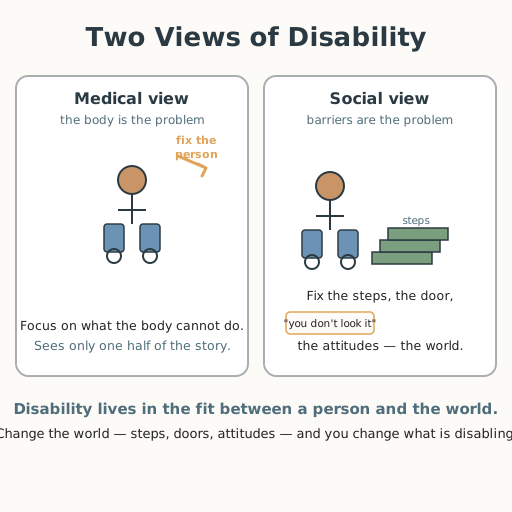
A person who uses a wheelchair is not stopped by their own body at the bottom of a flight of stairs; they are stopped by the stairs. A person who is deaf is not cut off by their ears in a room where everything is spoken aloud; they are cut off by a room that assumes everyone hears. The same person, in a building with a ramp and captions, can move and take part fully. That shift — from “fix the person” to “fix the steps, the doors, the assumptions” — is the single biggest idea in understanding disability.
Materials
- Two-views organizer
- Barrier-hunt checklist
Preparation
- Copy the organizer and checklist.
- Retrieval: from Lesson 8, living with a condition and person-first framing. Today we widen from conditions to disability and to the world’s role.
- Prepare a short list of the seven universal-design principles and a few assistive technology examples.
Facilitator note
This lesson is written to the learner (“you”). The ideas to land: disability is produced by the fit between a person and their environment — the social model — rather than by the body alone (the medical model); changing steps, doors, and attitudes changes what is disabling. Two anchored supports: assistive technology — glasses, wheelchairs, hearing aids, prosthetics, white canes — is common, ordinary, and used worldwide (S-099), and the seven principles of universal design (equitable use, flexibility, simple and intuitive, perceptible information, tolerance for error, low physical effort, size and space) turn “access” into “everyone” (S-369). The rights floor: people with disabilities have a recognized right to take part in recreation, leisure, and sport (CRPD, Article 30 — S-100), and inclusion means removing barriers and treating difference as ordinary (S-235, S-092). Hold “the social model” as a widely used framework, not a verdict that the body never matters — real bodies and real needs remain, and both models describe different pieces.
The egalitarianism lens: this is the lesson’s center — who is included, who is left out, and why. The ethics lens: removing barriers is a question of what we owe each other. The global lens: access standards and assistive devices differ vastly around the world (S-099). The technology lens: design — ramps, captions, screen readers — is technology deciding who belongs. Guard the room: disability is lived by learners and their families; lead with dignity, never pity. Preview: Lesson 10 turns barriers into the capstone — designing support with, not for.
Procedure
- Recall (5 min). From Lesson 8, we separated the condition from the person. Today: what does the world around the person do — help or block?
- Meet the two views (10 min). Two ways to see disability. Medical model: the body is the problem to fix — focus on what it cannot do. Social model: barriers are the problem — steps, narrow doors, print-only signs, spoken-only rooms, and attitudes that say “you don’t look disabled.” Disability lives in the fit between a person and the world; change the world and you change what is disabling. Both views describe something real, but the social view is where we have power.
- Assistive technology (6 min). Glasses, wheelchairs, hearing aids, prosthetics, white canes — these are common, ordinary tools used by people worldwide, not special exceptions (S-099). They are one way the fit between a person and the world is adjusted.
- Barrier hunt (14 min). With the checklist, audit a space you know — steps at an entrance, a doorway too narrow, a sign only in print, a video without captions, an attitude you have heard. For each barrier, write: who does it leave out, and what change would remove it?
- Universal design (8 min). Instead of fixing spaces one person at a time, design them for everyone from the start: equitable use, flexibility, simple and intuitive, perceptible information, tolerance for error, low physical effort, size and space (S-369). Pick one barrier you found and redesign it with these principles.
- The rights floor (6 min). Behind the redesign sits a right: people with disabilities have a recognized right to take part in recreation, leisure, and sport (S-100), and inclusion means removing barriers and treating difference as ordinary, not deficient (S-235, S-092).
- Close (6 min). Write your one-sentence answer to the essential question: what actually disables a person — and what follows from your answer?
Differentiation
- Support: Find one barrier in a familiar space and name one change that would remove it.
- Extension: Map a full space onto the seven principles of universal design, and write a short proposal for the single change that would include the most people.
Assessment
- Formative (peer + self): Can the learner distinguish the two models, identify a real barrier and whom it excludes, and propose a universal-design change?
- Portfolio artifact (unit): The completed barrier-hunt checklist with one redesign, kept for the unit’s support design.
Home connection
Audit one entrance or room at home or nearby: what is easy, what is a barrier, and for whom? Write one change and what it would cost in time or money.
Resources
- On assistive technology as common and worldwide: WHO, Assistive Technology fact sheet (S-099).
- On the seven principles of universal design: The Center for Universal Design, NC State University (S-369).
- On the rights frame (participation in recreation, leisure, sport): UN CRPD, Article 30 (S-100).
- On inclusion as removing barriers and treating difference as ordinary: UNESCO, Inclusion in Education (S-235); UNICEF, Inclusive education (S-092).