Lesson 04 — Telling the Story: Contrasting Accounts of Significance
Learners read two contrasting accounts of the same transformation — one centered on states, machines, and commerce, the other on workers, families, and the land — and name what each makes visible and invisible. They meet the "danger of a single story" (S-417) and practice the unit's anti-triumphalist habit: no single account is the whole truth, and contrasting accounts reveal the choices of significance inside every story.
Objectives
Objectives
- D08.S1.11.02 Evaluate how the choice of what counts as significant change shapes historical accounts, using contrasting examples.
Essential question
How do contrasting accounts of the same change reveal the choice of what counts as significant?
Key vocabulary
Materials
Standard materials
- Two-account comparison sheet · 1 per learner Side-by-side columns for two accounts of the same change, plus a "what each omits" row
- History journal · 1 per learner
Low-tech / no-cost
- Two voices, read aloud One learner reads each contrasting account; the class listens for what changes
Enriched / lab & device
- Short printed excerpts of two historical accounts of one change One centering states and commerce, one centering workers and the land
Works in different contexts
- large-group Read the two accounts aloud whole-class, then pairs complete the comparison sheet
- multi-age Younger learners retell each account in one sentence; older learners name the criterion and the omission
- self-directed A learner reads both accounts, fills the comparison sheet, and writes a paragraph on the single story
- level-grouped A ready group reads Adichie's argument (S-417) and applies it to the two accounts
- outdoor-only Two learners stand at opposite ends of a line and each tells the same event's story; the group names the difference
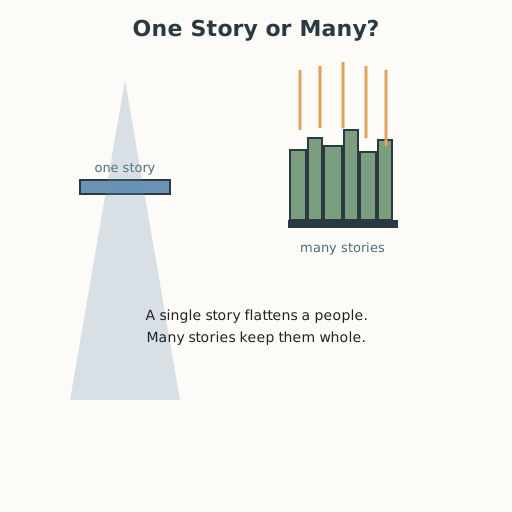
Lesson 4 — Telling the Story: Contrasting Accounts of Significance
Summary
The same change can be told many ways, and each telling chooses what to count as significant. Learners compare two accounts of one transformation — say, the growth of factory production — one written from the vantage of owners, states, and machines, the other from workers, families, and the land. They name each account’s criterion, what it omits, and why a single story about a people or a place is dangerous (S-417). This deepens the unit’s first essential question: significance is chosen, and contrasting accounts reveal the choosing.
Objectives
- Evaluate how the choice of what counts as significant change shapes historical accounts, using contrasting examples and naming what each omits. (D08.S1.11.02)
Connection
Two people can describe the same street after a storm: one notes the blocked road and the fallen power line; the other notes the flooded basement and the neighbor who helped carry the water out. Both are true. Neither is the whole street. History works the same way — every account lights up some things and leaves others in shadow.
Materials
- Two-account comparison sheet
- History journal
Preparation
- Prepare two short contrasting accounts of one change (see step 2) or use the ones in the lesson.
- Retrieval: from Lesson 1, that significance is a choice (S-314).
Facilitator note
The skill to land: read an account for its criterion (what it counts as significant) and its omissions (what it leaves out). The critical-thinking lens: learners name the vantage of each account and test it against another. The egalitarianism lens: centering only the powerful omits most people; a fair account widens the lens. The ethics lens: what we omit from a story can erase real lives and real harms. The global lens: no people is “one story”; Adichie’s warning against the single story is a global discipline (S-417). Keep the examples respectful and specific; the aim is to sharpen reading, not to mock any one account.
Procedure
- Recall (5 min). From Lesson 1: what makes an event “significant”? Say it in one sentence. Today we read two tellings of the same change.
- Read account one (8 min). Read the first account of the growth of factory production — one that centers owners, machines, and a nation’s rising wealth. On your sheet, note its criterion (what it treats as important) and its omissions.
- Read account two (8 min). Read the contrasting account — one that centers workers’ hours and injuries, families displaced into cities, and smoke over the river. Note its criterion and omissions.
- Compare (12 min). With a partner, fill the comparison sheet: what does each account light up? What does each leave in shadow? Where do they disagree about what mattered?
- The single story (10 min). The writer Chimamanda Ngozi Adichie warns of “the danger of a single story” — knowing only one account of a people or place flattens them into that one tale (S-417). Discuss: which of the two accounts, read alone, would be a “single story,” and what would it hide?
- Journal (10 min). Write: “A fair account of this change must include both… because…” Name at least one thing each account recovers that the other omits.
- Close (2 min). Preview: next we turn from change over time to knowledge — whose knowing has been counted as authoritative, and whose has been pushed aside.
Differentiation
- Support: Give a fixed set of “lit up / left out” phrases to sort under each account before writing.
- Extension: Write a short third account from a vantage neither text includes (e.g., a river, a child laborer), naming its new criterion.
Assessment
- Formative (peer + self): Can the learner state each account’s criterion and name at least one omission in each, and explain why no single account suffices?
- Portfolio artifact (unit): The comparison sheet and the “must include both…” journal entry, as the significance-choice evaluation.
Home connection
Find one news report or family retelling of a shared event. Ask: whose story does it center, and who or what does it leave out? Say what a second account would add.
Resources
- The danger of a single story: Chimamanda Ngozi Adichie, TEDGlobal 2009 (S-417).
- Periodization and significance as historiographical choices: Encyclopaedia Britannica, “Historiography” (S-314).
- Sourcing, corroboration, and causality as historical-thinking skills: Stanford History Education Group (S-316).