Lesson 05 — Dominant and Marginalized Knowledge Traditions
Learners evaluate how a dominant knowledge tradition — often formal, written science or scholarship — has related to marginalized traditions, such as Indigenous ecological knowledge and place-based practice, that were pushed aside or denied legitimacy under colonialism. Using cultural burning and Timbuktu's manuscripts as examples, they compare what each tradition knows and offers, and begin to argue for centering marginalized voices.
Objectives
Objectives
- D08.S2.11.01 Evaluate the relationship between dominant and marginalized knowledge traditions and argue for how marginalized voices can be centered.
Essential question
How have dominant and marginalized knowledge traditions related, and what does each offer?
Key vocabulary
Materials
Standard materials
- Two-traditions comparison chart · 1 per learner Columns for "what it knows", "how it knows", "who is credited", "what it offers"
- History journal · 1 per learner
Low-tech / no-cost
- Two short oral accounts, read aloud One from a formal-science tradition, one from a place-based tradition, both about the same land
Enriched / lab & device
- Excerpts from Kimmerer (S-427) and a formal science text on the same forest or fire To compare two ways of knowing the same living system
Works in different contexts
- large-group Read the two accounts aloud whole-class; pairs fill the comparison chart and share one contrast
- multi-age Younger learners name "what each one knows"; older learners analyze "who is credited" and "what is lost"
- self-directed A learner reads both accounts, completes the chart, and writes a paragraph on legitimacy
- level-grouped A ready group compares cultural burning (S-320) with a formal fire-science account and notes where they agree and differ
- outdoor-only Observe one patch of land and describe it twice — once as a scientist, once as a steward who has lived with it
Lesson 5 — Dominant and Marginalized Knowledge Traditions
Summary
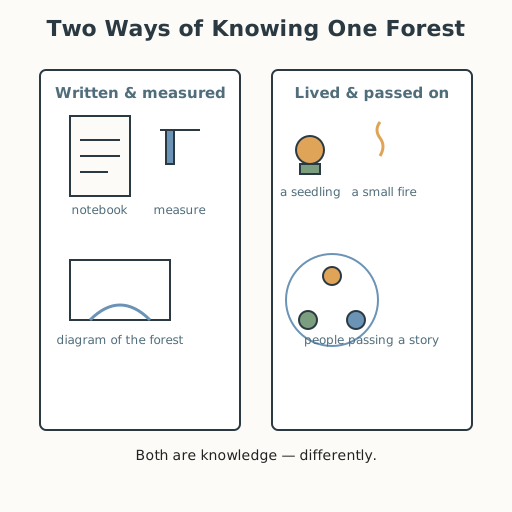
Peoples know the world in many ways — through experiment and written records, and through long, place-based practice passed across generations. Some traditions became dominant: their knowledge was treated as authoritative, written down, and taught in institutions. Others were marginalized: dismissed or suppressed, often under colonial rule. Learners compare two traditions that know the same land or forest, and meet two reminders that marginalized knowledge is real and deep — Aboriginal cultural burning (S-320) and the scholarly manuscripts of Timbuktu (S-201).
Objectives
- Evaluate the relationship between dominant and marginalized knowledge traditions, comparing what each knows and offers. (D08.S2.11.01)
Connection
Two people can know the same river: one measures its flow and charts its water quality; another has fished it for decades and reads the season by where the fish gather. The two knowings are different, and both are real. But the world often counts only one as “knowledge” — and that ranking has a history behind it.
Materials
- Two-traditions comparison chart
- History journal
Preparation
- Prepare the two accounts of the same land (step 2) or use cultural burning (S-320) against a formal fire-management description.
- Retrieval: from Grade 10, the idea that indigenous and scientific ways of knowing generate and test knowledge in different ways.
Facilitator note
Hold both traditions side by side, never ranking one as “primitive.” The egalitarianism lens: asking who was credited and who was dismissed is a fairness question. The global lens: Timbuktu’s manuscripts (astronomy, mathematics, medicine, law) prove that written scholarship flourished outside Europe and was honored on its own terms (S-201); cultural burning shows knowledge held in practice, not just in text (S-320). The ethics lens: calling one people’s knowledge “not knowledge” was part of colonial power, and it caused real loss. The environment lens: place-based knowledge often encodes long observation of a living system. Frame this as “both are knowledge, differently,” and let learners weigh what each offers.
Procedure
- Recall (5 min). From earlier grades: name two ways people can know the same natural thing (e.g., a forest, a season). Today we ask why one way became “official.”
- Meet the terms (10 min). A knowledge tradition is a people’s shared way of knowing — how they observe, test, record, and pass on understanding. A dominant tradition is treated as authoritative; a marginalized one is pushed aside or denied legitimacy. These positions come from power and history, not from how true the knowledge is.
- Compare two traditions (15 min). Read the two accounts of the same land: one formal and written, one place-based and held in practice. On the chart, fill “what it knows,” “how it knows,” “who is credited,” and “what it offers.”
- Two reminders (10 min). Aboriginal and Torres Strait Islander peoples have used cultural burning to care for Country for thousands of years — knowledge held in practice, not always in writing (S-320). And in Timbuktu, centuries of written scholarship in astronomy, mathematics, medicine, and law were gathered and honored (S-201). Both are real, deep knowledge.
- Discuss legitimacy (10 min). With a partner: why did one tradition become “official” while the other was marginalized? What was lost when one was denied?
- Journal (5 min). Write one sentence beginning: “Both traditions are knowledge because…” and one beginning: “One was marginalized because…”
Differentiation
- Support: Sort pre-written “knows / how it knows / offers” cards under the two tradition headings.
- Extension: Compare cultural burning (S-320) with a formal fire-science account and name one place they agree and one place they differ.
Assessment
- Formative (peer + self): Can the learner compare what the two traditions know and offer, and explain — in historical terms, not by ranking — why one became dominant?
- Portfolio artifact (unit): The completed comparison chart and the two journal sentences, as the first part of the knowledge-traditions argument.
Home connection
Ask an elder or neighbor how they know something in your place — weather, soil, a recipe, a repair. Write down what their knowledge knows and offers, set beside the “official” version.
Resources
- Aboriginal and Torres Strait Islander cultural burning as long-standing, living fire-management: CSIRO (S-320); Firesticks Alliance / Living Knowledge Network (S-321).
- The Timbuktu manuscripts and Timbuktu as a center of learning: UNESCO Memory of the World (S-201).
- Indigenous and scientific ways of knowing held side by side: Robin Wall Kimmerer, Braiding Sweetgrass (S-427).