Lesson 06 — Centering Marginalized Voices
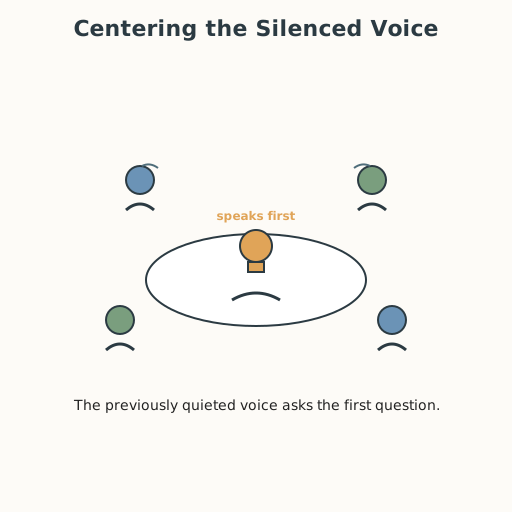
Learners move from *describing* the relationship between dominant and marginalized knowledge traditions to *arguing* for centering marginalized voices. They write a claim-reason-evidence argument that explains how centering changes what a community can know, credit, and heal, and they practice a "centered circle" in which the previously quieted voices speak first.
Objectives
Objectives
- D08.S2.11.01 Evaluate the relationship between dominant and marginalized knowledge traditions and argue for how marginalized voices can be centered.
Essential question
How can marginalized voices be centered, and why does centering them change what we know?
Key vocabulary
Materials
Standard materials
- Argument planner · 1 per learner Claim, reason, evidence, and counterargument boxes for a centering argument
- History journal · 1 per learner
Low-tech / no-cost
- A circle of voices Physically re-seat a discussion so the previously quieted voices speak first
Enriched / lab & device
- Short documentary clips or oral-history recordings from a marginalized knowledge tradition To hear the voices themselves, not only accounts of them
Works in different contexts
- large-group Run a "centered circle" discussion — marginalized voices first — then learners write their argument
- multi-age Younger learners list "who should speak first and why"; older learners write the full claim-reason-evidence argument
- self-directed A learner drafts the argument alone, checks each reason against evidence, and revises once
- level-grouped A ready group weighs a counterargument ("centering one voice silences another") and answers it
- outdoor-only Hold the centered-circle discussion outside; use a talking object passed to the one who has not yet spoken
Lesson 6 — Centering Marginalized Voices
Summary
Centering a marginalized voice is not the same as adding a footnote. It means treating that voice as a source of authority, crediting its knowledge, and letting it set some of the questions. Learners practice this directly: first in a “centered circle” where the previously quieted voices speak first, then in a written argument for centering, using claim, reason, and evidence and answering a counterargument fairly.
Objectives
- Argue for how marginalized voices can be centered, and explain how centering changes what is known, credited, and possible. (D08.S2.11.01)
Connection
Think of a group project where one person’s idea was always talked over. When someone finally said “let them finish,” the whole plan changed — the group heard what it had been missing. Centering is that move, practiced on the scale of whole knowledge traditions that were long talked over.
Materials
- Argument planner
- History journal
Preparation
- Prepare the argument planner and a short example of a “centered” versus “added-on” treatment of a voice.
- Retrieval: from Lesson 5, the terms dominant and marginalized knowledge tradition.
Facilitator note
The skill to land: a centering argument — claim, reason, evidence, and a fair answer to a counterargument (S-011 models this explicitly). The egalitarianism lens: centering is a repair of unfair credit and authority, not charity. The ethics lens: who gets to speak and be believed is a justice question. The global lens: across the world, peoples whose knowledge was suppressed under colonialism are now having it recognized, credited, and in some cases returned (repatriated). The critical-thinking lens: learners answer the real counterargument — “does centering one voice silence another?” — by distinguishing centering (giving the silenced a full seat) from silencing others. Keep the discussion cooperative, not competitive.
Procedure
- Recall (5 min). From Lesson 5: what made one knowledge tradition dominant and another marginalized? Today we argue for the repair.
- Centering vs. adding on (10 min). Worked example: adding a voice means quoting it once at the end; centering means asking it the first question, crediting it, and letting it shape the questions. Which changes the outcome more, and why?
- The centered circle (12 min). In a circle, pose a real question from the unit (e.g., “how should this forest be cared for?”). The rule: those who have been quieted — or who hold a tradition usually left out — speak first. Listen without interrupting.
- Plan the argument (15 min). On the planner, write: Claim — marginalized voices should be centered because… Reason(s) — centering recovers lost knowledge and repairs unfair credit. Evidence — name one tradition (e.g., cultural burning, S-320) and what centering it has changed. Counterargument — answer the worry that centering silences others.
- Write (10 min). Turn the planner into one tight paragraph in your journal.
- Close (3 min). One volunteer reads their claim aloud. Preview: next we ask how peoples have kept their languages and knowledge alive under pressure to assimilate.
Differentiation
- Support: Provide sentence starters for claim, reason, and counterargument.
- Extension: Write the argument twice — once centering a knowledge tradition, once centering a language — and note what shifts.
Assessment
- Formative (peer + self): Does the argument state a claim, give a reason backed by a named example, and answer a counterargument fairly?
- Portfolio artifact (unit): The completed argument planner and paragraph, as the knowledge-traditions argument for the unit.
Home connection
In a family or friend conversation, try the centered-circle rule once: let the person usually talked over speak first. Note what you heard that you might have missed.
Resources
- Cultural burning as an example of knowledge held in practice: CSIRO (S-320).
- Explicit modeling and guided practice for argument skills: Kirschner, Sweller & Clark (2006) (S-011).
- The Timbuktu manuscripts as evidence of marginalized written scholarship: UNESCO Memory of the World (S-201).