Lesson 07 — Language Under Pressure: Loss and Survival
Learners analyze why languages are lost — through pressure to assimilate, through schooling and law that forbade mother tongues — and what is lost with them: a way of naming the world, its knowledge, and a people's identity. They meet the scale of the world's roughly 7,000 languages and their endangerment (S-426), and the testimony of writers who lived between languages (S-424, S-425).
Objectives
Objectives
- D08.S2.11.02 Analyze how peoples have maintained and revitalized their languages, traditions, and knowledge in the face of pressure to assimilate.
Essential question
How have peoples maintained their languages under pressure to assimilate, and what is lost when a language is lost?
Key vocabulary
Materials
Standard materials
- Language-loss-and-survival chart · 1 per learner Columns for "what threatened the language", "what kept it alive", "what was lost with it"
- History journal · 1 per learner
Low-tech / no-cost
- A multilingual circle Learners who speak another language share one word each and what it carries
Enriched / lab & device
- Ethnologue language counts and a map of endangered languages (if available) To see the scale of the world's languages and their endangerment (S-426)
Works in different contexts
- large-group Share words in home languages whole-class, then pairs complete the chart from the readings
- multi-age Younger learners map "who taught me my words"; older learners analyze the pressure and the loss
- self-directed A learner reads the excerpts, completes the chart, and writes what a language carries
- level-grouped A ready group reads Ngũgĩ (S-424) and Anzaldúa (S-425) and compares their accounts of language and identity
- outdoor-only Sit in a circle and pass a word in a home language; discuss what the word knows that a translation misses
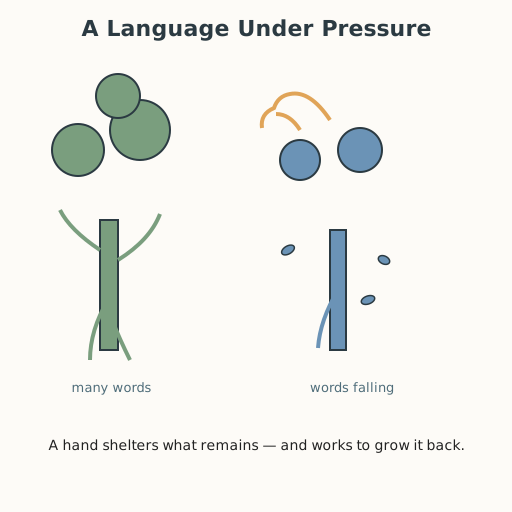
Lesson 7 — Language Under Pressure: Loss and Survival
Summary
A language is more than words: it names a people’s world, carries its knowledge, and holds its identity. Across the globe, peoples have been pressured to give up their mother tongues and speak a dominant language instead. Learners analyze what threatens a language, what keeps it alive, and what is lost when it is lost — drawing on the roughly 7,000 languages spoken today, many endangered (S-426), and on writers who lived between languages under colonial rule (S-424) and at the border between them (S-425).
Objectives
- Analyze how peoples have maintained their languages under pressure to assimilate, and what is carried — and lost — in a language. (D08.S2.11.02)
Connection
Think of a word in your home or family that has no perfect translation — a name for a kind of weather, a dish, a way of being together. That word knows something. When a language stops being spoken, the things it alone could name begin to fade with it.
Materials
- Language-loss-and-survival chart
- History journal
Preparation
- Prepare the short excerpts from Ngũgĩ (S-424) and Anzaldúa (S-425), or paraphrase their core idea.
- Retrieval: from earlier grades, that language carries culture and that many peoples keep more than one language at once.
Facilitator note
Hold this with care: many learners carry a language that has been pressured or lost in their own family, and the topic is close. The egalitarianism lens: the pressure to assimilate has fallen unevenly, on colonized and minoritized peoples most of all. The global lens: this is not one region’s story — roughly 7,000 languages are spoken today, many endangered (S-426). The ethics lens: forbidding a child’s mother tongue was an act of power with real, lasting harm. The critical-thinking lens: distinguish the fact of language loss from the value that every language matters. Affirm home languages as wealth (philosophy §multilingualism), and let learners who speak more than one language share freely — never as specimens.
Procedure
- Recall (5 min). From earlier grades: how is knowledge passed between generations? One way is language. Today we study what happens when a language is pressured out of use.
- The scale (8 min). More than 7,000 languages are spoken today, and many are endangered (S-426). A language is endangered when fewer and fewer children learn it as their first tongue. What does it mean that so many ways of naming the world are at risk?
- What threatens a language (12 min). Under colonial rule and nation-building, children were often forbidden to speak their mother tongue at school and were taught in the colonizer’s or state’s language instead. The Kenyan writer Ngũgĩ wa Thiong’o wrote that being made to write in English rather than Gikuyu distanced him from his people’s own culture and history (S-424). Fill the “what threatened it” column.
- What a language carries (12 min). The writer Gloria Anzaldúa lived between Chicano Spanish and English and wrote that one’s languages are part of one’s identity (S-425). With a partner, list what a language carries: names for land and seasons, stories, kinship, knowledge, identity. Fill “what was lost with it.”
- What kept it alive (10 min). Even under pressure, languages survived because families kept speaking them at home, songs and stories were passed on, and speakers refused to let them go. Fill “what kept it alive.” Share one word from a home language if you wish, and what it carries.
- Journal (8 min). Write: “When a language is lost, we lose…” — three concrete things, from the chart or your own life.
- Close (2 min). Preview: next lesson we meet the people who are bringing their languages home.
Differentiation
- Support: Provide a fixed list of “what a language carries” to match to examples before writing.
- Extension: Compare Ngũgĩ’s account (S-424) with Anzaldúa’s (S-425): how does each writer’s language situation differ, and what is shared?
Assessment
- Formative (peer + self): Can the learner name what threatens a language, what keeps it alive, and at least two concrete things carried in a language?
- Portfolio artifact (unit): The completed chart and the “when a language is lost” journal entry, as the first part of the revitalization analysis.
Home connection
Ask a family member for one word or phrase from your family’s languages that has no perfect translation, and write down what it carries.
Resources
- Roughly 7,000 living languages and their endangerment: Ethnologue (S-426).
- Language carrying culture and history, and the cost of writing in the colonizer’s language: Ngũgĩ wa Thiong’o, Decolonising the Mind (S-424).
- Living between languages and language as identity: Gloria Anzaldúa, Borderlands/La Frontera (S-425).