Lesson 08 — Bringing Languages Home: Revitalization
Learners study how peoples have *revitalized* their languages — Māori kōhanga reo (language nests begun 1982), Hawaiian Pūnana Leo (begun 1984), Welsh in schools and media, and the twentieth-century revival of Hebrew (S-428). They see the shared pattern: intergenerational immersion, community will, and the link between language and ecological knowledge (S-427), and they conclude with a mini revitalization plan of their own.
Objectives
Objectives
- D08.S2.11.02 Analyze how peoples have maintained and revitalized their languages, traditions, and knowledge in the face of pressure to assimilate.
Essential question
How have peoples revitalized their languages and knowledge, and what makes revitalization work?
Key vocabulary
Materials
Standard materials
- Revitalization case-study sheet · 1 per learner A table for four revitalization cases — who, what they did, what worked, what it proves
- History journal · 1 per learner
Low-tech / no-cost
- A story circle Rehearse the act of passing a story from an elder to a younger speaker, as revitalization does
Enriched / lab & device
- Audio of a revitalized language being spoken (if available) To hear the living result of the work
Works in different contexts
- large-group Assign one case per small group to report back; assemble the shared case-study sheet
- multi-age Younger learners retell one case as a story; older learners analyze the common pattern across cases
- self-directed A learner reads the cases, fills the sheet, and writes what the four share
- level-grouped A ready group reads the Hinton case list (S-428) and the Kimmerer language link (S-427) and connects them
- outdoor-only Re-enact a "language nest" — elders and children together naming the plants and places around them
Lesson 8 — Bringing Languages Home: Revitalization
Summary
Language loss is not fate. Learners study four documented cases of revitalization — the Māori kōhanga reo “language nests” begun in 1982, the Hawaiian Pūnana Leo preschools begun in 1984, Welsh in schools and media, and the twentieth-century revival of Hebrew (S-428) — and extract the shared pattern: immersion from the youngest age, elders and children together, and a community that decides the language matters. They see that language and ecological knowledge travel together (S-427) and plan a small revitalization act of their own.
Objectives
- Analyze how peoples have revitalized their languages and knowledge under pressure to assimilate, and what makes revitalization work. (D08.S2.11.02)
Connection
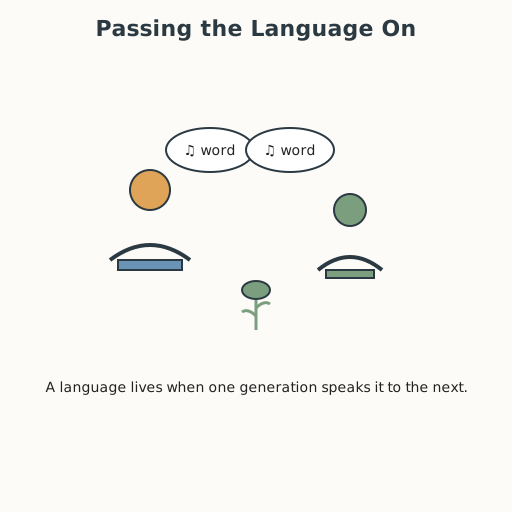
A language lives when a child learns it and, in turn, speaks it to another child. That is the whole engine of revitalization: not a museum of words, but the warm loop of one generation passing a living tongue to the next — like a seedling handed hand to hand.
Materials
- Revitalization case-study sheet
- History journal
Preparation
- Prepare one-paragraph summaries of the four cases (S-428), or the case-study sheet with the key facts pre-filled.
- Retrieval: from Lesson 7, what threatens a language and what it carries.
Facilitator note
The skill to land: compare cases to find a shared pattern — immersion, the intergenerational link, community will, and the connection of language to land and knowledge. The egalitarianism lens: revitalization is a people’s own act of repair, not a favor granted. The global lens: the cases span Aotearoa New Zealand, Hawaiʻi, Wales, and the Jewish diaspora — one human pattern in many places. The ethics lens: the earlier pressure to assimilate was a harm; revitalization is a healing. The community lens: this is collective work, elders and children together. Keep it hopeful and concrete — language revitalization is one of the great recoveries of the last century, and it is still happening.
Procedure
- Recall (5 min). From Lesson 7: name one thing a language carries. Today: how peoples have brought those languages back.
- Meet four cases (15 min). For each case, fill the sheet — who: (a) Māori kōhanga reo, language nests begun 1982; (b) Hawaiian Pūnana Leo preschools, begun 1984; (c) Welsh in schools and media; (d) Hebrew, revived over the twentieth century (S-428). What they did: immersed the youngest children in the language, with elders and community behind them. What worked: new generations became fluent speakers.
- Find the pattern (10 min). With a partner, list the three or four things every case shares. Where do the cases begin — with children, with elders, or with both?
- Language and land (8 min). The botanist Robin Wall Kimmerer writes that learning the Potawatomi language changed how she saw plants — the language names them as persons, not things, so the language carries an ethic of care (S-427). Discuss: how is a language also ecological knowledge?
- Plan a small act (12 min). In your journal, design one tiny revitalization step for a language you know or care about — a word a day, a story circle, recording an elder, teaching one song. Name who would be in the circle.
- Close (5 min). Share one step. Preview: we now turn to the land itself — settlement, resources, and a changing climate.
Differentiation
- Support: Work from the pre-filled case sheet; choose one case to retell as a three-step story.
- Extension: Connect the Kimmerer language-land link (S-427) to a named plant or place in your region, and say what its name teaches.
Assessment
- Formative (peer + self): Can the learner name the shared pattern across cases and explain how language carries ecological knowledge and why immersion matters?
- Portfolio artifact (unit): The case-study sheet and the mini revitalization plan, as the revitalization analysis for the unit.
Home connection
Learn one new word or phrase in a language of your family or community, and teach it to one other person — completing one loop of the revitalization engine.
Resources
- Four documented revitalization cases (Māori kōhanga reo 1982; Hawaiian Pūnana Leo 1984; Welsh; twentieth-century Hebrew revival): Leanne Hinton (ed.), Bringing Our Languages Home (S-428).
- Language linked to ecological knowledge: Robin Wall Kimmerer, Braiding Sweetgrass (S-427).
- Roughly 7,000 living languages: Ethnologue (S-426).