Lesson 10 — Forests and Water Across Regions
Learners deepen the settlement-resource-environment loop through two of its sharpest forms: deforestation — forests cover about 31 percent of the world's land and house more than half of its land species (S-220) — and water scarcity, with billions still lacking safely managed drinking water (S-065). They trace cause, effect, and *who is affected* in each, and link the two: clearing land changes how water moves, and both burdens fall unevenly.
Objectives
Objectives
- D08.S3.11.01 Analyze the relationship between human settlement, resource use, and environmental change, such as deforestation or water scarcity, across regions.
Essential question
How do deforestation and water scarcity connect settlement, resource use, and environmental change across regions?
Key vocabulary
Materials
Standard materials
- Forest-and-water case sheet · 1 per learner Two cases — deforestation and water scarcity — with cause, effect, and who is affected
- History journal · 1 per learner
Low-tech / no-cost
- A cleared patch and a planted patch Compare a cleared strip of ground with one that holds plants, and watch where water runs and stays
Enriched / lab & device
- FAO forestry figures and JMP water-access data (if available) To ground the cases in real numbers (S-220, S-065)
Works in different contexts
- large-group Divide the class — half studies deforestation, half water scarcity — then pair one from each to compare
- multi-age Younger learners name what a forest and clean water give; older learners trace cause, effect, and who is affected
- self-directed A learner completes both cases and writes one sentence linking the two
- level-grouped A ready group connects deforestation to habitat loss (S-220) and water scarcity to unequal access (S-065)
- outdoor-only Observe a local example of cleared land or water use and trace its loop on the ground
Lesson 10 — Forests and Water Across Regions
Summary
Two resources connect every settlement to its environment: forests and water. Forests cover about 31 percent of the world’s land and are home to more than half of its land animal and plant species; clearing them removes habitat and changes how water moves (S-220). Meanwhile, about one in four people still lack safely managed drinking water (S-065), and scarcity falls hardest on the least-advantaged. Learners trace both cases through the loop and ask the unit’s recurring question: who is affected?
Objectives
- Analyze the relationship between human settlement, resource use, and environmental change, through deforestation and water scarcity across regions. (D08.S3.11.01)
Connection
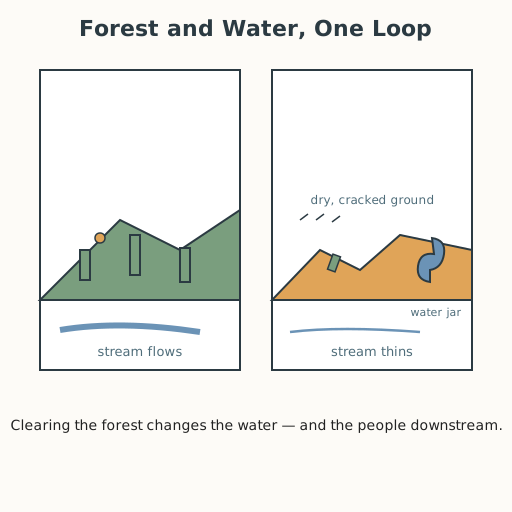
Cut a forest and the rain that once soaked into roots and soil now runs off hard ground, carrying soil with it; the stream below changes, and so does the village that drinks from it. Forest and water are not two separate problems — they are one loop, and people live inside it.
Materials
- Forest-and-water case sheet
- History journal
Preparation
- Copy the forest-and-water case sheet.
- Retrieval: from Lesson 9, the settlement-resource-environment loop.
Facilitator note
Keep the two cases concrete and connected, not a catalog of doom. The environment lens: deforestation changes habitat and hydrology (S-220), and water scarcity follows where water is overused or unevenly shared. The egalitarian lens: both burdens fall unevenly — about one in four people lack safely managed drinking water (S-065), and the poorest and most marginalized carry the heaviest share. The global lens: these are worldwide patterns with local faces. The critical-thinking lens: distinguish evidence (the figures) from values (that fair access and care for the land matter), and always attach the difficulty to agency — stewardship, restoration, and fair sharing are real and ongoing.
Procedure
- Recall (5 min). From Lesson 9: what are the three parts of the loop? Today we trace two of its sharpest forms.
- Case one: deforestation (15 min). Forests cover about 31 percent of the world’s land and house more than half of its land species (S-220). When they are cleared for fields, pasture, or timber, animals lose homes, soil washes away, and water no longer soaks in as it did. On the sheet, fill cause, effect, and who is affected.
- Case two: water scarcity (15 min). Water is essential to life and health, yet about one in four people lack safely managed drinking water (S-065). Scarcity grows where demand outruns supply, where water is polluted, and where access is unequal. Fill cause, effect, and who is affected.
- Link the two (10 min). With a partner: how does clearing land change water? Why do the burdens of both fall unevenly? Where does the loop turn back on the people?
- Journal (8 min). Write: “Forests and water are one loop because…” — then name one act of stewardship or fair sharing that could ease the loop.
- Close (2 min). Preview: next we ask how a changing climate is reshaping where and how people can live.
Differentiation
- Support: Use a cause/effect matching activity with pre-written cards for each case.
- Extension: Research one region’s deforestation or water-scarcity case and add a fourth column: “one response underway.”
Assessment
- Formative (peer + self): Can the learner trace cause, effect, and who is affected in each case, and explain how the two connect?
- Portfolio artifact (unit): The completed forest-and-water case sheet and journal entry, added to the settlement-resource-environment analysis.
Home connection
Notice one tree, stream, or water source near home. Ask an adult how it has changed in their lifetime, and write one cause and one effect of that change.
Resources
- Forests cover 31 percent of the world’s land and house more than half of its land species: FAO Forestry (S-220).
- About one in four people lack safely managed drinking water: WHO/UNICEF JMP (S-065); see also WHO drinking-water fact sheet (S-049).
- Irrigation and water-carrying as long human practice: National Geographic Education (S-130).