Lesson 12 — Responding with Care and Justice
Learners weigh responses to climate displacement — adapting in place, mitigating emissions, and planned relocation — against the standards of care and justice. They run a role circle to feel how the same response lands differently on different people, and write an evaluation that names who each response helps and burdens, arguing for the response most rooted in care and justice.
Objectives
Objectives
- D08.S3.11.02 Evaluate how climate change is reshaping where and how people can live, and weigh responses rooted in care and justice.
Essential question
How do I weigh responses to climate displacement that are rooted in care and justice?
Key vocabulary
Materials
Standard materials
- Response evaluation sheet · 1 per learner A table to weigh responses — who it helps, who it burdens, and whether it is rooted in care and justice
- History journal · 1 per learner
Low-tech / no-cost
- A role circle Learners take roles — a coastal family, a farmer, a planner, a neighbor inland — and weigh the same response from each seat
Enriched / lab & device
- Short case studies of planned relocation or adaptation (if available) To weigh real responses, not imagined ones
Works in different contexts
- large-group Run the role circle whole-class, then pairs complete the evaluation sheet for two responses
- multi-age Younger learners name "who is helped and who is burdened"; older learners argue which response is most just
- self-directed A learner weighs two responses alone, then writes which is more rooted in care and justice and why
- level-grouped A ready group weighs "adapt in place" against "planned relocation" and names the justice questions each raises
- outdoor-only Hold the role circle outdoors, each learner standing where their role's person would stand
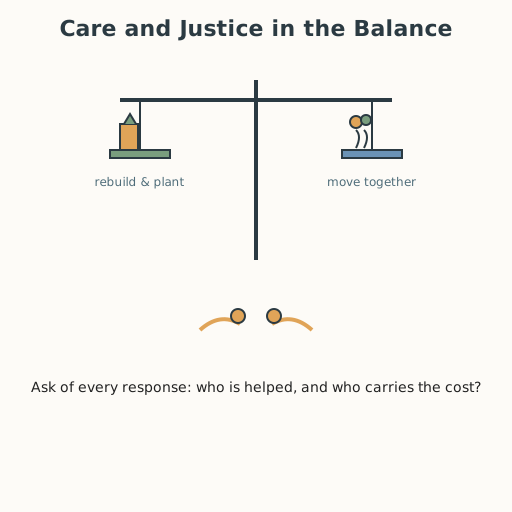
Lesson 12 — Responding with Care and Justice
Summary
When climate change reshapes where people can live, the question turns from what is happening to what should be done. Learners weigh three broad responses — adapting in place, cutting emissions (mitigation), and planned relocation — by asking who each helps and who each burdens. They hold a role circle to feel the same response from different seats, then argue for the response most rooted in care and justice.
Objectives
- Evaluate responses to climate displacement, weighing them against care and justice and naming who each helps and burdens. (D08.S3.11.02)
Connection
When a storm or a drought threatens a neighborhood, someone must choose: shore up the homes where they are, change how we all live so the harm slows, or help people move with dignity. Each choice helps some and burdens others. Weighing those choices fairly — not just efficiently — is what care and justice ask of us.
Materials
- Response evaluation sheet
- History journal
Preparation
- Prepare the three response cards and role cards for the role circle (step 3).
- Retrieval: from Lesson 11, the climate pressures and who is affected.
Facilitator note
The skill to land: weigh a response by who it helps and who it burdens, then judge it by care and justice. The ethics lens: a fair response cares for the people most affected, not only the most convenient. The egalitarian lens: the same response lands differently on a coastal family, a farmer, a planner, and a distant neighbor; good weighing names those differences. The environment lens: mitigation — cutting emissions — addresses the cause, not only the symptom. The global lens: responses vary by region and by resources, and solidarity across distance is part of the picture. The community lens: relocation done with a community, not to it, preserves belonging. Keep the role circle cooperative and respectful; no single answer is required.
Procedure
- Recall (5 min). From Lesson 11: name one climate pressure and who it affects most. Today: what should be done?
- Meet three responses (10 min). (a) Adapt in place — build higher, plant trees, store water, change crops. (b) Mitigate — cut the emissions driving the change, everywhere, especially where they are highest. (c) Planned relocation — help people move with dignity, resources, and community intact. Each helps some and burdens others.
- The role circle (15 min). Take a role — a coastal family, an inland farmer, a town planner, a person in a high-emitting country, a person in a low-emitting one. Weigh one response from each seat aloud. What does each role gain, and what does each give up?
- Evaluate (15 min). On the sheet, weigh two responses against care and justice: who does each help? who does each burden? which is most rooted in care and justice, and why?
- Journal (8 min). Write a short argument: “The most just response is… because…” naming the people it cares for and the burdens it fairly shares.
- Close (2 min). Preview: we now turn from the land to power — the movements that have fought for rights, labor, and liberation.
Differentiation
- Support: Weigh just one response with a “helps / burdens” two-column sheet before writing.
- Extension: Argue the reverse case — defend the response you did not choose — and name its strongest point.
Assessment
- Formative (peer + self): Can the learner weigh a response by who it helps and burdens, and argue for one response on care-and-justice grounds?
- Portfolio artifact (unit): The evaluation sheet and written argument, completing the climate-migration evaluation.
Home connection
Consider one local risk — flood, drought, heat — and one response your community could take. Ask: who would it help, and who would carry the cost?
Resources
- Climate and environment as drivers of displacement and the need for supported responses: IOM Climate Action (S-383).
- The IPCC as the authority on climate-system science: IPCC (S-005).
- Historical emitters versus those most exposed, grounding the justice question: Our World in Data (S-006).