Lesson 13 — Movements for Civil Rights, Labor, and Liberation
Learners compare social movements across three aims and three countries: civil rights (the Montgomery bus boycott, USA, 1955–56, S-324), labor (the Wave Hill walk-off by Gurindji stockworkers, Australia, 1966, S-206), and liberation (Ghana's independence movement under Kwame Nkrumah, S-276). They build a comparison chart of aim, strategy, and effect, and find what movements of very different peoples share.
Objectives
Objectives
- D08.S4.11.01 Compare social movements for civil rights, labor, and liberation across different countries and analyze their strategies and effects.
Essential question
How have movements for civil rights, labor, and liberation differed and what do they share?
Key vocabulary
Materials
Standard materials
- Movement comparison chart · 1 per learner Columns for movement, aim, strategy, and effect, across three cases
- History journal · 1 per learner
Low-tech / no-cost
- Three movement story cards One-paragraph tellings of a civil-rights, a labor, and a liberation movement, read aloud
Enriched / lab & device
- Short archival photos or footage of the three movements (if available) To see the people and places of each struggle
Works in different contexts
- large-group Assign one movement per small group to study, then assemble the shared comparison chart
- multi-age Younger learners retell one movement as a story; older learners compare strategy and effect across the three
- self-directed A learner reads the three cases, fills the chart, and writes what they share
- level-grouped A ready group contrasts a nonviolent movement (S-390) with a labor struggle (S-206) and names the different levers each pulled
- outdoor-only Re-enact one strategy — a march, a walk-off, a boycott line — on open ground and name its aim
Lesson 13 — Movements for Civil Rights, Labor, and Liberation
Summary
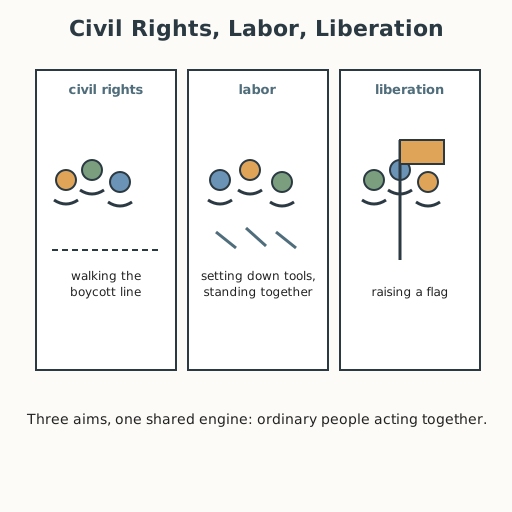
Ordinary people, acting together, have changed the terms of power. Learners compare three movements across three countries and three aims: civil rights — the Montgomery bus boycott in the United States (1955–56), when Black residents refused segregated buses for over a year until the buses were desegregated (S-324); labor — the Wave Hill walk-off in Australia (1966), when Gurindji stockworkers led by Vincent Lingiari struck for fair pay and the return of their land (S-206); and liberation — Ghana’s independence movement under Kwame Nkrumah, which used boycotts, strikes, and nonviolent “Positive Action” until independence on 6 March 1957 (S-276). They compare aim, strategy, and effect.
Objectives
- Compare social movements for civil rights, labor, and liberation across different countries and analyze their strategies and effects. (D08.S4.11.01)
Connection
A group of people who refuse together — to ride, to work, to obey an unjust rule — can do what no single person can. That is the engine of every social movement: not one hero, but many ordinary people making a shared refusal visible and costly to the unjust order.
Materials
- Movement comparison chart
- History journal
Preparation
- Copy the comparison chart; prepare the three movement story cards.
- Retrieval: from Grade 10, that freedom and dignity are ideas that spread and fuel struggles across continents.
Facilitator note
The skill to land: compare movements by aim, strategy, and effect — and by who gained. The egalitarian lens: these are struggles of people denied rights, fair pay, and self-rule, and they center ordinary people, not only leaders. The global lens: the three cases span three continents, and each belongs to its own people’s history — never reduced to a single narrative. The ethics lens: nonviolence and strikes are choices with costs and consequences, and learners weigh them fairly. The community lens: movements are collective, built on mutual support and solidarity. Note that the same strategy (boycott, strike, noncooperation) recurs across very different struggles — a shared human repertoire of resistance.
Procedure
- Recall (5 min). From earlier grades: what is a social movement, and name one you remember. Today we compare three.
- Civil rights (12 min). In Montgomery, Alabama (USA), Black residents boycotted segregated buses for over a year, beginning in December 1955 after Rosa Parks was arrested; the boycott ended in December 1956 when the buses were desegregated (S-324). Fill the chart: aim (equal treatment on buses), strategy (boycott, carpooling, noncooperation), effect (buses desegregated).
- Labor (12 min). At Wave Hill station in Australia (1966), about 200 Gurindji stockworkers and their families, led by Vincent Lingiari, walked off the job seeking fair pay and the return of their land (S-206). Fill the chart: aim (fair pay and land), strategy (walk-off/strike), effect (a landmark step toward land rights).
- Liberation (12 min). In Ghana, Kwame Nkrumah’s Convention People’s Party used boycotts, strikes, and nonviolent “Positive Action” against British colonial rule; Ghana became independent on 6 March 1957 — the first sub-Saharan African colony to do so (S-276). Fill the chart: aim (self-rule), strategy (boycotts, strikes, Positive Action), effect (independence).
- Compare (10 min). With a partner: what do the three share? Where do strategy and aim differ? Who gained, and what was won?
- Journal (4 min). Write one sentence: “Movements differ in aim but share…”
Differentiation
- Support: Work from the pre-filled story cards and a mostly-filled chart.
- Extension: Add a fourth movement (e.g., the 1952 Defiance Campaign in South Africa, S-146) and place it in the comparison.
Assessment
- Formative (peer + self): Can the learner state each movement’s aim, strategy, and effect, and name what the three share?
- Portfolio artifact (unit): The completed comparison chart, as the first half of the social-movements comparison.
Home connection
Ask an adult about a time people acted together to change something — in your family, workplace, or town. Note the aim, the strategy, and what changed.
Resources
- Montgomery bus boycott (USA, 1955–56): Encyclopaedia Britannica (S-324).
- Wave Hill walk-off (Australia, 1966), led by Vincent Lingiari: National Museum of Australia (S-206).
- Kwame Nkrumah and Ghana’s independence (1957): Encyclopaedia Britannica (S-276).