Lesson 03 — What Makes a Life Good?
Learners compare four traditions' answers to the question "what makes a life good?" — Greek *eudaimonia* (flourishing through virtue), Confucian *ren* (benevolence and right relationship), South Asian *dharma* (duty and harmony with one's role), and Buddhist *nirvana* (freedom from suffering). They notice what each values and warns against, and evaluate the accounts without ranking any above another.
Objectives
Objectives
- D09.S1.11.02 Evaluate competing accounts of what a good life or a good society means, drawing on more than one cultural tradition.
Essential question
What does it mean to live a good life, and how do different traditions answer?
Key vocabulary
Materials
Standard materials
- Good-life comparison chart · 1 per learner Four columns (tradition, key idea, what it values, what it warns against) to fill across four traditions
- Justice journal · 1 per learner
Low-tech / no-cost
- Four idea cards on paper One card each for flourishing (eudaimonia), benevolence (ren), duty and harmony (dharma), and freedom from suffering (nirvana), to read and sort
- Paper and pencil To draw the chart by hand
Enriched / lab & device
- Short primary-text excerpts (Aristotle, the Analects, the Bhagavad Gita, a Buddhist sutta) · 1 per group Brief, faithful renderings so learners meet each tradition in its own words, not only in summary
Works in different contexts
- large-group Introduce each tradition briefly whole-class, then small groups each take one and teach it back to the class
- multi-age Younger learners name one thing that makes a life good; older learners compare the four traditions and note where they agree and disagree
- self-directed A learner reads the four cards, fills the chart, and writes which idea most challenges their own view and why
- level-grouped A ready group also asks whether the four traditions can all be right at once, and argues
- outdoor-only Four stations outdoors, one per tradition; learners rotate and jot one phrase from each, then share in a circle
Lesson 3 — What Makes a Life Good?
Summary
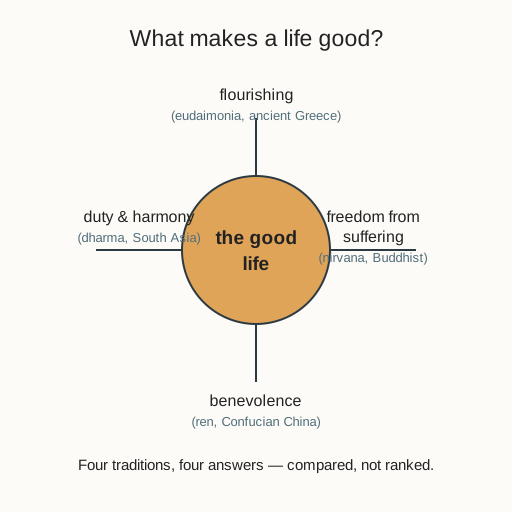
Learners compare four traditions’ answers to the question “what makes a life good?” — Greek eudaimonia (flourishing through virtue), Confucian ren (benevolence and right relationship), South Asian dharma (duty and harmony with one’s role), and Buddhist nirvana (freedom from suffering). They notice what each values and warns against, and evaluate the accounts without ranking any above another.
Objectives
- Evaluate competing accounts of what a good life means, drawing on more than one cultural tradition. (D09.S1.11.02)
Connection
Every culture, and every person, carries some answer to “what makes a life good?” — whether it is spoken aloud or shown in how people spend their days. Is a good life one of comfort, of honor, of usefulness to others, of peace of mind, of freedom? You have almost certainly absorbed an answer from the life around you without ever being asked to name it. This lesson names four old and serious answers from different parts of the world — not to make you choose one, but to let you see your own answer more clearly by setting it beside others.
Materials
- Good-life comparison chart
- Justice journal
- Four idea cards (low-tech: paper)
Preparation
- Copy or draw the comparison chart; prepare the four idea cards.
- Retrieval: from Grade 10 (D09.S1.10.02), critiquing moral arguments for hidden assumptions. Today we compare whole accounts of the good life.
- Prepare plain definitions: eudaimonia (flourishing — a life lived well through practiced virtue, Aristotle); ren (benevolence and right relationship); dharma (duty, rightness, and harmony with one’s role); nirvana (release from suffering and craving). Each is a tradition’s own concept, described faithfully, not judged.
Facilitator note
This lesson is written to the learner (“you”). The idea to land: the question “what makes a life good?” has many serious, ancient answers, and they are not all the same — flourishing through virtue (Aristotle, SEP Virtue Ethics, S-458), benevolence and relationship (Confucius, S-468), duty and harmony (dharma, S-469), and release from suffering (Buddhist ethics, S-467). The methodological point: these are accounts to evaluate, held side by side, none the default and none ranked above another. Do not let the lesson become “which is best?” — the skill is comparison, and the respect is that each tradition is a living answer for real people.
The ethics lens: each account is a claim about what is right and worth pursuing. The egalitarianism lens: no single tradition is treated as the standard against which others are measured — that is itself a fairness commitment. The global lens: these four are drawn from three continents and many centuries, and they stand for many more (Indigenous, Islamic, and other traditions appear in Lesson 4 and beyond). The critical-thinking lens: distinguishing “what a tradition says” (evidence) from “what I think is worth living for” (value). Preview: Lesson 4 asks the same question of whole societies.
Procedure
- Recall (5 min). In Grade 10 you critiqued moral arguments for hidden assumptions. Today: what is one answer to “what makes a life good?” you have heard or felt, from your own life?
- Meet four answers (15 min). Read the four idea cards. Flourishing (eudaimonia) — a life lived well by building virtues through practice (S-458). Benevolence (ren) — a life good through right relationship and care for others (S-468). Duty and harmony (dharma) — a life good by doing what one’s role and order require (S-469). Freedom from suffering (nirvana) — a life good by loosening craving and reaching peace (S-467).
- Fill the chart (12 min). For each tradition, write what it values and what it warns against (e.g., flourishing warns against a life of mere pleasure; benevolence warns against cold self-interest).
- Compare (10 min). With a partner, find one place two traditions agree and one place they disagree. Be precise: is it a real disagreement, or different words for a shared insight?
- Evaluate (8 min). In your justice journal, write which account most challenges your own view and why — not “which is best,” but which makes you think hardest.
- Close (4 min). Say, in your own words, why “the good life” has more than one answer, and why that matters for how we treat people who live differently.
Differentiation
- Support: Work with two of the four traditions and name one value each, leaving the comparison aside.
- Extension: Read a short excerpt from one tradition’s primary text and evaluate how well the summary captures it.
Assessment
- Formative (peer + self): Can the learner name the four accounts, state what each values and warns against, and compare two of them precisely?
- Portfolio artifact (unit): The completed comparison chart with the “what challenges me” reflection, opened in the justice journal.
Home connection
Ask someone at home what they think makes a life good, and which of the four ideas — flourishing, benevolence, duty, or peace — comes closest to their answer. Write one sentence on their answer and one on how it compares to yours.
Resources
- On virtue and flourishing: Stanford Encyclopedia of Philosophy, Virtue Ethics (S-458); on benevolence and relationship: SEP, Confucius (S-468); on duty and harmony: Encyclopaedia Britannica, dharma (S-469); on release from suffering: SEP, Ethics in Indian and Tibetan Buddhism (S-467).
- On worked examples and guided practice for comparison: Kirschner, Sweller & Clark (2006) (S-011).