Lesson 01 — Values, Purpose, and a Meaningful Life
Learners articulate, in their own words, their developing values, purpose, and sense of what a meaningful life looks like for them — three arms of one compass held loosely, not a finished map. This opens the closing portfolio and names the Grade-12 handoff to come.
Objectives
Objectives
- D01.S2.11.01 Articulate their developing values, purpose, and sense of what a meaningful life looks like for them.
Essential question
What are my developing values, purpose, and sense of what a meaningful life looks like for me — and how do I say it in my own words?
Key vocabulary
Materials
Standard materials
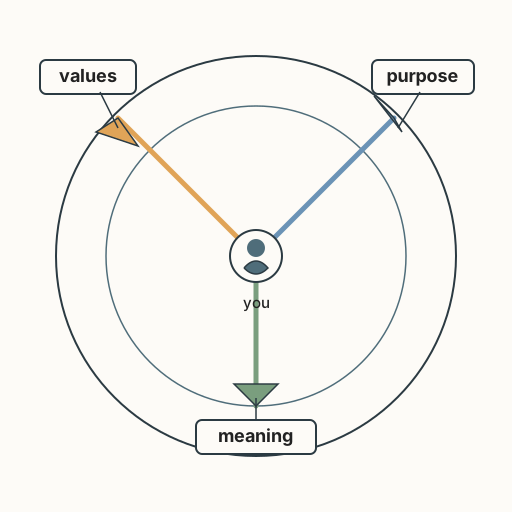
- Values–purpose–meaning compass (SVG) · 1 per learner or projected A compass rose with three labeled arms — values, purpose, meaning — meeting at a center where the learner stands
- Portfolio folder or journal · 1 per learner Where the year's closing artifacts will gather
Low-tech / no-cost
- A large sheet of paper and a pen Draw the compass by hand — three arrows meeting at a center — and write your own words on each arm
- Voice and memory Speak your values, purpose, and sense of meaning aloud to a partner; no writing needed
Enriched / lab & device
- A short audio or video self-recording · 1 per learner Record a two-minute statement of your values, purpose, and meaning for the digital portfolio
Works in different contexts
- large-group Build one shared compass on a board with the whole class's examples, then learners draft their own; pairs read one arm back to each other
- multi-age Younger learners name one value and one thing that gives their day meaning; older learners draft all three arms and argue how they connect
- self-directed A learner drafts the three arms alone, then reads the statement back and circles the arm that feels least certain yet
- level-grouped A ready group adds a counter-consideration — one value they hold that might shift in Grade 12, and why that is fine
- outdoor-only Find three natural objects that stand in for values, purpose, and meaning, place them in a triangle, and explain each to a partner
Lesson 1 — Values, Purpose, and a Meaningful Life
Summary
Learners return to the year’s identity work and name, in their own words, three things that point the way: their values (what they hold as good), their purpose (the direction they are leaning), and their sense of what a meaningful life looks like for them. The three are held as a compass, not a map — a direction to steer by, never a verdict. This is the first artifact of the closing portfolio and the first step toward the Grade-12 handoff.
Objectives
- Articulate my developing values, purpose, and sense of what a meaningful life looks like for me. (D01.S2.11.01)
Connection
Think of the last time you chose one path over another — what to study, who to stand with, how to spend a free hour. Under that small choice there was a value: something you hold as good, even when no one is watching. String a few of those choices together and you begin to see a direction, a purpose. And the kind of life you are quietly aiming toward — that is meaning. Whether you grow up by a river, in a city, on a farm, or between places, these three — what you hold good, where you are leaning, and what a good life looks like to you — are yours to name. This lesson asks you to say them, in your own words, as they stand today.
Materials
- Values–purpose–meaning compass (SVG)
- Portfolio folder or journal
Preparation
- Retrieval cue: from Unit 1 this year (D01.S2.11.01 is anticipated there as “Feelings, Identity & Purpose”), and from Grade 10’s closing unit (the considered position and the whole-person map). Today we add the purpose and meaning arms explicitly.
- Prepare three plain working definitions: a value is something you hold as good; a purpose is the direction your life is leaning, discovered by trying and reflecting; meaning is your sense of what makes a life worth living, in your own terms.
- Model one worked example of the three-arm compass before learners draft their own (worked example first: Kirschner, Sweller & Clark, S-011).
Facilitator note
This lesson is written to the learner (“you”). The idea to land, warmly and without pressure: values, purpose, and meaning are three arms of one compass that the learner holds — developing, revisable, and theirs to steer. Identity is a developing story, not a finished fact (Erikson, S-155); the selves a person imagines becoming — “possible selves” — are the bridge between the present and future motivation (Markus & Nurius, S-399); and a sense of purpose grows by trying, reflecting, and being supported, not by sudden certainty — roughly one in five young people reports a clear sense of purpose, and that is ordinary, not a failure (Damon, S-400). Hold all three as description, and the line “you are allowed not to know yet” as a value we protect.
Hold the four lenses visibly. Ethics: naming what you hold good is the first step of acting on it — values become ethics when they meet real choices. Egalitarianism: no one’s purpose outranks another’s; a purpose may be quiet or loud, near or far, and a meaningful life can look like care for a family or a movement, a craft or a calling. Global/anthropological: what counts as a meaningful life differs across cultures — a life of service, of craft, of kinship, of study, of prayer, of tending land — and no one culture’s answer is the default. Critical-thinking: distinguishing a value you have chosen and tested from one you have merely inherited is an act of careful, honest thought. Model once (S-011), then let learners draft. Keep the tone celebratory; this is the heart of the capstone.
Procedure
- Recall (7 min). Without looking back, name two things you remember from your identity and purpose work this year — a value you named, or a self you imagined becoming. Then check yourself: what did you get right, and what has shifted since?
- Meet the compass (8 min). Look at the graphic: three arms — values, purpose, meaning — meet where you stand. A value is what you hold good; a purpose is the direction you are leaning; meaning is your sense of a life worth living. Which of the three is easiest for you to name today, and which hardest?
- Draft your compass (20 min). Draw the three arms and write on each, in your own words. Values: two or three things you hold as good, with one line on how you know you hold them (a choice you actually made). Purpose: the direction you are leaning right now — and one thing you have tried that helped you discover it. Meaning: one or two sentences on what a good, worthwhile life looks like for you — not for anyone else. Leave room to revise; this is a compass, not a map.
- Read it back (8 min). Read your compass once, quietly or to a partner. Underline the line you feel most certain of, and circle the line you are still deciding. Notice that both can be true at once.
- Close (7 min). Write one sentence that begins: “The life I am learning to steer toward is one where…” Put it at the top of your portfolio. This is page one.
Differentiation
- Support: Provide sentence starters for each arm (“I hold as good…”, “I am leaning toward…”, “A worthwhile life for me looks like…”) and ask for one line each.
- Access (blind / low vision): Describe the compass aloud — three labeled arms meeting at a center where a figure stands — and offer a tactile version: three sticks or cords laid from a central stone in three directions, each labeled by touch.
- Alternative expression (non-writing, non-oral): Build the compass with three found objects placed from a center, and point to each as a partner or pre-printed label names it; the closing sentence may be a chosen symbol or drawing.
- Extension: Add a counter-consideration — one value you might hold differently in Grade 12, and a sentence on why revising it would be growth, not failure.
Assessment
- Formative (self + peer): Can the learner name values, a leaning purpose, and a sense of meaning in their own words — and distinguish the arm they are certain of from the arm they are still deciding?
- Portfolio artifact (unit): The three-arm compass with the closing sentence, as the first page of the closing portfolio.
Home connection
Ask an adult who has known you a long time: “What value do you see me holding, even when I do not say it?” Decide whether what they name belongs on your compass — and whether you agree with it.
Resources
- On identity as a developing, lifelong process: Erikson, Childhood and Society (1950) (S-155).
- On “possible selves” as the bridge from present to future motivation: Markus & Nurius (1986), American Psychologist 41(9), 954–969 (S-399).
- On purpose as something that grows by trying and reflecting, not certainty: Damon (2008), The Path to Purpose (S-400).
- On worked examples and guided practice for a new skill: Kirschner, Sweller & Clark (2006) (S-011).