Lesson 02 — The Purpose Story, Carried into Grade 12
Learners shape their values–purpose–meaning compass into a purpose story with a past, a present, and a Grade-12 chapter — and practice revising it as a living narrative they carry forward, not a verdict to defend. This deepens the values-and-purpose objective and sets up the authorship work of Lesson 3.
Objectives
Objectives
- D01.S2.11.01 Articulate their developing values, purpose, and sense of what a meaningful life looks like for them.
Essential question
How does my developing purpose become a story I carry into Grade 12 — a living narrative, not a verdict?
Key vocabulary
Materials
Standard materials
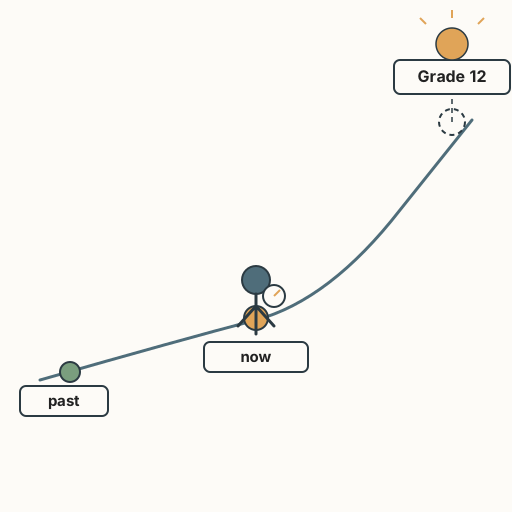
- Purpose-path graphic (SVG) · 1 per learner or projected A winding path from past through now to a dashed summit marked "Grade 12", with the compass from Lesson 1 carried forward
- Writing journal or portfolio · 1 per learner
Low-tech / no-cost
- Paper and pencil Draw the path by hand — past on the left, now in the middle, a dashed Grade-12 summit on the right
- Voice and memory Tell the three-part purpose story (past, now, Grade 12) aloud to a partner
Enriched / lab & device
- A short audio or video self-recording · 1 per learner Tell the purpose story in your own voice for the digital portfolio
Works in different contexts
- large-group Model one complete worked example aloud, then learners draft in pairs and read one line back to the group
- multi-age Younger learners tell past and now; older learners add the Grade-12 chapter and the evidence for it
- self-directed A learner drafts the story alone, reads it aloud once, and revises the line that felt least true
- level-grouped A ready group adds a counter-consideration — one way the Grade-12 chapter might surprise them, and how they would respond
- outdoor-only Walk a real path in three stages — past, now, the summit ahead — and speak one sentence at each stop
Lesson 2 — The Purpose Story, Carried into Grade 12
Summary
Learners take the compass from Lesson 1 and shape it into a purpose story — a narrative identity that links the past (what shaped their values), the present (where their purpose now stands), and a Grade-12 chapter (where they mean to take it). They practice revising it, discovering that a purpose is a living story they hold loosely, not a verdict to defend. This is the handoff bridge into Grade 12, the capstone year of integration.
Objectives
- Shape my developing values, purpose, and sense of meaning into a revisable story with reasons for the Grade-12 chapter. (D01.S2.11.01)
Connection
A purpose written in pencil can be revised; a purpose carved in stone cannot. Think of a path you once thought led nowhere that later led somewhere — the direction was not wrong, the map was just drawn too early. Your purpose is the same kind of thing: not a wall you are trapped inside, but a trail you keep redrawing as you walk. The question this lesson asks is not “what is my one fixed destiny?” but “where is my purpose leaning now, and what chapter do I mean to write next year?” — knowing the chapter can surprise you.
Materials
- Purpose-path graphic (SVG)
- Writing journal or portfolio
Preparation
- Retrieval cue: from Lesson 1, the three-arm compass; from Grade 10’s closing unit, the past–now–next story. Today we add the dimension of time and a named Grade-12 horizon.
- Prepare the three-part frame: past (what shaped my values), now (my purpose, in one or two sentences), Grade 12 (one chapter I mean to write next year, and why I believe it — my evidence).
- Note the Grade-12 summit this strand builds toward: an integrated sense of who I am, what I value, and how I will act (D01.S2.12.01), and authoring my identity within global, cultural, and technological forces rather than being defined by them (D01.S2.12.02).
Facilitator note
This lesson is written to the learner (“you”). The idea to land: purpose is not a verdict but a story — a narrative identity linking past, present, and an imagined future — and the learner is its author, free to revise it. Narrative identity (McAdams, S-404) and “possible selves” (Markus & Nurius, S-399) are the descriptive research; a sense of purpose grows by trying and reflecting, and only a minority of young people hold a clear one, which is ordinary rather than deficient (Damon, S-400). Identity is a lifelong process, not a finished fact (Erikson, S-155). Hold all of this as description; “you are allowed to revise, and ‘I don’t know yet’ is a complete answer” is a value we protect.
Hold the four lenses visibly. Ethics: revising your purpose is an act of honesty toward yourself — it keeps your story true. Egalitarianism: no one’s Grade-12 chapter is more “correct”; a purpose may be quiet or loud, and a meaningful life can look many ways. Global/anthropological: in many traditions the self is told as a story that belongs to a people and a place, not only to an individual — invite learners to tell it their way, solo or communal. Critical-thinking: the Grade-12 chapter must carry a reason — evidence from what you have tried, not a wish — and distinguishing the two is the thinking skill at stake. Model the three-part frame once (S-011), then let learners draft. Keep it warm.
Procedure
- Recall (7 min). From Lesson 1, what was the closing line of your compass? Now add time: every purpose has a past (what shaped it), a now (where it stands), and a next (where it is going). Say which of the three feels easiest to name, and which hardest.
- See the path (8 min). Look at the purpose-path graphic: past on the left, now in the middle, and a dashed summit on the right marked “Grade 12.” The dashed line means the summit is open — you are allowed to climb toward it without knowing every step.
- Draft your purpose story (20 min). Write three short paragraphs. Past: one thing — a person, a place, an experience — that shaped your values. Now: your purpose, one or two sentences, in your own words. Grade 12: one chapter you mean to write next year, and one reason you believe it (your evidence — something you have tried, noticed, or come back to).
- Revise it (8 min). Read your story aloud once, quietly or to a partner. Find the line that felt least true, and change it. Notice that revising did not break the story — it made it more yours.
- Close (7 min). Under your story write: “This purpose is mine, and mine to revise.” Add it to your portfolio — it is your Grade-12 letter to yourself.
Differentiation
- Support: Provide three sentence starters — “My values were shaped by…”, “My purpose now leans toward…”, “In Grade 12 I want to write a chapter where…” — and ask for one line each.
- Access (blind / low vision): Describe the path aloud — past on the left, now in the middle, a dashed Grade-12 summit on the right — and offer a tactile path of three stones laid left, middle, and right that the learner can walk.
- Alternative expression (non-writing, non-oral): Tell the past–now–Grade-12 story by placing three found objects in a row and pointing to each, or by drawing three scenes; a partner may scribe only if the learner chooses.
- Extension: Add a counter-consideration — one way the Grade-12 chapter might surprise you, and how you would respond if it did.
Assessment
- Formative (self + peer): Can the learner link past, present, and a reasoned Grade-12 chapter, and revise the story when a line does not feel true?
- Portfolio artifact (unit): The three-part purpose story with the closing line, kept in the portfolio.
Home connection
Tell one adult your Grade-12 chapter and the reason you believe it. Ask them what they were leaning toward at your age — and whether their purpose, too, kept revising.
Resources
- On narrative identity as a revisable life story: McAdams (2001), Review of General Psychology 5(2), 100–122 (S-404).
- On “possible selves” as the bridge to future motivation: Markus & Nurius (1986) (S-399).
- On purpose growing by trying and reflecting, not certainty: Damon (2008) (S-400).
- On identity as a lifelong process: Erikson (1950) (S-155).
- On the Grade-12 summit this strand builds toward: D01.S2.12.01 and D01.S2.12.02 in
curriculum/standards/domains/domain-01-self-and-identity/domain.md. - On worked examples and guided practice: Kirschner, Sweller & Clark (2006) (S-011).