Lesson 03 — Authoring My Project: A Commitment I See Through
Learners take authorship of a personal project or commitment and build a four-step loop — commit, plan, act, check and adjust — to see it through with self-direction into Grade 12. They learn that authorship is a loop they steer, not a single heroic leap, and that "not yet" is information, never a verdict.
Objectives
Objectives
- D01.S3.11.02 Take authorship of a personal project or commitment and see it through with self-direction.
Essential question
How do I take authorship of a personal project or commitment and see it through with self-direction into Grade 12?
Key vocabulary
Materials
Standard materials
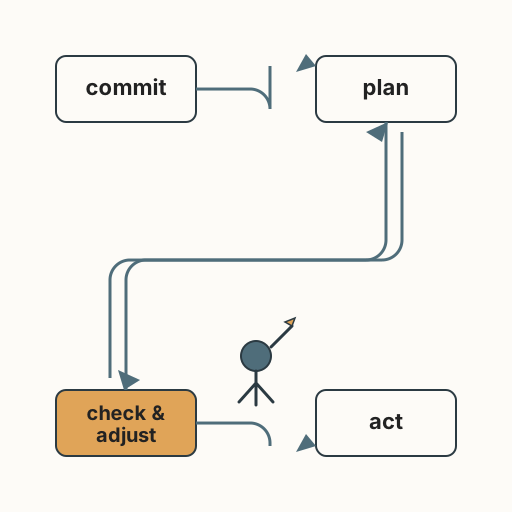
- Authorship loop graphic (SVG) · 1 per learner or projected A four-step loop — commit, plan, act, check and adjust — steered by the learner as author
- A one-page project plan · 1 per learner Commitment, plan, milestones, progress checks, and a fallback ready in advance
Low-tech / no-cost
- Paper folded into four panels One panel each for commit, plan, act, and check-and-adjust
- Voice and a partner Plan the four steps aloud and have a partner ask the checking question
Enriched / lab & device
- A shared digital document or planner app · 1 per learner To keep the plan live and revise it across Grade 12
Works in different contexts
- large-group Model one full worked example, then learners plan individually and pairs check each other's progress-check step
- multi-age Younger learners choose a commitment and one milestone; older learners add a progress check, a fallback, and an accountability partner
- self-directed A learner completes the four steps alone, then reads the plan back and asks how it will know the work is going
- level-grouped A ready group adds a second milestone, a fallback resource, and a named moment to ask for help
- outdoor-only Plan the project like a journey — name a destination (commitment), a route (plan), and a landmark where you will look back and check
Lesson 3 — Authoring My Project: A Commitment I See Through
Summary
Learners take the purpose they articulated in Lessons 1–2 and attach it to something real: a personal project or commitment they will author and see through. They build a four-step loop — commit, plan, act, check and adjust — and learn that authorship is a loop they steer, not a single heroic leap. This is the D01.S3.11.02 artifact of the capstone and the bridge to the self-directed life goal of Grade 12 (D01.S3.12.01).
Objectives
- Take authorship of a personal project or commitment and see it through with self-direction. (D01.S3.11.02)
Connection
Think of the last thing you built or stuck with on your own — a piece of music, a repair, a skill, a habit, a cause you kept showing up for. You did not wait for permission; you picked a commitment, planned a way in, acted, and checked whether it was working. That is authorship, and you already do it. This lesson names that skill and puts it on a four-step loop, so you can steer one real commitment into Grade 12 — and beyond — on purpose instead of by accident.
Materials
- Authorship loop graphic (SVG)
- A one-page project plan
Preparation
- Retrieval cue: from Grade 10’s closing unit, the four-step learning plan (choose a goal, find resources, check progress, adjust); from this unit’s Lessons 1–2, the purpose and its Grade-12 chapter. Today we attach the purpose to one real commitment.
- Prepare one worked example of the four-step authorship loop.
- Note the Grade-12 summit: exercising self-directed agency by setting, planning, and acting on a meaningful life goal with autonomy and accountability (D01.S3.12.01).
Facilitator note
This lesson is written to the learner (“you”). The idea to land: authorship is a four-step loop — commit, plan, act, check and adjust — and the learner is the author at every step. Specific, checkable commitments outperform vague wishes (Locke & Latham, S-223); checking progress (self-testing) is one of the strongest learning techniques we know (Dunlosky et al., S-039; Roediger & Karpicke, S-228); and the “check and adjust” step is where mastery lives — “not yet” is information, never a verdict (Dweck, S-096 — held honestly: growth-mindset effects are real but modest, and effort is not a guarantee).
The ethics lens: a commitment you can check honestly is a commitment you can be trusted with — including by yourself. The egalitarian lens: resources are not evenly distributed — a plan that names a fallback (a person, a free library, a neighbor’s skill) works for more lives than one that assumes money and devices. The global lens: self-paced, low-resource schooling (Escuela Nueva, S-008) and teaching at the learner’s level (TaRL, S-009) show that self-direction works across very different places — it is not a privilege of the few. The critical-thinking lens: distinguishing a checkable milestone from a vague hope is careful thought, not opinion. Distinguish evidence from values: the loop and the power of checking progress are descriptive; “every learner deserves to steer their own work” is a value we hold. Model the loop once (S-011), then let learners plan.
Procedure
- Recall (7 min). When you stuck with something on your own this year, what did you do first, and how did you know it was working? Name the steps you already use — today we give them names.
- Meet the loop (8 min). Look at the authorship-loop graphic. The four steps — commit, plan, act, check and adjust — repeat, like walking. A commitment that cannot be checked is only a wish; a check tells you the truth so you can steer.
- Author your plan (20 min). On your one-page plan, write: (a) Commit — one real project or commitment, tied to your purpose, phrased so you could tell if you got there. (b) Plan — at least two resources: a person, a place, a skill, a tool; name a fallback if the first fails. (c) Act — the first concrete step you can take this week, however small. (d) Check and adjust — a milestone, a small test, a thing you can do or show; and what you will change if the check says “not yet.”
- Peer-check (8 min). Trade plans with a partner. Ask them one question: “How will you know it is working?” Help them make the check specific — and offer to be their accountability partner.
- Close (7 min). Read your plan once and circle the step you feel strongest in. Put it in your portfolio — it is your Grade-12 commitment to yourself.
Differentiation
- Support: Provide a sentence starter for each step (“I commit to…”, “I can draw on…”, “My first step is…”, “I will know it is working when…, and if not I will…”).
- Access (blind / low vision): Describe the loop aloud — commit, plan, act, check and adjust — and offer four folded-paper panels or cards the learner can touch in order.
- Alternative expression (non-writing, non-oral): Build the plan with four cards or found objects placed in order and pointed to; a partner reads each label and the learner confirms with a nod, gesture, or pointing.
- Extension: Add a second milestone and a note on how you will seek help at the right moment — balancing independence with asking, the skill Grade 12 asks you to sustain.
Assessment
- Formative (self + peer): Can the learner state a specific commitment, two resources with a fallback, a first step, and a concrete progress check with an adjustment?
- Portfolio artifact (unit): The one-page project plan, as the self-direction artifact of the capstone.
Home connection
Show your plan to an adult and ask them to be one of your resources — or to name someone they know who could help. A commitment with a person in it travels further than one alone.
Resources
- On why specific, checkable commitments outperform vague wishes: Locke & Latham (1990) (S-223).
- On retrieval practice and self-testing as high-utility techniques: Dunlosky et al. (2013), Psychological Science in the Public Interest 14(1) (S-039); Roediger & Karpicke (2006) (S-228).
- On “not yet” as information rather than verdict: Dweck, Mindset (2006) (S-096) — held honestly, with the replication cautions.
- On self-paced, low-resource schooling across contexts: Escuela Nueva (S-008); Pratham Teaching at the Right Level (S-009).
- On the Grade-12 summit this strand builds toward: D01.S3.12.01 and D01.S3.12.02 in
curriculum/standards/domains/domain-01-self-and-identity/domain.md. - On worked examples for new skills: Kirschner, Sweller & Clark (2006) (S-011).