Lesson 04 — Strengthening Belonging: A Contribution I Can Plan
Learners envision and plan a contribution that strengthens belonging in a community they care about — naming who is on the edge of the circle and why, and designing one concrete contribution with a first step. This is the D02.S3.11.02 artifact and the bridge to the nested-communities summit of Grade 12.
Objectives
Objectives
- D02.S3.11.02 Envision and plan a contribution that strengthens belonging in a community they care about.
Essential question
How do I envision and plan a contribution that strengthens belonging in a community I care about?
Key vocabulary
Materials
Standard materials
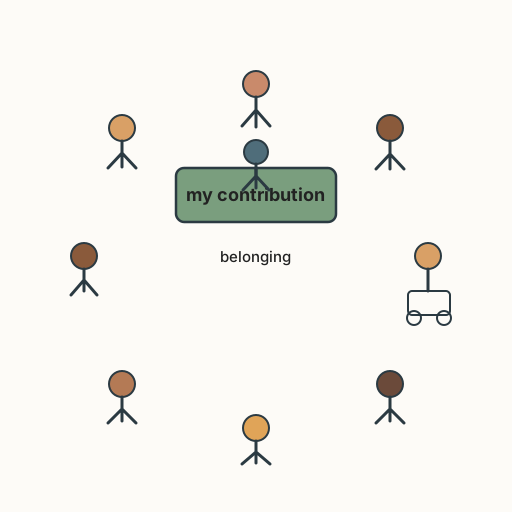
- Belonging-circle graphic (SVG) · 1 per learner or projected A ring of people with a gap, and a single person placing one labeled contribution that closes the circle
- Writing journal or portfolio · 1 per learner
Low-tech / no-cost
- Chalk or a stick to draw a circle in the ground Draw a circle, leave a gap, and stand in the gap to plan one contribution that closes it
- Voice and discussion Name one community you care about, who is on the edge of it, and one thing you could do to draw them in
Enriched / lab & device
- A map or photo of the community (paper or digital) · 1 per pair To ground the plan in the real place and its real edges
Works in different contexts
- large-group Build one shared belonging circle on a board and name its edges whole-class, then learners plan their own contribution in pairs
- multi-age Younger learners name one community and one contribution; older learners analyze who is on the edge and why, then plan a contribution with a first step
- self-directed A learner chooses one community, names who is on its edge, and writes a one-page contribution plan with a first step
- level-grouped A ready group adds a second edge — a person or group whose belonging is limited by structure, not by effort — and plans for it
- outdoor-only Stand in a circle with one gap; one person steps into the gap and says a contribution they would make; the circle closes
Lesson 4 — Strengthening Belonging: A Contribution I Can Plan
Summary
Learners pick a community they actually care about and plan one contribution that strengthens belonging in it. The core move is honest: belonging is a circle with edges, and edges are not random. Learners name who is on the edge and why — then design a contribution that draws people in, with a first step they can take. This is the D02.S3.11.02 artifact and the bridge to the Grade-12 summit of nested communities from family to the global community of all life (D02.S3.12.01).
Objectives
- Envision and plan a contribution that strengthens belonging in a community I care about. (D02.S3.11.02)
Connection
Every group you belong to — a family, a neighborhood, a team, a faith or cultural community, an online circle, a workplace — has an edge. Some people stand inside it easily; others hover at the edge, half in and half out, because of language, money, ability, age, or simply because no one has reached for them yet. Belonging is not a given; it is something people build, one welcome at a time. This lesson asks you to look at one circle you care about, see its edge honestly, and plan one contribution that strengthens the circle — a small act, planned carefully, is enough to begin.
Materials
- Belonging-circle graphic (SVG)
- Writing journal or portfolio
Preparation
- Retrieval cue: from Grade 10’s closing unit, the nested-communities chain (local, regional, national, global); from Unit 3 this year (Relationships, Community & Solidarity), who is in and who is out. Today we turn analysis into a plan.
- Prepare the working frame: belonging = being inside a circle where you are known, valued, and able to act; contribution = an action, not a feeling, that strengthens the circle.
- Note the Grade-12 summit: articulating my place within nested communities, from family to the global community of all life (D02.S3.12.01), and weighing belonging, solidarity, and collective responsibility in deciding how to act (D02.S3.12.02).
Facilitator note
This lesson is written to the learner (“you”). The idea to land: belonging is not a given — it is built, and it has edges; a contribution is a planned action that draws people in, and naming who is on the edge is the honest first step. The descriptive research: even arbitrary group assignment triggers in-group favoritism, so “who is in and who is out” runs deeper than intention (Tajfel’s minimal-group work, S-232); and a community’s boundaries are often imagined and built rather than natural (Anderson, S-415, on the nation as an “imagined community” — held as description, not insult). The inclusion ideal — that settings should treat difference as ordinary rather than deficient and remove barriers so every person is valued — is a value we hold (UNESCO, S-158; used as a value frame, not a factual claim).
The egalitarian lens is central: notice whose belonging is limited by structure — a stair where there could be a ramp, a language only some speak, a cost some cannot meet — not by effort. The ethics lens: a contribution is a promise to act, and it should be kept small and doable. The global/anthropological lens: communities take many shapes — village, diaspora, chosen family, movement — and no shape is the default or the best; the circle is one map, not the only one. The critical-thinking lens: distinguishing a real edge (who is actually left out) from a comfortable guess (who we assume is fine) is careful description, not opinion. Model one worked example (S-011), then let learners plan. Hold the tone hopeful — a small, specific contribution is enough to begin.
Procedure
- Recall (7 min). Name one community you belong to and care about. Then ask: who is at the center of that circle, and who hovers at the edge? Say one name or one kind of person for each.
- See the circle (8 min). Look at the belonging-circle graphic: a ring with a gap. Belonging has edges, and edges are not random — language, money, ability, age, or simply not being reached for can put a person at the edge. A contribution is the block that closes the gap.
- Name the edge honestly (12 min). Choose one community you care about. Write: who is at the center, who is at the edge, and why — is the edge about structure (a barrier) or about reaching (no one has reached yet), or both? Be specific; “everyone is welcome” usually hides a real edge.
- Plan the contribution (15 min). Design one contribution that strengthens belonging. Write: (a) what you will do (an action, not a feeling); (b) who it draws in; (c) how it removes a barrier or extends a welcome; (d) the first step you can take this week. Keep it small enough to actually do.
- Close (8 min). In your portfolio, finish: “The circle I want to strengthen is ___, and one way I can draw someone in is ___.” This is your belonging artifact.
Differentiation
- Support: Provide a fill-in frame — “In my ___, the center is ___, the edge is ___, and one thing I could do to draw people in is ___.”
- Access (blind / low vision): Describe the circle aloud — a ring of people with a gap, one figure placing a contribution block into the gap — and offer a tactile circle of stones with one gap the learner can close with a final stone.
- Alternative expression (non-writing, non-oral): Close a real gap in a circle of people or objects, and point to the person (or stone) you would draw in as a partner reads the prompts; the plan may be spoken or drawn.
- Extension: Plan for a structural edge — one barrier (a stair, a cost, a language) your contribution could remove or soften, and how you would check it actually worked.
Assessment
- Formative (self + peer): Can the learner name a community, its center and its edge, and design a specific, first-stepped contribution that strengthens belonging?
- Portfolio artifact (unit): The belonging-circle contribution plan, as the community artifact of the capstone.
Home connection
Ask an elder or neighbor: “Who do you remember being left at the edge of a community, and what drew them in — or what could have?” Add what you learn to your plan.
Resources
- On in-group/out-group dynamics and their habit-driven nature: Tajfel (1970, 1971) (S-232).
- On community boundaries as imagined and built, not natural: Benedict Anderson, Imagined Communities (1983) (S-415).
- On inclusion and belonging as a value: UNESCO, “Learning to Live Together” (S-158) — held as a value frame, not a factual claim.
- On the Grade-12 summit this strand builds toward: D02.S3.12.01 and D02.S3.12.02 in
curriculum/standards/domains/domain-02-relationships-and-community/domain.md. - On worked examples for new skills: Kirschner, Sweller & Clark (2006) (S-011).