Lesson 03 — Responding with Wisdom, Not Reaction
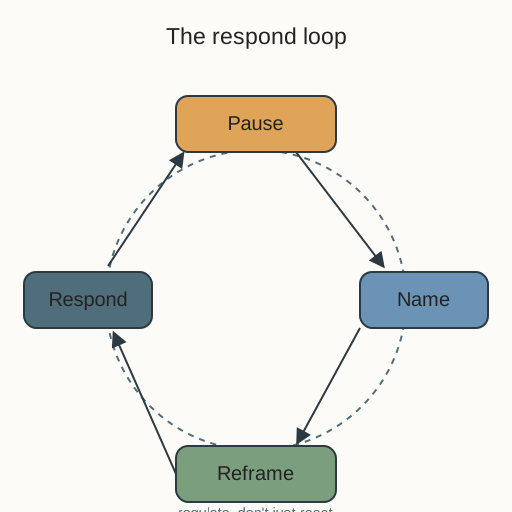
Learners build a concrete skill for emotionally charged personal moments: the respond loop — **Pause, Name, Reframe, Respond.** They learn that a feeling can be regulated without being suppressed, that how we interpret a moment shapes the feeling it produces, and that wisdom means choosing a response that carries insight and care. They rehearse the loop on everyday heated moments and self-check their responses.
Objectives
Objectives
- D01.S1.12.02 Respond to complex, emotionally charged personal and global situations with insight, care, and emotional wisdom.
Essential question
When a situation is emotionally charged, how do I respond with insight and care instead of mere reaction?
Key vocabulary
Materials
Standard materials
- Respond loop card · 1 per learner A four-step card — Pause, Name, Reframe, Respond — with a worked example on the back
- Charged-moment slips · 1 set per pair Everyday heated moments (a harsh message, a public correction, an unfair accusation, a friend's sudden anger) to practice the loop on
Low-tech / no-cost
- Paper and pencil To draw the loop and write out one worked response
- Voice and breath The pause step can be practiced as one slow breath before speaking — no materials needed
Enriched / lab & device
- One plain-language page on the appraisal model · 1 per pair A short page on how thoughts and interpretations shape emotion (the cognitive-appraisal idea), to ground the "reframe" step
Works in different contexts
- large-group Model the loop on one whole-class example, then pairs rehearse one slip each, then a few perform for feedback
- multi-age Younger learners practice only Pause and Name; older learners run all four steps and critique each other's responses
- self-directed A learner works the loop on two slips alone and writes a response for each, then checks it against the "insight and care" test
- level-grouped A ready group also distinguishes *suppressing* a feeling from *regulating* it, and argues which is healthier and why
- outdoor-only The four steps become four physical stations; walk the loop, pausing (and breathing) at each before answering
Lesson 3 — Responding with Wisdom, Not Reaction
Summary
Learners build a concrete skill for emotionally charged personal moments: the respond loop — Pause, Name, Reframe, Respond. They learn that a feeling can be regulated without being suppressed, that how we interpret a moment shapes the feeling it produces, and that wisdom means choosing a response that carries insight and care.
Objectives
- Respond to a complex, emotionally charged personal situation with insight and care, using a deliberate loop instead of raw reaction. (D01.S1.12.02)
Connection
Think of the last time a message, a look, or a correction hit you like a wave — and you answered before you had finished feeling it. Maybe the answer was right; maybe it made the moment worse. The difference between reacting and responding is not that responding people feel less. It is that they give the feeling a short, deliberate route to travel before it becomes words or actions. That route is learnable — and this lesson teaches it.
Materials
- Respond loop card
- Charged-moment slips
- Paper and pencil (low-tech)
- Appraisal-model page (enriched)
Preparation
- Copy or draw the respond loop card; prepare the charged-moment slips.
- Retrieval: from Lesson 1, the compass/fog check; from Grade 11 (D01.S1.11.02), naming areas of emotional strength and growth. Today we turn insight into a practiced response.
- Prepare a worked example of the loop (model it once before guided practice: Kirschner, Sweller & Clark, S-011). Plain definitions: regulation is managing a feeling’s shape and route — not deleting it; appraisal is the interpretation that sits between an event and the feeling it produces (Beck, S-159); reframe is trying on a truer, kinder interpretation.
Facilitator note
This lesson is written to the learner (“you”). The idea to land: response is a skill, not a personality trait. Emotion can be regulated — its expression managed and its interpretation examined — and regulation is distinct from suppression, which decouples the felt emotion from the outward show at a cost (Gross, S-225). The appraisal idea — that a thought or interpretation shapes the feeling an event produces — is a well-established account, offered descriptively (Beck, S-159), not as therapy and not as a command to feel differently.
The ethics lens: a response that carries insight and care is partly an ethical claim — about what the other person is owed even when I am upset. The egalitarianism lens: who is expected to stay composed and who is allowed to be “passionate” is not even across people; regulation is a skill everyone deserves to learn, never a demand placed only on some. The global lens: how much feeling may be shown, and to whom, varies by culture (display rules) — the loop is a tool, not one culture’s script for “calmness.” The critical-thinking lens: the reframe step is a check on the accuracy of my own interpretation, not a trick to feel good.
Safeguarding: slips are everyday, one-step-removed moments. Do not require any learner to disclose their own conflicts. If a learner brings up real distress, honor it and redirect to support, not to the exercise.
Procedure
- Recall (5 min). From Lesson 1: what is the one question to ask a strong feeling before acting (compass or fog)? Today we build the whole route from feeling to response.
- Meet the loop (10 min). Work the model example together (S-011): a harsh, one-line message arrives. Pause — one slow breath, no typing yet. Name — what do I feel? (hurt and defensive). Reframe — what else might be true? (they may be tired, or misread my words; this may not be about me). Respond — now choose words that carry insight and care.
- Practice the loop (15 min). In pairs, take a charged-moment slip and walk all four steps out loud. Let your partner pause you at “Respond” and ask: does this carry insight and care?
- Distinguish regulate from suppress (8 min). Argue briefly: what is the difference between managing a feeling and swallowing it? Why does swallowing it tend to cost more later?
- Write your own response (10 min). Pick the slip that felt hardest. Write a response you would actually send or say, using all four steps.
- Close (5 min). Say the loop in your own four words, and name the step you find hardest.
Differentiation
- Support: Practice only Pause and Name; for Respond, choose from two pre-written options and say why one carries more care.
- Extension: Rehearse a second response to the same moment from two different relationships (a friend vs. a stranger), and explain how the loop changes.
Assessment
- Formative (peer + self + performance): Can the learner walk all four steps, distinguish regulating from suppressing, and produce a response that passes the “insight and care” test?
- Portfolio artifact (unit): The written response with the loop annotated, kept in the capstone journal.
Home connection
Next time a heated moment comes up at home, try to Pause–Name–Reframe–Respond before answering. Afterwards, write one sentence on which step helped most.
Resources
- On emotion regulation (and the cost of suppression): Gross, The Emerging Field of Emotion Regulation (S-225).
- On interpretation shaping emotion (appraisal): Beck, Cognitive Therapy and the Emotional Disorders (S-159).
- On worked examples for a new skill: Kirschner, Sweller & Clark (2006) (S-011); on spaced retrieval: Dunlosky et al. (2013) (S-039).