Lesson 04 — Caring at a Distance
Learners practice responding to large, emotionally charged global situations with care that stays clear and useful. They learn the difference between **empathic concern** (feeling for another, which moves us to act) and **personal distress** (feeling swamped, which turns us inward), and they notice **numbing** — the way care can fade when a problem feels too big. They map one real situation onto their circles of reach and commit to one concrete action.
Objectives
Objectives
- D01.S1.12.02 Respond to complex, emotionally charged personal and global situations with insight, care, and emotional wisdom.
Essential question
How do I respond to large, emotionally charged global situations with care that stays clear-headed and useful?
Key vocabulary
Materials
Standard materials
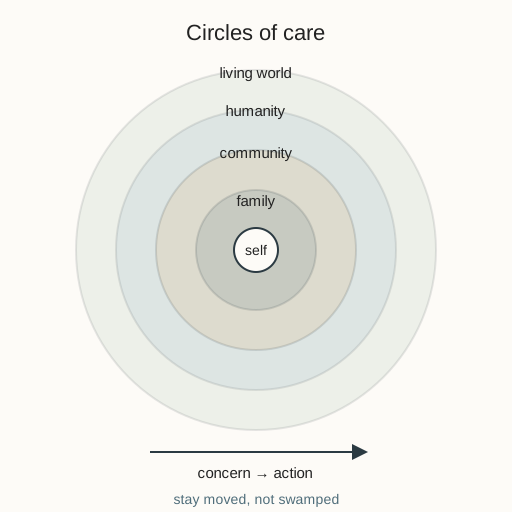
- Circles-of-care map · 1 per learner Concentric circles (self, family, community, humanity, living world) with a space to note one real, charged global situation and one useful response at each reach
- Global situation cards · 1 set per pair Four real, emotionally charged global situations (a flood displacing families, a war forcing people from home, a species going extinct, a strike for fair wages) described factually and gently
Low-tech / no-cost
- Paper and pencil To draw the circles by hand and write one response
- The news, told aloud The facilitator describes one global situation in two sentences, so no printed cards are needed
Enriched / lab & device
- One plain-language page on empathic concern vs. distress · 1 per pair A page distinguishing feeling *for* another (concern that moves to help) from feeling *swamped by* another's pain (distress that turns inward), to ground the response step
Works in different contexts
- large-group Read one situation whole-class and build the circles map together, then pairs each take a second situation
- multi-age Younger learners name one feeling the people affected might have; older learners map responses at each circle and argue which is most useful
- self-directed A learner chooses one situation, fills the map alone, and writes one concrete action they could actually take this month
- level-grouped A ready group also analyzes when feeling turns to numbing (too big to feel) and how to keep care active without being swamped
- outdoor-only Draw the circles in the ground and stand in each ring while naming what you could do from there
Lesson 4 — Caring at a Distance
Summary
Learners practice responding to large, emotionally charged global situations with care that stays clear and useful. They learn the difference between empathic concern (feeling for another, which moves us to act) and personal distress (feeling swamped, which turns us inward), and they notice numbing — how care can fade when a problem feels too big. They map one real situation onto their circles of reach and commit to one concrete action.
Objectives
- Respond to a complex, emotionally charged global situation with insight, care, and emotional wisdom, choosing action over being swamped. (D01.S1.12.02)
Connection
You live in a time when a flood, a war, or a strike on the other side of the world arrives on your screen before breakfast. The feeling it raises is real — and it is easy for that feeling to go one of two unhelpful ways: it can wash over you and then drain away into “too big, not my problem,” or it can swamp you until you look away entirely. Emotional wisdom at this scale is not feeling less. It is feeling in a way that keeps you able to act.
Materials
- Circles-of-care map
- Global situation cards
- Paper and pencil (low-tech)
- Empathic concern vs. distress page (enriched)
Preparation
- Copy or draw the circles-of-care map; prepare the global situation cards, kept factual and gentle (no graphic imagery — see Facilitator note).
- Retrieval: from Lesson 3, the respond loop; from Grade 11 (D01.S2.11.02), what we owe people unlike ourselves. Today we scale the loop up to the world.
- Prepare plain definitions (model once: Kirschner, Sweller & Clark, S-011): empathic concern is other-oriented feeling that moves us to help; personal distress is self-oriented feeling of being overwhelmed by another’s pain — two different responses with different consequences (Batson, S-230). Numbing is the fading of feeling when a problem’s scale exceeds what we can hold.
Facilitator note
This lesson is written to the learner (“you”). The idea to land: care at a distance needs a route to action, or it turns into distress or numbness. The concern-versus-distress distinction is well evidenced — other-oriented empathic concern motivates helping, while self-oriented distress motivates escape (Batson, S-230); empathy is a real, well-studied route to prosocial behavior, and it is not automatic (Decety & Cowell, S-231). Hold this as description, not as a demand that learners feel a prescribed way about distant suffering.
The ethics lens: whether and how to respond to distant suffering is a question of what we owe strangers. The egalitarianism lens: whose suffering gets noticed and whose gets forgotten is uneven — proximity, race, and wealth shape whose crisis becomes “the” crisis. The global lens: this is the global lens, made practical — a flood in one river valley, a drought in another, a strike in one city, all real and all different. The critical-thinking lens: verify what you are told about a distant crisis before your feeling commits you to a response.
Safeguarding: describe situations factually and gently; no graphic or gratuitous detail; always connect to agency (something the learner can do). If a learner has a lived connection to a crisis, let them speak only if they choose, and hold it as honored experience, not a case study.
Procedure
- Recall (5 min). From Lesson 3: what are the four steps of the respond loop? Today we use them on situations too big for one person.
- Meet concern vs. distress (10 min). Work a model example (S-011): a flood displaces thousands of families. Feeling for them (concern) makes you ask “what can I do from here?” Feeling swamped by the images (distress) makes you want to close the screen. Both are real; only one keeps you able to act. Name the third danger: numbing — the feeling fading because the scale is too big.
- Map a situation (15 min). In pairs, take a global situation card. On the circles map, note one useful, real response at each reach: what I can feel and understand (self), what I can do with family and community, and what I can support toward humanity and the living world.
- Argue the useful response (8 min). Which single response is both possible and useful, rather than merely symbolic? Defend your choice.
- Commit to one action (10 min). Write one concrete action you can actually take this month — a donation, a letter, a shift in what you buy, a conversation — and one sentence on how you will keep care from curdling into numbness.
- Close (5 min). Say, in one sentence, the difference between being moved and being swamped — and which one lets you help.
Differentiation
- Support: Name one feeling the affected people might have and one small thing you could do, leaving the full map for later.
- Extension: Research the situation’s facts in two sources and check them against each other before writing your action (two-source check).
Assessment
- Formative (peer + self): Can the learner distinguish concern from distress, name numbing, map a response at multiple reaches, and commit to a concrete, useful action?
- Portfolio artifact (unit): The completed circles-of-care map with the committed action, kept in the capstone journal.
Home connection
Pick one global situation and, with someone at home, find one real thing your household could do together. Write one sentence on what you decided.
Resources
- On empathic concern vs. personal distress: Batson, Fultz & Schoenrade (1987) (S-230).
- On empathy as a route to prosocial behavior (not automatic): Decety & Cowell (S-231).
- On worked examples for a new skill: Kirschner, Sweller & Clark (2006) (S-011); on spaced retrieval: Dunlosky et al. (2013) (S-039).