Lesson 05 — The Moral Judgment Lab
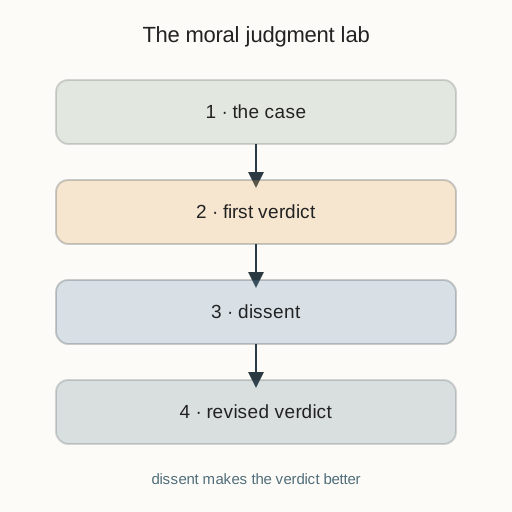
Learners run a full, deliberate moral judgment on a single complex, emotionally charged case — the week's capstone. They gather the three inputs (reasons, feeling, evidence), form a first verdict, *surface a dissent*, and then revise. The lesson makes visible that good judgment is a process with a revision step, not a single flash of certainty.
Objectives
Objectives
- D01.S1.12.01 Integrate emotional understanding into ethical judgment, recognizing how emotion informs and can bias moral reasoning.
- D01.S1.12.02 Respond to complex, emotionally charged personal and global situations with insight, care, and emotional wisdom.
Essential question
How do I run a full, fair moral judgment — with feeling seated at the table — on a complex, charged situation?
Key vocabulary
Materials
Standard materials
- Judgment lab frame · 1 per learner A one-page organizer — the case, the three inputs (reasons, feeling, evidence), the first verdict, the dissent, the revised verdict — for a full deliberation
- Case study · 1 per learner A single complex, age-appropriate case that brings together ethical weight and emotional charge (see Facilitator note)
Low-tech / no-cost
- Paper and pencil To draw the lab frame and write out the deliberation by hand
- The case, read aloud The facilitator reads the case twice, so no printed copies are needed
Enriched / lab & device
- One short page on dissent in good decisions · 1 per pair A plain-language page on why surfacing disagreement (rather than smoothing it over) improves decisions, to frame the dissent step
Works in different contexts
- large-group Deliberate the case in small panels, then a whole-class round shares each panel's revised verdict and the dissent that improved it
- multi-age Younger learners contribute what each person in the case might feel; older learners run the full lab and vote only after the dissent step
- self-directed A learner works the frame alone, writes a first and revised verdict, and invents their own dissent to check against
- level-grouped A ready group also writes the *principle* their verdict implies and tests it against a second, slightly different case
- outdoor-only The steps become four stations around the space; move through the case, first verdict, dissent, and revised verdict in turn
Lesson 5 — The Moral Judgment Lab
Summary
Learners run a full, deliberate moral judgment on a single complex, emotionally charged case — the week’s capstone. They gather the three inputs (reasons, feeling, evidence), form a first verdict, surface a dissent, and then revise. The lesson makes visible that good judgment is a process with a revision step, not a single flash of certainty.
Objectives
- Integrate emotional understanding into ethical judgment across a full deliberation, and respond with insight and care under emotional charge. (D01.S1.12.01, D01.S1.12.02)
Connection
Real moral decisions are rarely made in a clean instant. A committee weighing whether to close a polluting factory that employs a whole town, a family deciding who to tell a painful truth, a student council deciding a penalty for a friend — each one starts with a strong first feeling, meets reasons and facts, hears a disagreement, and only then lands. Today you practice landing that way, slowly and on purpose, so that when a real decision arrives without warning you already know the route.
Materials
- Judgment lab frame
- Case study
- Paper and pencil (low-tech)
- Dissent page (enriched)
Preparation
- Copy the judgment lab frame; prepare the case study — one case that is ethically weighty and emotionally charged but one step removed from learners’ private lives. A reliable shape: a scarce resource, a competing duty, and a real cost no matter the choice (e.g., a hospital with one ventilator, a scholarship between two worthy students, a community deciding whether to allow a factory that both pays and pollutes). Avoid cases that map directly onto a learner’s likely trauma.
- Retrieval: the whole week — compass/fog (L1), the triangle (L2), the respond loop (L3), concern vs. distress (L4). Today: run them all at once.
- Model the frame’s four stages once (Kirschner, Sweller & Clark, S-011).
Facilitator note
This lesson is written to the learner (“you”). The idea to land: judgment is a deliberation with a revision step, and dissent is an asset, not a threat. Surfacing disagreement improves decisions — which is why the frame forces a dissent before the final verdict. Emotion sits in the deliberation as an input (Lerner et al., S-333; Decety & Cowell, S-231), never as the whole verdict.
The ethics lens: the case is an ethics question, and the verdict is a claim about what is right. The egalitarianism lens: require learners to name whose voice is weakest in the case and what the verdict does to that person. The global lens: note that the same case, read in a different culture’s moral tradition, might weight the inputs differently — and that is data, not a mistake. The critical-thinking lens: the dissent step is a check on premature certainty; the revision step is a check on stubbornness.
Safeguarding: use the provided case or an equivalent kept one step removed. Do not require disclosure of personal trauma. If learners grow heated, that is the material — name it and return to the frame rather than adjudicating their private disputes.
Procedure
- Recall the week (5 min). In pairs, retrieve the week’s four tools: compass/fog, the judgment triangle, the respond loop, and concern vs. distress. Say each in one phrase.
- Read the case (8 min). Hear or read the case twice. Quietly, note your first feeling — name it precisely (RULER, S-015) — but do not announce a verdict yet.
- Gather the inputs (12 min). On the lab frame, list reasons (consequences, duties), feeling (yours and each person’s), and evidence (what you can verify; what you cannot).
- Form the first verdict (8 min). Write it in one sentence, with the single strongest reason and the single strongest feeling behind it.
- Surface the dissent (8 min). In your panel, one person argues against the verdict — as fairly and strongly as they can. Write down the best point the dissent made.
- Revise (10 min). Write your revised verdict. It may be the same or different — say what the dissent changed, and what feeling added that reason alone would have missed.
- Close (4 min). In one sentence: what did the revision step do that a single flash of certainty would not have?
Differentiation
- Support: Complete reasons + feeling only, and revise by choosing between two provided verdicts with reasons.
- Extension: Write the principle your verdict implies, then test it against a second, slightly different case — does it still hold? Revise if it does not.
Assessment
- Summative + portfolio (unit): The completed judgment lab frame — inputs, first verdict, dissent, revised verdict — as a capstone artifact of emotional-moral judgment.
- Formative (peer + self): Could the learner name all three inputs, host a fair dissent, and explain what revision changed?
Home connection
Summarize the case to someone at home in two sentences (no names, real or invented), and ask what their verdict would be and why. Write one sentence on where they differed from you.
Resources
- On emotion as input to (and possible bias in) judgment: Lerner, Li, Valdesolo & Kassam (2015) (S-333).
- On empathy and moral behavior: Decety & Cowell (S-231).
- On precise labeling of feeling: RULER approach, Yale Center for Emotional Intelligence (S-015).
- On worked examples: Kirschner, Sweller & Clark (2006) (S-011); on spaced retrieval across the week: Dunlosky et al. (2013) (S-039).