Lesson 06 — One Self, Across Contexts
Learners open the identity arc by articulating an integrated self — who they are, what they value, and how they will act — and then testing whether that self holds together across the different contexts of a real life. They name a through-line that stays constant, and they meet the idea that identity is an evolving story, not a finished fact.
Objectives
Objectives
- D01.S2.12.01 Articulate an integrated sense of who they are, what they value, and how they will act, holding together across contexts.
Essential question
Who am I, and how do I hold one self together across different contexts?
Key vocabulary
Materials
Standard materials
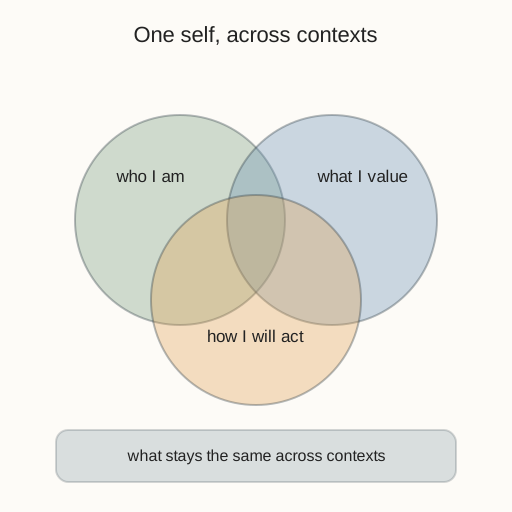
- Self-map template · 1 per learner A three-column organizer — who I am, what I value, how I will act — with a fourth column for 'what stays the same across contexts'
- Context cards · 1 set per pair Six contexts (home, school or work, friends, online, a place of worship or community, a job interview) to test whether the self holds together across them
Low-tech / no-cost
- Paper and pencil To draw the self-map by hand and write one through-line sentence
Enriched / lab & device
- One plain-language page on narrative identity · 1 per pair A short page on the idea that we build a life story linking past, present, and future — offered as a descriptive theory, not a required genre
Works in different contexts
- large-group Brainstorm the three columns whole-class, then individuals each write their own map and one through-line
- multi-age Younger learners fill only "who I am"; older learners complete all four columns and argue about what stays the same
- self-directed A learner completes the map alone and writes one sentence naming the single thing that holds them together across contexts
- level-grouped A ready group also distinguishes the *core* self from the *roles* they play, and argues which parts are truly constant
- outdoor-only Three marked zones for the three columns; stand in each, speak one answer, then step back and name what remained the same
Lesson 6 — One Self, Across Contexts
Summary
Learners open the identity arc by articulating an integrated self — who they are, what they value, and how they will act — and then testing whether that self holds together across the different contexts of a real life. They name a through-line that stays constant, and they meet the idea that identity is an evolving story, not a finished fact.
Objectives
- Articulate an integrated sense of who they are, what they value, and how they will act, and hold it together across contexts. (D01.S2.12.01)
Connection
You are not the same person in every room — you speak one way at home, another with friends, another at a job interview. That is not hypocrisy; it is the ordinary art of living in many contexts at once. The question identity asks is the opposite one: is there something underneath that is the same in every room? Most people who live with a settled sense of who they are can name a few constants — values and commitments that do not change with the audience. Today you look for your constants.
Materials
- Self-map template
- Context cards
- Paper and pencil (low-tech)
- Narrative identity page (enriched)
Preparation
- Copy or draw the self-map template; prepare the context cards.
- Retrieval: from Grade 11 (D01.S2.11.01), articulating values and what a meaningful life looks like. Today we add the capstone turn: integration across contexts.
- Prepare plain definitions (model once: Kirschner, Sweller & Clark, S-011): an integrated self is one whose parts — identity, values, actions — are consistent enough to be the same person across situations. Narrative identity is the idea that we make sense of ourselves through an evolving life story linking past, present, and future (McAdams, S-404) — offered as a descriptive account, never a required genre, and explicitly not a claim that a story must be tidy (a learner may feel fragmented or uncertain, and “I don’t know yet” is a complete answer).
Facilitator note
This lesson is written to the learner (“you”). The idea to land: an integrated self is a set of constants — values and commitments — that hold across contexts, not a rigid sameness in every room. Identity is a developing, lifelong process, not a finished fact (Erikson, S-155); the “life story” account is one well-supported way to describe how we knit that process together (McAdams, S-404). Hold both as description, and never as a verdict: this unit must never hand a learner a label.
The ethics lens: the “how I will act” column is an ethical claim — about what kind of person one intends to be. The egalitarianism lens: some contexts let people show their full self and others force parts of it into hiding; the cost of that hiding is not evenly distributed. The global lens: what “the same person” means varies by culture — some traditions center the individual self, others center the self-in- relationship; neither is the default. The critical-thinking lens: testing whether something is truly constant across contexts is a check on self-description, not a performance of consistency.
Safeguarding: nothing here requires disclosure of trauma, family secrets, or marginalized identities. If a learner’s “contexts” include real danger or precarity, allow them to write about any contexts they choose, or none, and honor silence.
Procedure
- Recall (5 min). From Grade 11: what did you name as your values and your sense of a meaningful life? Today we ask whether those hold across every room you enter.
- Meet the three columns (10 min). Work the frame together (S-011): who I am (facts, roles, identities), what I value (the commitments that guide me), how I will act (what I do because of those values). A facilitator example: “I am a sister and a student; I value honesty; so I will not copy a friend’s exam even when it is tempting.”
- Build your map (12 min). Fill the three columns for yourself, in your capstone journal.
- Test across contexts (12 min). Draw a context card. Ask: in this room, which of my columns stay the same and which shift? After three cards, name the parts that never shifted.
- Write the through-line (8 min). Write one sentence that names the constant: “In every room, I am still the person who ___.”
- Close (5 min). Say why a through-line is a center you return to, not a cage — and why “I don’t know yet” is also a complete answer.
Differentiation
- Support: Fill only “who I am” and “what I value,” and name one thing that is the same at home and with friends.
- Extension: Write the through-line, then test it against a future context you expect to enter (university, a first job, a new city) and revise it.
Assessment
- Formative (peer + self): Can the learner fill all three columns and name at least one genuine constant across contexts?
- Portfolio artifact (unit): The self-map with the through-line sentence, kept in the capstone journal (a seed for Lesson 10’s statement).
Home connection
Ask someone at home what one thing about them stays the same in every room. Write it down and compare it to your own through-line.
Resources
- On identity as a lifelong, developing process: Erikson, Childhood and Society (S-155).
- On narrative identity as an evolving life story: McAdams, The Psychology of Life Stories (S-404).
- On worked examples: Kirschner, Sweller & Clark (2006) (S-011); on spaced retrieval: Dunlosky et al. (2013) (S-039).