Lesson 11 — A Goal Worth Pursuing
Learners open the purpose arc by imagining possible selves — the person they hope to become, fear becoming, and expect to become — and deriving from them a candidate life goal. They test that goal against four questions (is it mine, meaningful, reachable, and worth its cost?) and choose one to carry into the planning lesson. The lesson holds that purpose grows by trying and reflecting, not by sudden certainty.
Objectives
Objectives
- D01.S3.12.01 Exercise self-directed agency by setting, planning, and acting on a meaningful life goal with autonomy and accountability.
Essential question
How do I choose a life goal that is genuinely mine — meaningful, reachable, and worth the cost of pursuing it?
Key vocabulary
Materials
Standard materials
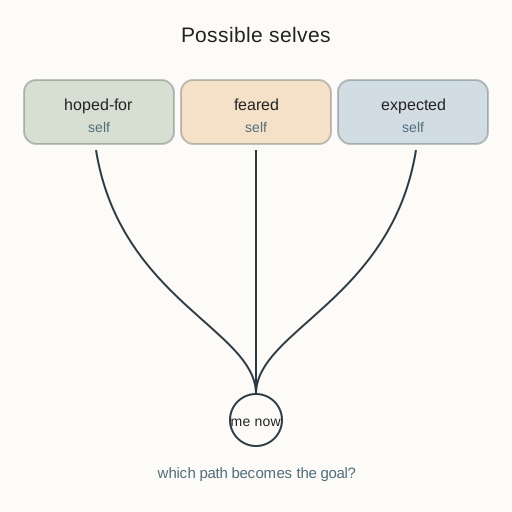
- Possible-selves map · 1 per learner Three diverging paths from a present self — the self I hope to become, the self I fear becoming, the self I expect to become — each ending in a possible goal
- Goal test cards · 1 set per pair Four questions to test a candidate goal: Is it mine or borrowed? Is it meaningful to me? Is it reachable in steps? Am I willing to pay its cost?
Low-tech / no-cost
- Paper and pencil To draw the map and test one goal by hand
Enriched / lab & device
- One plain-language page on purpose · 1 per pair A short page on how a sense of purpose grows by trying and reflecting (not sudden certainty), and that it is not rare to lack one yet
Works in different contexts
- large-group Brainstorm possible selves whole-class, then individuals each draw their three paths and test one goal
- multi-age Younger learners name one thing they hope to become; older learners complete the map and run all four goal tests
- self-directed A learner draws the map alone, tests three candidate goals against the four questions, and chooses one to carry forward
- level-grouped A ready group also distinguishes a goal *for me* from a goal *for others' approval*, and argues how to tell them apart
- outdoor-only Three paths marked on the ground from a starting point; stand on each and name the self at its end
Lesson 11 — A Goal Worth Pursuing
Summary
Learners open the purpose arc by imagining possible selves — the person they hope to become, fear becoming, and expect to become — and deriving from them a candidate life goal. They test that goal against four questions (is it mine, meaningful, reachable, and worth its cost?) and choose one to carry into the planning lesson. The lesson holds that purpose grows by trying and reflecting, not by sudden certainty.
Objectives
- Exercise self-directed agency by choosing a meaningful life goal that is genuinely their own. (D01.S3.12.01)
Connection
Ask a hundred people your age what they want to do and most will give you a job title borrowed from a parent, a feed, or a fear. A meaningful goal is different: it is something you would still care about if no one praised you for it, something that pulls you forward even when it is hard. The strange fact is that very few people your age feel certain of their purpose — and that is normal, not a failure. Purpose is not found fully formed; it is grown by trying, reflecting, and being supported along the way.
Materials
- Possible-selves map
- Goal test cards
- Paper and pencil (low-tech)
- Purpose page (enriched)
Preparation
- Copy or draw the possible-selves map; prepare the goal test cards.
- Retrieval: from Grade 11 (D01.S2.11.01), values and what a meaningful life looks like; from Lesson 10, the integrated self statement. Today the statement gains a direction.
- Prepare plain definitions (model once: Kirschner, Sweller & Clark, S-011): a possible self is a self a person imagines becoming — hoped-for, feared, or expected (Markus & Nurius, S-399); a meaningful goal is one that is genuinely one’s own and worth its cost; purpose is a stable, self-chosen direction that grows by exploration and reflection, not sudden certainty (Damon, S-400).
Facilitator note
This lesson is written to the learner (“you”). The idea to land: a meaningful goal is chosen, tested, and worth its cost — and not having one yet is normal, not a deficit. Possible selves are the bridge between the present self and future motivation (Markus & Nurius, S-399). Purpose grows by trying, reflecting, and being supported, and only a minority of young people report a clear sense of it — so the lesson must relieve pressure, not add it (Damon, S-400).
The ethics lens: what makes a goal worth pursuing is partly an ethical question — what it does for others, not only for oneself. The egalitarianism lens: the menu of possible selves is not the same length for everyone — a goal is only genuinely “mine” if I chose it among real options, and some learners have had fewer; honor that rather than moralizing about ambition. The global lens: what counts as a worthy goal — a trade, a calling, a role in family, a craft — varies across cultures; none is the default or the “higher” path. The critical-thinking lens: the four tests are a check that separates a borrowed goal from an authored one.
Safeguarding: no learner is required to commit publicly or to reveal a feared self rooted in trauma. Feared selves may stay private; the map’s feared path can be drawn lightly or left as “one I’d rather not name.”
Procedure
- Recall (5 min). From Lesson 10: what is your integrated self statement? Today it gains a direction — a goal worth walking toward.
- Meet possible selves (10 min). Work a model example (S-011): from “me now,” three paths — the self I hope to become (a healer, a builder), the self I fear becoming (a person who gave up), the self I expect to become (the likely next step). Notice each path ends in a possible goal.
- Draw your map (12 min). In your capstone journal, draw your three paths and name the self at each end. (The feared path may stay private or light.)
- Test a candidate goal (12 min). Choose one goal implied by your hoped-for or expected path. Run the four tests: Is it mine or borrowed? Is it meaningful to me? Is it reachable in steps? Am I willing to pay its cost?
- Choose (8 min). Write the goal you will carry into tomorrow’s planning lesson, and one sentence on which test it passed most easily and which was hardest.
- Close (5 min). Say why “I don’t know yet” is a fine place to begin a search for purpose — and what small thing would be worth trying this month.
Differentiation
- Support: Draw only the hoped-for and expected paths, and test one goal against just two questions (“mine?” and “meaningful?”).
- Extension: Name a feared self that is motivating (the person you refuse to become) and derive one goal from refusing it.
Assessment
- Formative (peer + self): Can the learner imagine hoped-for/feared/expected selves, test a candidate goal against the four questions, and choose one with reasons?
- Portfolio artifact (unit): The possible-selves map and chosen goal, kept in the capstone journal (feeds Lesson 12’s plan).
Home connection
Ask someone at home what goal they most wanted at your age and whether it stayed theirs or was borrowed. Write one sentence on what you learned about choosing.
Resources
- On possible selves as a bridge to future motivation: Markus & Nurius, Possible Selves (S-399).
- On purpose growing by exploration and reflection (and its rarity at this age): Damon, The Path to Purpose (S-400).
- On worked examples: Kirschner, Sweller & Clark (2006) (S-011); on spaced retrieval: Dunlosky et al. (2013) (S-039).