Lesson 10 — The Integrated Self Statement
Learners consolidate the identity arc into a single written artifact: the integrated self statement. Drawing on the week's work — the through-line, the value-action map, the authoring map, and the "what I keep" list — they draft, peer-check, and revise a statement of who they are, what they value, how they will act, and how they author themselves within the forces around them.
Objectives
Objectives
- D01.S2.12.01 Articulate an integrated sense of who they are, what they value, and how they will act, holding together across contexts.
- D01.S2.12.02 Explain how they author their identity within global, cultural, and technological forces rather than being defined by them.
Essential question
How do I write, in my own words, who I am, what I value, how I will act, and how I author myself within the forces around me?
Key vocabulary
Materials
Standard materials
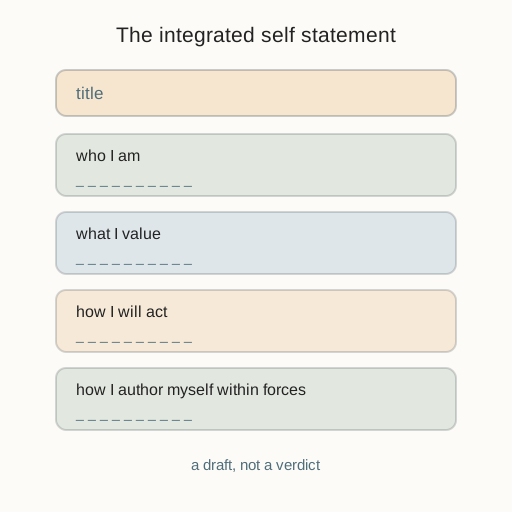
- Statement frame · 1 per learner A one-page organizer with four prompts — who I am, what I value, how I will act, and how I author myself within forces — and a space for a title
- Peer-check guide · 1 per pair Three questions a partner asks: Is it specific? Does it hold across contexts? Does it sound like you and no one else?
Low-tech / no-cost
- Paper and pencil To write the statement by hand and read it aloud
Enriched / lab & device
- One plain-language page on writing a life story · 1 per pair A short page on narrative identity as an evolving story, to frame the statement as a draft of a living document, not a final verdict
Works in different contexts
- large-group Draft individually, then read one line each in a circle; the class notes what a strong line does
- multi-age Younger learners write only "who I am" and "what I value"; older learners complete all four prompts and the title
- self-directed A learner drafts the statement alone, revises against the three questions, and files it as a portfolio artifact
- level-grouped A ready group also writes the statement in two registers — plain and one-sentence distilled — and compares them
- outdoor-only Draft on paper, then read the title aloud to the group; the space itself becomes the audience
Lesson 10 — The Integrated Self Statement
Summary
Learners consolidate the identity arc into a single written artifact: the integrated self statement. Drawing on the week’s work — the through-line, the value-action map, the authoring map, and the “what I keep” list — they draft, peer-check, and revise a statement of who they are, what they value, how they will act, and how they author themselves within the forces around them.
Objectives
- Articulate an integrated sense of self held across contexts, and explain how they author identity within global, cultural, and technological forces. (D01.S2.12.01, D01.S2.12.02)
Connection
A capstone is a place where scattered work becomes one thing. This week you wrote a through-line, named a value-action gap, mapped what you inherited and what you chose, and listed what no feed decides. Left separate, those are notes. Woven together, they become something you can carry: a short statement, in your own words, of who you are and how you intend to live. People in every culture mark the passage to adulthood with some version of this — a vow, a naming, a commitment. Today you write yours as a draft, not a verdict.
Materials
- Statement frame
- Peer-check guide
- Paper and pencil (low-tech)
- Life-story page (enriched)
Preparation
- Copy or draw the statement frame; prepare the peer-check guide.
- Retrieval: the identity arc — Lesson 6 (through-line), Lesson 7 (value-action map), Lesson 8 (authoring map), Lesson 9 (what I keep). Today they become one document.
- Prepare a model statement (worked example first: Kirschner, Sweller & Clark, S-011), and hold the frame explicitly as a draft of a living story, never a final verdict — identity is an evolving process (Erikson, S-155), and an “I don’t know yet” line is welcome.
Facilitator note
This lesson is written to the learner (“you”). The idea to land: the integrated self is written, and it is written as a draft — a living story, not a verdict. Identity is a lifelong, developing process (Erikson, S-155), and a life story is how people knit past, present, and future together (McAdams, S-404); both are offered as description. The statement is a capstone artifact, not a test of who is “more” integrated.
The ethics lens: “how I will act” makes the statement an ethical commitment, not only self-description. The egalitarianism lens: every self is honored as a whole in the making — no statement is better than another, and no learner’s identity is graded against a template. The global lens: the form (a written statement) is one culture’s shape for this; other traditions mark the same passage with a vow, a song, a naming — none is the default, and learners may adapt the form. The critical-thinking lens: the peer-check’s three questions are a check for specificity, consistency, and authenticity — exactly the habits the unit trains.
Safeguarding: the statement may include anything a learner chooses to include; nothing is required about trauma, family, or marginalized identity. A learner may write it privately or share one line only. The artifact belongs to the learner.
Procedure
- Recall the week (5 min). In pairs, retrieve the four pieces: your through-line (L6), your value-action commitment (L7), your kept/revised/refused (L8), your “what I keep” list (L9).
- Meet the frame (8 min). Read the model statement (S-011). Notice it answers four prompts: who I am, what I value, how I will act, how I author myself within forces. A strong line is specific and sounds like no one else.
- Draft (15 min). Write your statement in your capstone journal — four lines and a title. Write freely; revision comes next.
- Peer-check (10 min). Exchange with a partner. Ask the three questions: Is it specific? Does it hold across contexts? Does it sound like you? Mark one line to strengthen.
- Revise (10 min). Rewrite the one line your partner marked, and read the whole statement once aloud, quietly or to your partner.
- Close (5 min). Say why this document is a draft you will revisit, not a cage — and why “I don’t know yet” can live inside it too.
Differentiation
- Support: Write only “who I am” and “what I value,” with the title, and revise one line.
- Extension: Distill the statement to a single sentence you could say from memory, and test whether it holds in a future context you expect to enter.
Assessment
- Summative + portfolio (unit): The integrated self statement (draft), filed as a capstone artifact in the capstone journal.
- Peer + self: Did the learner answer all four prompts, respond to the three questions, and make a visible revision?
Home connection
Read your statement (or one chosen line) to someone at home. Write one sentence on their reaction and one on how the statement felt to say aloud.
Resources
- On identity as a lifelong process: Erikson, Childhood and Society (S-155).
- On narrative identity as an evolving life story: McAdams, The Psychology of Life Stories (S-404).
- On worked examples: Kirschner, Sweller & Clark (2006) (S-011); on spaced retrieval across the unit: Dunlosky et al. (2013) (S-039).