Lesson 03 — The Stress Wave and the Return to Calm
Learners map the body's stress system — the sympathetic "stress wave" that readies the body for danger and the parasympathetic "return to calm" that settles it — and learn that trouble comes not from the wave but from a wave that never turns off. They practice a slow, long-exhale breath and name three personal tools for helping the body return to calm, adding a regulation skill to their growing framework.
Objectives
Objectives
- D03.S1.12.01 Integrate the body-mind connection into a personal framework for lifelong awareness and wellbeing, and explain it to others.
Essential question
How does the body's stress system work, and how do I help it return to calm when it stays on too long?
Key vocabulary
Materials
Standard materials
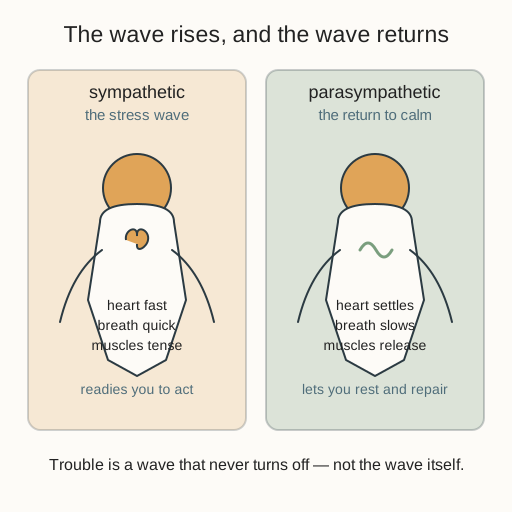
- Stress-and-calm two-panel · 1 per learner A two-panel organizer — "stress wave" (sympathetic) and "return to calm" (parasympathetic) — with a space to list personal calm-returning tools
Low-tech / no-cost
- Paper and pencil To draw the two-panel diagram by hand when no printed organizer is available
Enriched / lab & device
- One plain-language page on the autonomic nervous system · 1 per pair A short page on the sympathetic and parasympathetic branches and the costs of chronic stress, to ground the physiology
Works in different contexts
- large-group Build the two lists (stress signs, calm signs) whole-class, then pairs each name one personal tool for returning to calm
- multi-age Younger learners name one body sign of stress and one of calm; older learners trace a full stress wave → return cycle and explain the physiology
- self-directed A learner draws the two panels, lists three personal calm tools, and writes one sentence on what happens when the wave does not turn off
- level-grouped A ready group distinguishes acute stress (helpful, brief) from chronic stress (wearing) and argues why the difference matters
- outdoor-only Run or step quickly until the heart rises, then practice a slow, long-exhale breath and notice the return to calm in real time
Lesson 3 — The Stress Wave and the Return to Calm
Summary
Learners map the body’s autonomic nervous system: the sympathetic branch that raises the stress wave (faster heart, quicker breath, tensed muscles — the fight–flight–freeze response) and the parasympathetic branch that returns the body to calm (APA, S-338; Cleveland Clinic, S-339). They learn that the wave itself is not the enemy — it readies the body for real danger — and that harm comes from chronic stress, a wave that never turns off. They practice a slow, long-exhale breath and name three personal tools for returning to calm.
Objectives
- Explain the stress response and the return to calm, and practice at least one regulation skill, building toward a personal framework. (D03.S1.12.01)
Connection
A car swerves toward you and, before you think, your heart is pounding and your muscles are ready. That is your body doing its job — the stress wave readies you to act. The trouble begins when the wave never switches off: when the danger is not a car but a deadline, a debt, a message, a news feed — and your body stays braced for hours, days, years. Learning how the wave works, and how to help it return to calm, is not about being “relaxed.” It is about a body that can switch back on time so it can rest, repair, and be ready for the next real thing.
Materials
- Stress-and-calm two-panel
- Autonomic-nervous-system summary (enriched)
Preparation
- Copy or draw the stress-and-calm two-panel.
- Retrieval: from Grade 8 (D03.S1.08.01), the nervous system sensing and responding; from Lesson 2, reading the body’s signals. Today we add the physiology of the wave and its off-switch.
- Prepare a plain definition: the sympathetic branch raises the stress wave; the parasympathetic branch returns the body to calm (worked example first: Kirschner, Sweller & Clark, S-011).
Facilitator note
This lesson is written to the learner (“you”). The idea to land, held as description, never as a claim that stress is a personal failing: the stress wave is an adaptive response; chronic stress — when the response does not turn off — carries real costs (muscle tension, cardiovascular strain, sleep and mood disruption) (APA, S-338). The wave is raised by the sympathetic branch and settled by the parasympathetic branch (Cleveland Clinic, S-339); a slow, long-exhale breath is one evidence-supported way to help the return to calm (Harvard Health, S-340). Offer these as one scientific account among others, and hold breathing practices from many traditions (pranayama, qigong, and others) side by side without ranking them.
The ethics lens: the skill of returning to calm lets us act on choice rather than alarm, which is also kinder to the people around us. The egalitarianism lens: who gets to rest is not even across lives — some people live under constant stress through no fault of their own, and the fix is partly social, not only personal technique. The global lens: calm-returning practices are found in many traditions and languages, so no single method is the default. The critical-thinking lens: not every racing heart means danger, and not every calm means safety — we read signals in context. The technology lens: screens, feeds, and constant alerts are among the most common reasons the stress wave never fully switches off — a body braced for messages, not for danger — so returning to calm includes learning when to put the device down. Preview: Lesson 4 assembles the framework so far into something you can carry and explain.
Procedure
- Recall (5 min). From Lesson 2: name one precise signal you read in your own body. Today we learn the system behind that signal.
- Meet the wave (10 min). Work a model example first (S-011): the near-miss car. List what the body does (heart up, breath quick, pupils wide, muscles tense) — that is the sympathetic stress wave, readied in an instant. Now name the return: slow breath, settled heart, released muscles — the parasympathetic branch.
- Trace the loop (10 min). With a partner, trace one real stress moment from your week: what raised the wave, what your body did, and how (or whether) it came back down. Name where it got stuck, if it did.
- Practice the return (8 min). Together, practice a slow, long-exhale breath: in for a short count, out for a longer one, a few rounds. Notice one thing that settles.
- List your tools (12 min). In your journal, list three personal tools that help your body return to calm (breath, movement, music, water, rest, a person, a place). Write one sentence on when you would use each.
- Close (5 min). Say, in your own words, why “stress is the enemy” is the wrong sentence — and what the truer one is.
Differentiation
- Support: Name one stress sign and one calm sign, and practice the long-exhale breath once, leaving the physiology vocabulary aside.
- Extension: Research one breathing or body practice from a tradition you know (pranayama, qigong, box breathing, and others) and compare its claims with the evidence you met today.
Assessment
- Formative (peer + self): Can the learner name the two branches, describe the wave and the return, and list one personal calm tool with a sense of when to use it?
- Portfolio artifact (unit): The completed stress-and-calm two-panel with the three-tool list, filed in the journal.
Home connection
Teach someone at home the long-exhale breath and ask them what they noticed. Write one sentence about what happened and one about when in your shared day such a tool might be useful.
Resources
- On the stress response and the costs of chronic stress: American Psychological Association, Stress effects on the body (S-338).
- On the sympathetic/parasympathetic branches: Cleveland Clinic, What Happens During Fight-or-Flight (S-339).
- On breath control helping the return to calm: Harvard Health, Relaxation techniques (S-340).
- On worked examples for a new skill: Kirschner, Sweller & Clark (2006) (S-011); on retrieval and spacing: Dunlosky et al. (2013) (S-039).