Lesson 04 — A Framework I Can Carry and Explain
Learners assemble the unit's first three lessons into a single four-spoke framework — notice, name, regulate, reflect — and practice carrying it and explaining it in plain words to another person. This is the unit's first capstone artifact: a written lifelong body–mind framework the learner can pass on.
Objectives
Objectives
- D03.S1.12.01 Integrate the body-mind connection into a personal framework for lifelong awareness and wellbeing, and explain it to others.
Essential question
How do I assemble what I know about the body–mind connection into a framework I can carry for life and explain to someone else?
Key vocabulary
Materials
Standard materials
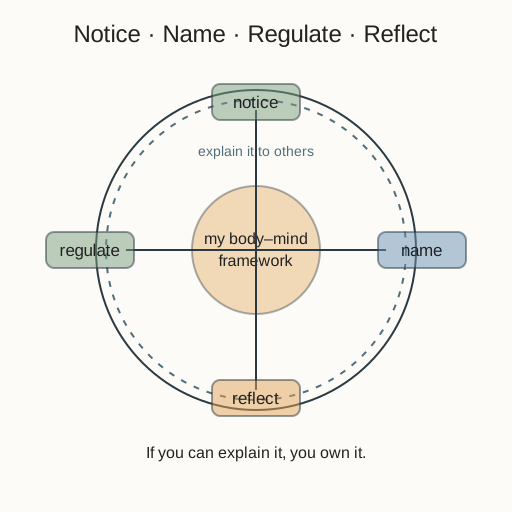
- Framework wheel · 1 per learner A four-spoke wheel — notice, name, regulate, reflect — with a space for one sentence each and a ring for "how I would explain this to someone else"
Low-tech / no-cost
- Paper and pencil To draw the wheel by hand when no printed organizer is available
Enriched / lab & device
- One-page summary of the unit's three prior lessons · 1 per pair A compact recap (the loop, precise reading, the stress wave and return) to ground the synthesis
Works in different contexts
- large-group Build the wheel whole-class, then learners pair off and each explains their framework aloud to a partner in under a minute
- multi-age Younger learners explain one spoke (e.g., "notice") to a partner; older learners explain the whole wheel and field a question about it
- self-directed A learner completes the wheel alone, then writes a short plain-language explanation of it "to a friend who has never studied this"
- level-grouped A ready group also writes a one-line version of each spoke that a younger child could understand
- outdoor-only Walk the four spokes as four stations — notice, name, regulate, reflect — and speak one line aloud at each to a partner
Lesson 4 — A Framework I Can Carry and Explain
Summary
Learners assemble the unit’s first three lessons into one four-spoke framework — notice, name, regulate, reflect — that turns scattered skills into a portable, explainable whole. Each learner writes the framework in their own words and then explains it to someone else in plain language. This is the unit’s first capstone artifact: a written lifelong body–mind framework the learner can carry and pass on (D03.S1.12.01).
Objectives
- Integrate the body–mind connection into a personal framework for lifelong awareness and wellbeing, and explain it clearly to others. (D03.S1.12.01)
Connection
A skill you cannot explain is a skill you only half-own. Knowing that you feel your body, read its signals, and help it return to calm is one thing; being able to hand that to someone else — a friend who is overwhelmed, a younger sibling, a person you are caring for — is another. The act of explaining is not a test of memory; it is how a framework becomes yours. Today you build the framework and then prove you own it by teaching it.
Materials
- Framework wheel
- Unit recap (enriched)
Preparation
- Copy or draw the framework wheel.
- Retrieval: from Lessons 1–3, the loop, precise reading, and the stress wave and return. Today we synthesize them into one framework and practice explaining it.
- Prepare a plain definition: a framework is a small set of named steps you can carry and reuse — not a rulebook, but a reusable pattern (worked example first: Kirschner, Sweller & Clark, S-011).
Facilitator note
This lesson is written to the learner (“you”). The idea to land: a framework is only yours once you can explain it — explaining is retrieval and elaboration, which is what makes learning durable (Dunlosky et al., S-039). The four spokes (notice → name → regulate → reflect) are offered as one reusable pattern, not a universal law: learners may rename, reorder, or swap spokes, so long as the framework is honest to the real body–mind connection and something they would actually use. Honor every body: the framework must work for a body that senses differently, moves differently, or needs different tools — no single “correct” calm-returning method is imposed.
The ethics lens: a framework is judged by what it lets you do for yourself and others, not by how impressive it sounds. The egalitarianism lens: the plain-language version is the real one — if it cannot be explained to a child or a busy friend, it is not yet owned. The global lens: learners may carry body–mind wisdom from their own tradition; the framework should make room for it rather than replace it. The critical-thinking lens: every step is a hypothesis to check against the body, not a ritual to obey. The technology lens: apps and trackers can prompt the first two spokes — notice and name — but a framework you can carry must work with no device, no signal, and no battery, because it lives in you, not in the tool. Preview: Lesson 5 turns from the present moment to the whole lifetime.
Procedure
- Recall (5 min). In one line each, name what you learned in Lessons 1, 2, and 3. Today we bind them into one thing you can carry.
- Meet the wheel (10 min). Work a model example first (S-011): a person before a hard conversation. Notice the body (tight chest), name it (“I’m braced”), regulate (slow exhale, drop the shoulders), reflect (“what do I actually want to say?”). Run the four spokes on one more shared example together.
- Write your own (12 min). In your journal, write the four spokes in your own words, with one real example threaded through all four. Add one line on how your body does each step.
- Explain it (10 min). Pair up. Each of you explains your framework to the other in under a minute, then answers one question. Switch.
- Refine after explaining (8 min). Change whatever was unclear when you said it aloud — a word, an order, an example. Write the final plain-language version.
- Close (5 min). Say, in one sentence, what changed about your framework when you had to explain it to someone else.
Differentiation
- Support: Use the four given spokes as-is and explain just the first two aloud, leaving the rest to the written version.
- Extension: Write a one-line version of the whole framework that a younger child could understand, and a one-line version for a stressed adult — and name how the two differ and why.
Assessment
- Summative (portfolio): The written lifelong body–mind framework — four spokes in the learner’s own words, threaded with a real example, and rendered in plain language someone else could follow. This is the unit’s first capstone artifact.
- Peer: Did the partner understand the explanation well enough to restate one spoke correctly?
Home connection
Explain your framework to someone at home and ask them to repeat it back in their own words. Write one sentence about what they understood easily and one about what they had to ask you to repeat.
Resources
- On explaining-as-retrieval and spacing for durable learning: Dunlosky et al. (2013) (S-039).
- On worked examples for a new synthesis skill: Kirschner, Sweller & Clark (2006) (S-011).