Lesson 05 — A Body Across a Lifetime
Learners map the body across a whole lifespan — child, teen, adult, older adult — and learn that the body changes at every stage, trading one set of capacities for another, rather than simply declining. They replace a fear-of-aging story with a change-and-adaptation story in which dignity is constant even as the body shifts, opening the unit's across-a-lifetime reflection.
Objectives
Objectives
- D03.S1.12.02 Articulate how to sustain their own and others' embodied health and dignity across a lifetime, including aging and change.
Essential question
How does a body change across a whole lifetime, and how do I honor those changes rather than fear them?
Key vocabulary
Materials
Standard materials
- Lifespan arc · 1 per learner A long arc with four life stages (child, teen, adult, older adult) and, beneath each, a space to name what the body can do then and what it needs
Low-tech / no-cost
- Paper and pencil To draw the arc and life stages by hand when no printed organizer is available
Enriched / lab & device
- One page on physical activity across the lifespan · 1 per pair A short WHO-grounded page on functional capacity across life and how movement needs shift with age, to ground the change-not-decline framing
Works in different contexts
- large-group Build the arc whole-class on a board, each learner adding one "what a body can do" or "what a body needs" at each stage
- multi-age Younger learners place themselves on the arc and name one change they have already noticed; older learners compare their own stage with an older and a younger one and note what each needs
- self-directed A learner draws the arc, fills each stage for a real or imagined life, and writes one sentence on how the arc changes their picture of aging
- level-grouped A ready group also distinguishes "change" from "decline" and argues about a stage where a capacity can *grow*
- outdoor-only Walk the arc as a long path, stopping at four marks to name aloud what a body can do and needs at each stage
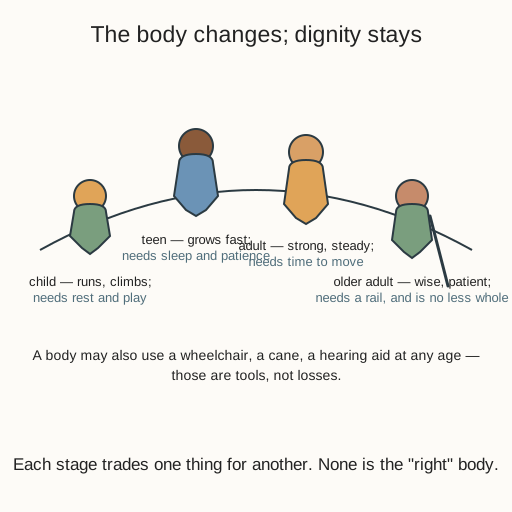
Lesson 5 — A Body Across a Lifetime
Summary
Learners map the body across a whole lifespan — child, teen, adult, older adult — and learn that the body changes at every stage, trading one set of capacities for another rather than simply declining. They meet functional capacity as something that shifts across life and can be supported at every age (WHO, S-341). They replace a fear-of-aging story with a change-and-adaptation story in which dignity stays constant even as the body shifts, opening the unit’s across-a-lifetime reflection.
Objectives
- Describe how bodies change across a lifetime and articulate how to honor those changes, building toward sustaining embodied health and dignity. (D03.S1.12.02)
Connection
Somewhere near you, right now, there is likely a child who can run all day but cannot tie every shoe, a teenager whose body is changing faster than their sense of it, an adult whose knees remember old games, and an older person whose balance asks for a rail but whose patience is deeper than it ever was. None of these is a broken version of the others. Each is a body at a stage, trading one thing for another. The story you inherit about aging — that it is only loss — is one story, and it is not the truest one. Today you learn to tell the truer one: a body changes, and you can meet each change with adaptation and dignity.
Materials
- Lifespan arc
- Lifespan-movement summary (enriched)
Preparation
- Copy or draw the lifespan arc.
- Retrieval: from Lesson 4, the framework you built — today we stretch it across time, from one moment to a whole life.
- Prepare a plain definition: functional capacity is what a body can do, day to day — and it shifts across life and can be supported at every age (WHO, S-341). A value-frame we hold separately: dignity is constant even as the body changes.
Facilitator note
This lesson is written to the learner (“you”). The idea to land, held as description plus an explicit value: the body changes across life — capacities shift and can be supported at every age (WHO’s functional-capacity-across-the-lifespan framing, S-341) — and the judgment that every stage carries dignity is a value we choose, not a fact to prove. Keep the two distinct: “bodies change” is evidence; “aging is not decline” is partly evidence (some capacities hold or grow) and partly a values commitment against ageism. No single “ideal” body at any age; every stage is a whole stage, not a failed younger stage.
The ethics lens: how we treat aging bodies is a test of how we treat people. The egalitarianism lens: some bodies change early, some late, some through illness or injury — the arc looks different for everyone, and no arc is “lesser.” The global lens: cultures honor elders and aging in sharply different ways — some center elders, some push them to the edge — and the lesson holds many ways side by side without ranking. The critical-thinking lens: “decline” is a claim to check, not a word to accept — ask which capacity, when, and what supports it. The technology & environment lens: a body changing across life meets a built world that either supports it — a rail, a bench, a ramp, a lift — or abandons it, and assistive and medical technology extend what an aging body can do; the difference between a hard old age and a full one is often design, not biology. Preview: Lesson 6 turns from the changing body to the dignity that stays constant.
Procedure
- Recall (5 min). From Lesson 4: what are your four spokes? Today we ask how the body that runs your framework changes over a lifetime.
- Meet the arc (10 min). Work a model example first (S-011): a single person’s body at four ages — the child who runs everywhere, the teen in a growth spurt, the adult balancing work and movement, the older adult whose balance needs a rail but whose knowledge and patience grow. At each stage name one gain and one shift.
- Build your arc (12 min). On the lifespan arc, write one real or imagined “what a body can do” and one “what a body needs” at each stage. Mark where you are now.
- Argue change vs. decline (10 min). With a partner, choose one capacity and argue: is its change a loss, a trade, or a gain? Agree on a fairer word than “decline.”
- Name the constant (8 min). If the body changes at every stage, what stays the same? Write one sentence on the dignity that does not age.
- Close (5 min). Say, in your own words, what is wrong with the sentence “aging is only loss” — and what the truer sentence is.
Differentiation
- Support: Fill two stages (your own and one older) with one capability and one need each, leaving the full arc aside.
- Extension: Interview or read about one older person’s life and note one capacity that grew with age — then connect it to how their community supports (or fails to support) them.
Assessment
- Formative (peer + self): Can the learner describe change across at least two life stages, distinguish change from decline, and name what stays constant?
- Portfolio artifact (unit): The completed lifespan arc, filed as the opening of the across-a-lifetime embodied-health reflection.
Home connection
Ask an older person in your life what their body could do at your age and what it does differently now — and one thing they are better at now than then. Write one sentence about each.
Resources
- On functional capacity shifting across the lifespan and being supportable at every age: World Health Organization, Physical activity fact sheet (S-341).
- On worked examples for a new analytical skill: Kirschner, Sweller & Clark (2006) (S-011); on retrieval and spacing: Dunlosky et al. (2013) (S-039).