Lesson 06 — Dignity Is Embodied
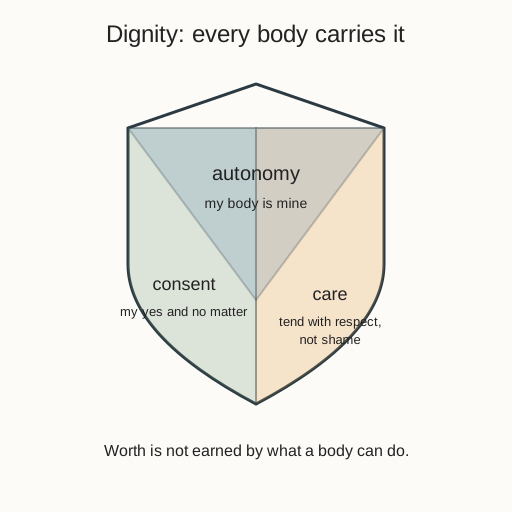
Learners name embodied dignity as something each person carries and tends, not something earned by a particular body. They fill a three-field shield — autonomy, consent, care — with their own commitments, and learn that dignity is a right held by every person regardless of ability, grounded in a shared human-rights frame and held here as a value commitment.
Objectives
Objectives
- D03.S1.12.02 Articulate how to sustain their own and others' embodied health and dignity across a lifetime, including aging and change.
Essential question
How do I sustain my own embodied dignity — respect for my body and its autonomy — across a lifetime?
Key vocabulary
Materials
Standard materials
- Dignity shield · 1 per learner A shield-shaped organizer with three fields — autonomy, consent, care — and a space for one commitment in each
Low-tech / no-cost
- Paper and pencil To draw the shield by hand when no printed organizer is available
Enriched / lab & device
- One page on the right to dignity and participation · 1 per pair A short page on human dignity (UDHR Article 1) and the right to take part in recreation and sport regardless of disability (CRPD Article 30)
Works in different contexts
- large-group Build the three fields whole-class, then learners each write one personal commitment per field
- multi-age Younger learners name one way they keep their own body safe and respected; older learners analyze a case where autonomy was honored or overridden
- self-directed A learner completes the shield alone and writes one sentence on where their own autonomy has been honored and where it has been pressed
- level-grouped A ready group also distinguishes care (given) from control (taken) and argues where the line falls in a caregiving case
- outdoor-only Stand in a wide space and mark a personal boundary with arms; name one thing others may not do to your body without your consent
Lesson 6 — Dignity Is Embodied
Summary
Learners name embodied dignity as something each person carries and tends — not something earned by a particular kind of body. They fill a three-field shield — autonomy, consent, care — with their own commitments, and learn that dignity is a right held by every person regardless of ability, grounded in a shared human-rights frame (UDHR Article 1, S-149) and held here explicitly as a value commitment, not a fact to prove.
Objectives
- Articulate how to sustain one’s own embodied dignity — autonomy, consent, and care for the body — across a lifetime. (D03.S1.12.02)
Connection
Think of a time someone touched you, commented on your body, or made a decision for you without asking. Or a time someone asked first, listened to your no, and left you feeling more like yourself. Those two moments are the difference dignity is made of. It is not a luxury reserved for some bodies; it is the baseline every body is owed. The work of a lifetime is partly external — being treated with respect — and partly internal: treating your own body, at every age and in every condition, as worthy of care and its own “yes” and “no.”
Materials
- Dignity shield
- Dignity-and-rights summary (enriched)
Preparation
- Copy or draw the dignity shield.
- Retrieval: from Grade 8 (D03.S4.08.01), body autonomy and consent; from Lesson 5, the body that changes across a lifetime. Today we name what stays constant: dignity.
- Prepare a plain definition: dignity here is the worth every person carries simply by being a person — held as a value commitment (UDHR Article 1, S-149), not a factual claim.
Facilitator note
This lesson is written to the learner (“you”). The idea to land, held as value, plainly labeled as value: every person is born with dignity and worth (UDHR Article 1, S-149), and every person has the right to take part in recreation and sport regardless of disability (CRPD Article 30, S-100). These are shared human commitments, not scientific facts — the lesson must keep that distinction clean. The three fields (autonomy, consent, care) are one way to organize the practice of dignity, not a universal law.
The ethics lens: dignity is about what we owe — to ourselves and to others — before any question of what we can do. The egalitarianism lens: dignity is not graded by ability, age, appearance, or productivity; a body that needs help is not a body with less worth. The global lens: how dignity is expressed differs across cultures and families, so no single expression is the default — but the underlying claim of equal worth is the shared ground. The critical-thinking lens: “care” and “control” can look alike, and we learn to tell them apart by asking whose “yes” and “no” count. The technology lens: bodily autonomy now extends beyond touch to data — who tracks, stores, and shares information about our bodies — so consent and dignity apply to devices and records as much as to hands. Preview: Lesson 7 extends dignity from oneself to caring for another.
Procedure
- Recall (5 min). From Lesson 5: what changes across a lifetime, and what stays constant? Today we give the constant a name — dignity.
- Meet the three fields (10 min). Work a model example first (S-011): an older person, or a person with a disability, deciding about their own care. Autonomy — the decision is theirs. Consent — their yes and no are asked for and honored. Care — the body is tended with respect, not merely managed. Run one more shared example together.
- Fill your shield (12 min). On the dignity shield, write one commitment in each field for your own body: a boundary you will hold (autonomy), a “no” you will honor (consent), and a way you will tend your body with respect rather than shame (care).
- Argue care vs. control (10 min). With a partner, take a caregiving case and argue where “caring for” becomes “controlling.” Name the test you used to tell them apart.
- Name the right (8 min). Write one sentence on why dignity belongs to every body equally — and one on what that requires of you toward your own body.
- Close (5 min). Say, in your own words, what “my body is mine” means at every age, including the ages when your body may need help.
Differentiation
- Support: Fill one field (consent) with one clear boundary, and discuss the other two aloud rather than in writing.
- Extension: Find one real policy or practice where a group’s bodily autonomy was overridden in the name of care, and argue what a dignity-preserving version would look like.
Assessment
- Formative (peer + self): Can the learner define the three fields, distinguish care from control, and write one authentic commitment in each?
- Portfolio artifact (unit): The completed dignity shield, filed in the journal as part of the across-a-lifetime reflection.
Home connection
Ask someone at home what “dignity” means to them when it comes to their own body, and one way they keep it. Write one sentence about their answer and one about how it differs from yours.
Resources
- On equal dignity and worth as a shared human commitment: UN Universal Declaration of Human Rights, Article 1 (S-149).
- On the right to take part in recreation and sport regardless of disability: UN CRPD, Article 30 (S-100).
- On worked examples for a new analytical skill: Kirschner, Sweller & Clark (2006) (S-011); on retrieval and spacing: Dunlosky et al. (2013) (S-039).