Lesson 08 — Movement Feeds the Whole Person
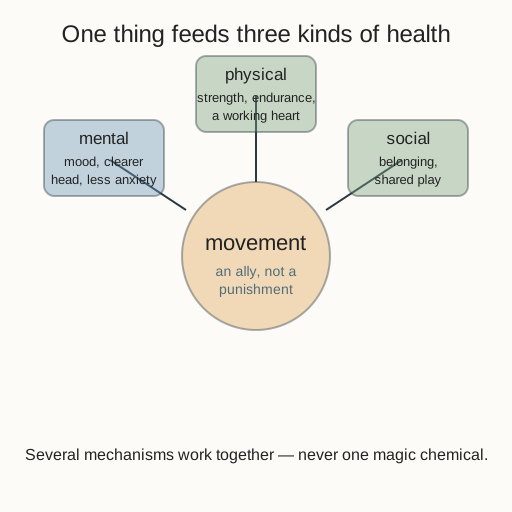
Learners map how movement feeds the whole person at once — physical health (strength, endurance, heart), mental health (mood, reduced anxiety and depression), and social health (belonging, shared play) — and learn that no single chemical explains it; several mechanisms work together. They log one personal benefit in each branch and begin to see movement as a lifelong ally, not a chore.
Objectives
Objectives
- D03.S2.12.01 Integrate movement into a lifelong, adaptable plan that supports physical, mental, and social health.
Essential question
Why does movement belong in every life — and how does it feed physical, mental, and social health at once?
Key vocabulary
Materials
Standard materials
- Three-branch map · 1 per learner A movement-centered diagram with three branches — physical, mental, social — and a space to log one benefit in each from personal experience
Low-tech / no-cost
- Paper and pencil To draw the three-branch map by hand when no printed organizer is available
Enriched / lab & device
- One plain-language page on exercise and mental health · 1 per pair A short page on the evidence linking movement to mood and reduced anxiety and depression, with mechanisms named honestly (one chemical is never the whole story)
Works in different contexts
- large-group Brainstorm benefits whole-class into three columns, then learners each log one personal example per branch
- multi-age Younger learners name one way moving makes them feel; older learners connect a specific mechanism (endorphins, BDNF, social connection) to a benefit
- self-directed A learner completes the map alone and writes one sentence on which of the three branches matters most to them right now and why
- level-grouped A ready group also distinguishes correlation from causation in the exercise–mood evidence and argues how strong the link really is
- outdoor-only Move together for ten minutes (walk, dance, or play), then name aloud one physical, one mental, and one social thing you noticed
Lesson 8 — Movement Feeds the Whole Person
Summary
Learners map how movement feeds the whole person at once — physical health (strength, endurance, a working heart), mental health (mood, reduced symptoms of anxiety and depression), and social health (belonging, shared play). They learn that no single chemical explains the mental-health link; several mechanisms work together — endorphins, monoamines, and BDNF among them (Mikkelsen et al., S-408) — and that regular physical activity carries significant physical and mental health benefits (WHO, S-341). They log one personal benefit in each branch.
Objectives
- Explain how movement supports physical, mental, and social health together, building toward a lifelong movement plan. (D03.S2.12.01)
Connection
Think of the last time you moved on purpose — a walk, a game, a dance, a swim, a climb. Afterward, more than your legs changed: your mood shifted, your head cleared, and if you moved with someone, you probably felt closer to them. Movement is one of the few things that feeds the body, the mind, and the company of others at the same time. That is why it belongs in every life, at every age — not as a punishment for eating, but as a lifelong ally.
Materials
- Three-branch map
- Exercise-and-mental-health summary (enriched)
Preparation
- Copy or draw the three-branch map.
- Retrieval: from Grade 8 (D03.S2.08.01), strength, endurance, and flexibility; from Lesson 5, the body across a lifetime. Today we ask why movement matters, across all three dimensions of health.
- Prepare a plain definition: whole-person benefit means movement helps physical, mental, and social health together — not one at a time.
Facilitator note
This lesson is written to the learner (“you”). The idea to land, held as evidence, hedged honestly: regular physical activity supports significant physical and mental health benefits (WHO, S-341), and the exercise–mood link involves several mechanisms — endorphins, monoamines (serotonin, dopamine, noradrenaline), and BDNF among them — not one magic chemical (Mikkelsen et al., S-408). Model the honest hedge: this is a correlation-and-mechanism story, not “exercise cures depression.” Movement is one support, not a replacement for care a person may need. No body-shaming, ever: the frame is “movement as ally,” never “you must look or perform a certain way.”
The ethics lens: prescribing movement to others is done with care — it can help and it can also become a demand. The egalitarianism lens: access to safe, joyful movement is not equal, and the social branch matters most where isolation is deepest. The global lens: what “movement” means differs everywhere — dancing, farming, walking, games, swimming — and no single form is the default. The critical-thinking lens: “movement improves mood” is a claim with real evidence, but we read it with the correlation/causation care it deserves. The technology lens: labor-saving devices and screens have made sitting the default in many lives, which is exactly why deliberate movement now matters more — and a wearable can measure movement but cannot supply the motive, which still comes from the person. Preview: Lesson 9 names the building blocks of a movement life.
Procedure
- Recall (5 min). From Lesson 5: how does a body change across life? Today we ask what movement gives it at every age.
- Meet the three branches (10 min). Work a model example first (S-011): a person who starts a short daily walk. Trace what changes — physical (heart, strength), mental (mood, sleep, clearer head), social (a walking partner, a hello). Name the three branches and the honest hedge: several mechanisms, not one chemical.
- Sort the benefits (10 min). With a partner, sort a list of benefits into the three branches, arguing the ones that span two or three.
- Log your own (10 min). On the three-branch map, write one benefit you have actually felt from movement in each branch — physical, mental, social.
- Argue the evidence (8 min). In pairs, take the claim “movement improves mood.” Is it correlation, causation, or both? Name what would convince you it is causal.
- Close (5 min). Say, in one sentence, why movement belongs in every life — and why it is an ally, not a punishment.
Differentiation
- Support: Log one benefit in a single branch and discuss the others aloud; skip the correlation/causation argument.
- Extension: Find one study or report on exercise and mental health and evaluate whether its claim is stronger than “linked to” — and why.
Assessment
- Formative (peer + self): Can the learner name the three branches, sort benefits with reasons, and log one authentic benefit in each?
- Portfolio artifact (unit): The completed three-branch map, filed as the opening of the lifelong movement plan.
Home connection
Ask someone at home what moving does for them — body, mind, or company. Write one sentence about their answer and one about which branch matters most to you now.
Resources
- On exercise and mental health mechanisms (endorphins, monoamines, BDNF, among others): Mikkelsen et al. (2017), Exercise and mental health (S-408).
- On regular physical activity and its physical and mental health benefits: WHO, Physical activity fact sheet (S-341).
- On worked examples for a new analytical skill: Kirschner, Sweller & Clark (2006) (S-011); on retrieval and spacing: Dunlosky et al. (2013) (S-039).