Lesson 07 — Caring for Another's Body and Dignity
Learners turn dignity outward: how to care for another person's body — across aging, illness, or disability — while protecting their agency. They learn the ask–listen–adapt loop and see assistive technology (wheelchairs, hearing aids, and other aids) as ordinary tools that widen a person's own choices, and they complete the unit's across-a-lifetime reflection on sustaining others' dignity.
Objectives
Objectives
- D03.S1.12.02 Articulate how to sustain their own and others' embodied health and dignity across a lifetime, including aging and change.
Essential question
How do I care for another person's body and dignity — across aging, illness, and change — without taking over their agency?
Key vocabulary
Materials
Standard materials
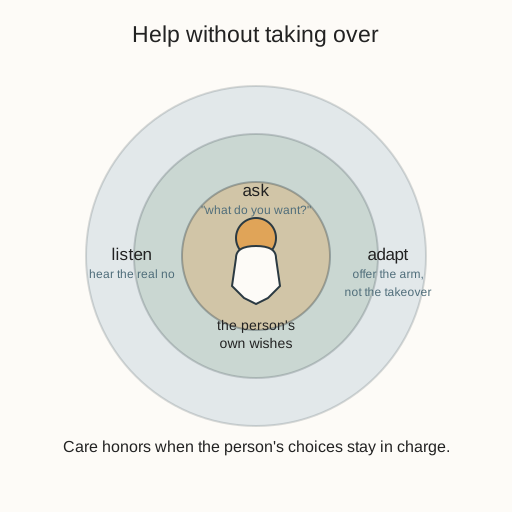
- Care circle · 1 per learner A circle with the person cared-for at the center and three rings outward — ask, listen, adapt — with a space for one concrete example of each
Low-tech / no-cost
- Paper and pencil To draw the care circle by hand when no printed organizer is available
Enriched / lab & device
- One page on assistive technology as ordinary tools · 1 per pair A short WHO-grounded page on wheelchairs, hearing aids, and other aids as common tools used worldwide, to normalize support
Works in different contexts
- large-group Role-play a caregiving moment whole-class, then pairs each write one example per ring of the circle
- multi-age Younger learners name one way they already help a younger or older person; older learners analyze a case where help overrode the person's own wishes
- self-directed A learner completes the circle alone and writes one sentence on how "helping" and "taking over" differ
- level-grouped A ready group also designs a support plan that maximizes the cared-for person's own choices
- outdoor-only One partner closes their eyes or sits while the other offers help — then swap and name what felt like support and what felt like being controlled
Lesson 7 — Caring for Another’s Body and Dignity
Summary
Learners turn dignity outward: how to care for another person’s body — across aging, illness, or disability — while protecting their agency. They learn the ask–listen–adapt loop and come to see assistive technology (wheelchairs, hearing aids, and other aids) as ordinary tools that widen a person’s own choices (WHO, S-099). This completes the unit’s across-a-lifetime embodied-health reflection on sustaining both one’s own and others’ dignity.
Objectives
- Articulate how to sustain others’ embodied health and dignity across a lifetime, including through caregiving that protects agency. (D03.S1.12.02)
Connection
Almost everyone will, at some point, help care for another body — an aging parent, a sick friend, a child, a partner after an injury. And almost everyone will, at some point, be cared for. The difference between care that honors and care that humiliates is not how much you do; it is whose wishes stay in charge. The skill is learning to help without taking over — to support another person’s dignity so that being helped never costs them their “yes” and “no.”
Materials
- Care circle
- Assistive-technology summary (enriched)
Preparation
- Copy or draw the care circle.
- Retrieval: from Lesson 6, the three fields of dignity (autonomy, consent, care); from Grade 11 (D03.S4.11.02), designing respectful support for chronic conditions and disabilities. Today we put dignity to work in caregiving.
- Prepare a plain definition: assistive technology is any tool — a wheelchair, glasses, a hearing aid, a cane — that helps a person do what they want to do; such aids are common, ordinary tools used worldwide (WHO, S-099). Supported autonomy is help that increases a person’s own choices rather than replacing them.
Facilitator note
This lesson is written to the learner (“you”). The idea to land, held as description plus value: caregiving can protect or erode dignity, and the difference is whether the cared-for person’s agency stays in charge — so the core skill is ask–listen–adapt. Assistive technology (wheelchairs, hearing aids, prosthetics, white canes) is common and ordinary, used worldwide (WHO, S-099), and the right to take part in recreation and sport regardless of disability is a shared human commitment (CRPD Article 30, S-100). Hold the value plainly as value. Normalize help: needing or giving care is not a mark of lesser worth on either side.
The ethics lens: help that ignores a person’s wishes is not help — it is control, even when kindly meant. The egalitarianism lens: care work falls unevenly across gender, class, and family roles worldwide, and that distribution is a question of justice, not only of kindness. The global lens: cultures arrange care in many ways — extended family, community, institutions — and none is the single “right” model. The critical-thinking lens: “what is best for you” is a claim to check against the person’s own stated wishes. The technology lens: assistive technology — a wheelchair, a hearing aid, a screen reader, a voice device — is dignity made mechanical, widening a person’s own choices rather than replacing them; the ask–listen–adapt loop applies to choosing tools, not only to giving help. Preview: Lesson 8 pivots from dignity to movement as a lifelong plan.
Procedure
- Recall (5 min). From Lesson 6: what are the three fields of dignity? Today we ask how to give that dignity to another body we are helping.
- Meet ask–listen–adapt (10 min). Work a model example first (S-011): helping an older relative who now needs help dressing. Ask what they want, listen to the real answer (including the “no”), adapt your help to their wishes — offer the arm, not the takeover. Contrast with the same scene done as control.
- Sort the moments (10 min). With a partner, sort short caregiving moments as “supported autonomy” or “took over,” and name what each would have to change to move toward the first.
- Draw your circle (12 min). On the care circle, write one real or imagined example of asking, one of listening, one of adapting — for a person you might one day care for.
- Reflect across a lifetime (10 min). Write the across-a-lifetime reflection: one paragraph on how you will sustain your own embodied dignity and one on how you will protect another’s — through aging, illness, and change.
- Close (5 min). Say, in one sentence, how “I’ll do everything for you” can fail a person, and what the better promise is.
Differentiation
- Support: Give one example of each ring from your own family or community, and write the reflection as two sentences rather than a paragraph.
- Extension: Research one assistive technology and how it widens a person’s choices, then connect it to the dignity frame (e.g., a hearing aid, a screen reader, a prosthetic).
Assessment
- Summative (portfolio): The completed care circle and the two-part across-a-lifetime reflection (sustaining one’s own and others’ dignity) — the unit’s second capstone artifact.
- Peer: Can a partner name the difference between the learner’s “supported autonomy” and “took over” examples?
Home connection
Ask someone at home who has helped care for another person what they learned about protecting the person’s dignity. Write one sentence about their answer and one about what you will do differently.
Resources
- On assistive technology as common, ordinary tools used worldwide: WHO, Assistive Technology fact sheet (S-099).
- On the right to take part in recreation and sport regardless of disability: UN CRPD, Article 30 (S-100).
- On worked examples for a new skill: Kirschner, Sweller & Clark (2006) (S-011); on retrieval and spacing: Dunlosky et al. (2013) (S-039).