Lesson 09 — The Building Blocks of a Movement Life
Learners name the four building blocks of a movement life — aerobic, strength, balance, and flexibility — and learn that a balanced routine draws on all four, with balance and functional activity mattering especially as people age. They sort everyday activities under the blocks and find that many build two or three at once, laying the foundation for designing their own plan.
Objectives
Objectives
- D03.S2.12.01 Integrate movement into a lifelong, adaptable plan that supports physical, mental, and social health.
Essential question
What are the building blocks of movement — and how do they work together across a lifetime?
Key vocabulary
Materials
Standard materials
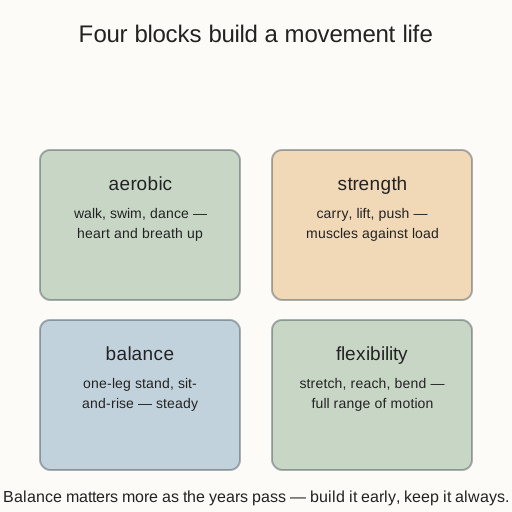
- Four-block foundation · 1 per learner A foundation diagram with four blocks — aerobic, strength, balance, flexibility — and a space to name one real activity for each
Low-tech / no-cost
- Paper and pencil To draw the four blocks by hand when no printed organizer is available
- Activity cards A deck of everyday activities (carrying water, climbing stairs, dancing, gardening, swimming, sweeping, yoga, lifting a child, walking a slope) to sort under the four blocks
Enriched / lab & device
- One page on a balanced routine across the lifespan · 1 per pair A short WHO-grounded page on aerobic, muscle-strengthening, and balance/functional activity, including the note that balance matters especially for older adults
Works in different contexts
- large-group Sort the activity cards whole-class into four columns, then learners each name one personal activity per block
- multi-age Younger learners match one activity to one block; older learners find activities that build two or three blocks at once and argue where they belong
- self-directed A learner sorts the cards, names one activity per block from their own life, and writes one sentence on which block they most need to add
- level-grouped A ready group also explains why balance training matters more with age and designs a two-activity balance routine
- outdoor-only Try one activity for each block on the spot — a brisk walk, a carry, a one-leg stand, a stretch — and name which block each built
Lesson 9 — The Building Blocks of a Movement Life
Summary
Learners name the four building blocks of a movement life — aerobic, strength, balance, flexibility — and learn that a balanced routine draws on all four, with balance and functional activity mattering especially as people age (WHO, S-341). They sort everyday activities under the blocks and discover that many build two or three at once, laying the foundation for designing their own plan.
Objectives
- Identify the building blocks of movement and how they work together across a lifetime, building toward a personal movement plan. (D03.S2.12.01)
Connection
Movement is not one thing. Carrying a child up a hill, dancing all night, sitting on the floor and rising again, holding a plank — each asks something different of a body. A movement life, like a sturdy house, is built of a few blocks: the endurance to keep going (aerobic), the power to lift and carry (strength), the steadiness to stay upright and catch a fall (balance), and the range to reach and bend (flexibility). You are probably already using all four every day without naming them. Today you learn the names, so you can build with them on purpose.
Materials
- Four-block foundation
- Activity cards (low-tech: paper)
- Balanced-routine summary (enriched)
Preparation
- Copy or draw the four-block foundation; prepare the activity cards.
- Retrieval: from Grade 8 (D03.S2.08.01), strength, endurance, and flexibility; from Lesson 8, why movement matters. Today we name the components of movement.
- Prepare a plain definition: aerobic activity is sustained movement that raises heart and breath; strength work makes muscles work against resistance; balance keeps you steady; flexibility keeps the range of motion. A balanced routine draws on all four (WHO, S-341).
Facilitator note
This lesson is written to the learner (“you”). The idea to land, held as evidence, hedged honestly: a balanced routine includes aerobic (endurance) and muscle- strengthening activity, with balance and flexibility part of functional capacity across the lifespan — and balance/functional training matters especially for older adults (WHO, S-341). This is a general guide, not a prescription: intensity, form, and safety are individual, and every body adapts the blocks to its own needs. No single “correct” routine is imposed; a wheelchair user, a person with a chronic condition, and an elite athlete all use the same four blocks, differently.
The ethics lens: the blocks are tools for health and joy, never a yardstick of worth. The egalitarianism lens: “exercise” is not only gyms and sports — carrying water, farming, sweeping, dancing, and care work all build these blocks, and those are as real as any workout. The global lens: the same four blocks appear in countless forms worldwide, so no single form is the default. The critical-thinking lens: a claim about “the best exercise” is a claim to check against the four blocks and the person’s own body. The technology & environment lens: the four blocks were once built invisibly by the physical work of daily environments — farming, carrying, climbing — and labor-saving technology has quietly removed much of that incidental movement, so most people must now add the blocks back on purpose. Preview: Lesson 10 turns the blocks into your own plan.
Procedure
- Recall (5 min). From Lesson 8: what three kinds of health does movement feed? Today we name the components of movement itself.
- Meet the four blocks (10 min). Work a model example first (S-011): a farmer’s day — carrying water (strength), walking the slopes (aerobic), steadying on uneven ground (balance), bending to plant (flexibility). Name the four blocks and how one day builds all of them.
- Sort the cards (12 min). With a partner, sort each activity card under the block it most builds — and mark the ones that build two or three at once.
- Find your blocks (12 min). On the four-block foundation, write one real activity from your own life for each block. Name one block you have plenty of and one you are missing.
- Design a balance add-on (8 min). In pairs, design a simple two-activity balance routine someone could do at an older age (e.g., standing on one leg by a wall, then a slow sit-and-rise). Note why balance matters more with age (WHO, S-341).
- Close (5 min). Say, in one sentence, why “exercise” is bigger than gyms and sports.
Differentiation
- Support: Sort only the clearest cards and name one activity per block from daily life, leaving the balance design aside.
- Extension: Audit one person’s real day (your own or a family member’s) and map which blocks it already builds and which it misses.
Assessment
- Formative (peer + self): Can the learner name the four blocks, sort activities with reasons, and identify a block they have and a block they lack?
- Portfolio artifact (unit): The completed four-block foundation, filed as the scaffold for the lifelong movement plan.
Home connection
Watch one ordinary day at home and name one activity that builds each of the four blocks for someone there. Write one sentence per block.
Resources
- On aerobic, muscle-strengthening, and balance/functional activity across the lifespan, with balance mattering especially for older adults: WHO, Physical activity fact sheet (S-341).
- On worked examples for a new analytical skill: Kirschner, Sweller & Clark (2006) (S-011); on retrieval and spacing: Dunlosky et al. (2013) (S-039).