Lesson 09 — Drafting: Structure, Style, and Evidence
Learners turn a plan into a draft, building paragraphs as small arguments — topic sentence, evidence, warrant, transition — and making deliberate choices about structure, style, and voice. They learn that a draft is meant to be imperfect, and that drafting with a scaffold makes the imperfection *usable* for revision.
Objectives
Objectives
- D04.S3.12.01 Produce a sustained, polished piece of writing that demonstrates command of structure, style, and evidence for a chosen audience.
Essential question
How do I turn a plan into a draft — building structure, choosing a style, and integrating evidence so each paragraph carries the argument forward?
Key vocabulary
Materials
Standard materials
- Drafting scaffold · 1 per learner A paragraph-level scaffold — topic sentence, evidence, warrant, transition — to build the body of the piece section by section
- Deliberation journal · 1 per learner Continuing the unit-long log
Low-tech / no-cost
- Paper and pencil To draft by hand and mark up paragraphs
- Sentence-starter bank Ways to introduce evidence ('one measurement shows...'), to warrant ('this matters because...'), and to transition ('in contrast...') without a device
Enriched / lab & device
- One word processor with version history · 1 per learner To draft digitally, save versions, and use voice dictation where it helps access
Works in different contexts
- large-group Draft the first paragraph together on the board, then learners draft their own and read one sentence each aloud — or in writing, sign, or AAC — in a "draft chain"
- multi-age Younger learners write one topic sentence and one piece of evidence; older learners draft full sections with warrants and transitions
- self-directed A learner drafts two sections from their plan, then reads them — aloud, silently, or via screen reader — and marks where the argument stalls
- level-grouped A ready group also varies sentence length and word choice deliberately, then explains the effect of each choice
- outdoor-only Write each sentence of a paragraph on a card, lay them in order, and physically rearrange until the argument moves cleanly
Lesson 9 — Drafting: Structure, Style, and Evidence
Summary
Learners turn a plan into a draft, building paragraphs as small arguments — topic sentence, evidence, warrant, transition — and making deliberate choices about structure, style, and voice. A draft is meant to be imperfect; drafting with a scaffold makes that imperfection usable for revision.
Objectives
- Draft a sustained piece with clear structure, deliberate style, and integrated evidence, paragraph by paragraph. (D04.S3.12.01)
Connection
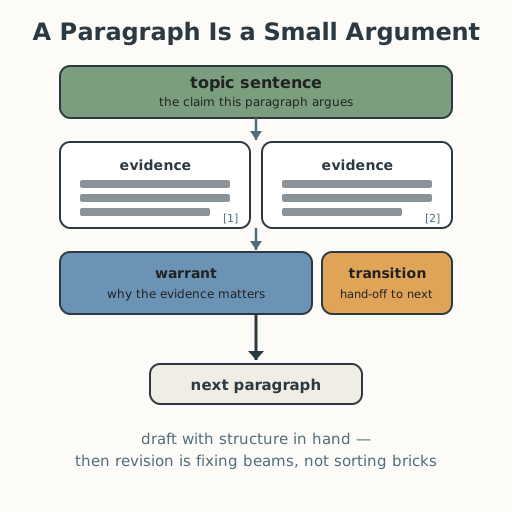
Every paragraph you have ever admired is doing a quiet job: it opens with a claim, brings evidence, says why the evidence matters, and hands the reader to the next paragraph. None of that is magic — it is a pattern you can learn and repeat. A draft is not the finished piece; it is the first time the idea stands on its own feet. The trick is to draft with structure in hand, so that when you revise, you are fixing a building that already has beams, not sorting a pile of bricks.
Materials
- Drafting scaffold
- Deliberation journal
- Sentence-starter bank (low-tech: paper)
Preparation
- Copy the drafting scaffold; prepare the sentence-starter bank.
- Retrieval: from Lesson 8, the writing plan; from Lesson 2, claim/grounds/warrant. Today we add the capstone turn: drafting (worked example first: Kirschner, Sweller & Clark, S-011).
- Prepare the paragraph-as-argument frame, an extension of Toulmin’s model (S-236): topic sentence (the claim), evidence (the grounds), warrant (why the evidence supports the claim), transition (how the paragraph hands off to the next). Explicit strategy instruction and the writing process are evidence-supported (IES, S-171; Graham & Perin, S-102).
Facilitator note
This lesson is written to the learner (“you”). The idea to land, held as description: a paragraph is a small argument — claim, evidence, warrant, transition — extending the claim/grounds/warrant model (Toulmin, S-236), and drafting with explicit strategy instruction is evidence-supported (IES, S-171; Graham & Perin, S-102). The scaffold is a servant, not a master: a paragraph that breaks the pattern deliberately can be stronger, and a learner whose home language or tradition structures prose differently should be honored, not corrected into one mold.
The ethics lens: integrated evidence is quoted and cited honestly — a writer’s integrity lives in not passing another’s words off as one’s own. The egalitarianism lens: the scaffold puts a doable pattern in every learner’s hands, so clear structure is not the property of the fluent. The global lens: rhetorical structures differ across cultures — some traditions circle a point, others state it outright — and no single shape is “correct.” The technology lens: word processors, version history, and voice dictation change how we draft and who can draft; the tool assists, but the thinking is the writer’s. The environment lens: drafting is a place to choose deliberately — a screen draft needs no paper, and a voice-first draft lets a writer think aloud while moving — small choices with real effects. The critical-thinking lens: “does this evidence actually support this topic sentence?” is the check a writer runs on every paragraph. Preview: Lesson 10 revises the draft into its finished form.
Procedure
- Recall (5 min). From Lesson 8: what five parts made your plan? Today the plan becomes paragraphs.
- Meet the paragraph-as-argument (10 min). Work a model example first (S-011). Watch one paragraph take shape: topic sentence (the claim), evidence (a measurement or quotation, cited), warrant (why the evidence supports the claim), transition (the hand-off). Name each part and what it does for the reader.
- Draft the body (15 min). Using your plan and the scaffold, draft two or three body paragraphs. Use the sentence-starter bank where it helps, but keep your own voice.
- Read and mark (10 min). Read your paragraphs aloud to a partner — or read them silently, have a partner or screen reader read them back, or sign them — and mark where the argument moves cleanly and where it stalls; note any evidence that is asserted but not yet shown.
- Vary the style (8 min). Revise one paragraph’s style only: change sentence lengths, choose one more precise word, and read it again — aloud, silently, or via screen reader — to hear the difference.
- Close (5 min). Say — or write, sign, type, or use AAC for — why a draft is meant to be imperfect, and what “good enough to revise” means to you.
Differentiation
- Support: Draft one paragraph (topic sentence + one evidence + one warrant), leaving transitions and style for later.
- Extension: Draft a section that deliberately breaks the pattern for effect — a one-sentence paragraph, a delayed claim — and explain what the break does.
- Communication access: Every spoken step — reading aloud, or closing aloud — can be completed in writing, signing, typing, or AAC instead. Learners who are non-speaking, d/Deaf, hard-of-hearing, or who use AAC draft, mark, and share in their preferred mode; no step requires producing or hearing sound.
- Writing access (dyslexia, low-vision, spelling difficulty): The draft may be produced by voice — dictated to a scribe or recorded with speech-to-text where a device exists — and read back by a partner or screen reader (low-tech fallback: a partner or facilitator reads the draft back, or the learner traces each sentence finger-by-finger). Spelling and decoding difficulty is distinct from composition and thinking: a learner who spells non-standardly may draft with power and precision, and no “correct penmanship” or standard spelling is required — what is assessed is structure, style, and integrated evidence, not the letter forms.
Assessment
- Formative (peer + self): Can the learner draft paragraphs with a topic sentence, cited evidence, a warrant, and a transition, and vary style deliberately?
- Portfolio artifact (unit): The drafted body paragraphs, filed in the deliberation journal as the working draft.
Home connection
Read one paragraph of your draft to someone at home — or share it in writing, sign, or AAC — and ask them where they got lost or wanted to know more. Mark that spot and plan one revision.
Resources
- On the claim/grounds/warrant structure a paragraph extends: Toulmin, The Uses of Argument (S-236).
- On the writing process and strategy instruction: IES, Teaching Secondary Students to Write Effectively (S-171); Graham & Perin, Writing Next (S-102).
- On worked examples for a new skill: Kirschner, Sweller & Clark (2006) (S-011); on feedback: Hattie, Visible Learning (S-012).