Lesson 09 — A Sustained Performance: Skill and Vision
Learners meet the performance parallel of Lessons 1 and 5: a *sustained performance* is not a string of movements but one piece with a beginning, middle, and end, held together by a single concept or through-line and shaped by rehearsal. They study capoeira — a form where movement, music, and meaning are one — then devise a short piece with a through-line of their own.
Objectives
Objectives
- D07.S3.12.01 Produce and perform a sustained piece that shows technical skill and a coherent creative vision, with a written artist statement.
Essential question
What turns a series of movements into one sustained performance with technical skill and a coherent creative vision — and how do I begin mine?
Key vocabulary
Materials
Standard materials
- Performance-capstone journal · 1 per learner For concept notes, movement sketches, statements, and critiques — the unit-long record
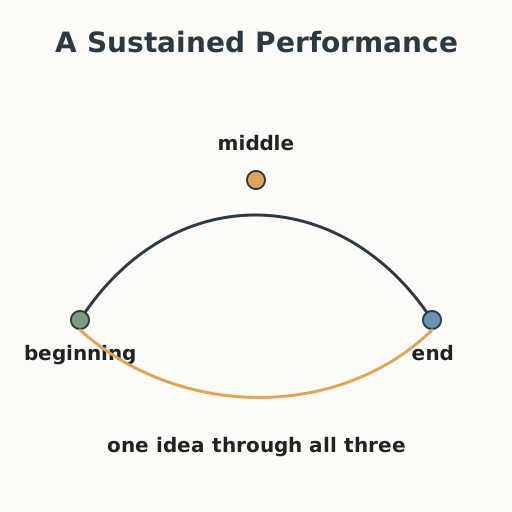
- Performance-arc sheet · 1 per learner A beginning-middle-end arc with a line naming the single idea that carries through all three
Low-tech / no-cost
- Body, voice, and found space Any movement, gesture, or spoken/signed text; no costume, prop, or stage required
- A rehearsal partner or mirror To watch, respond, and revise the piece through rehearsal
Enriched / lab & device
- A camera or phone to record rehearsals · 1 per learner or pair To watch the piece back and revise what does not read clearly
Works in different contexts
- large-group Model the through-line whole-class, then learners devise a short piece in pairs and share sections
- multi-age Younger learners build one movement sequence; older learners name the concept and refine it through rehearsal
- self-directed A learner devises the arc, rehearses alone, records it, and writes the through-line
- level-grouped A ready group also identifies the moment where the piece's meaning is clearest and where it is muddiest
- outdoor-only Devise the piece for the space at hand — a field, a path, a clearing — using the ground and distance as part of the choreography
Lesson 9 — A Sustained Performance: Skill and Vision
Summary
Learners meet the performance parallel of Lessons 1 and 5: a sustained performance is not a string of movements but one piece with a beginning, middle, and end, held together by a single concept or through-line and shaped by rehearsal. They study capoeira — a form where movement, music, and meaning are one — then devise a short piece with a through-line of their own.
Objectives
- Produce and perform a sustained piece that shows technical skill and a coherent creative vision, with a written artist statement. (D07.S3.12.01)
Connection
Think of a gesture everyone knows — a greeting, a dance step, a way of carrying something, a ritual of welcome or farewell. A performance is many such movements woven into one piece with a beginning, a middle, and an end, all saying one thing. Everywhere people mark joy, grief, work, and welcome through the moving body — dance, ritual, and drama are a first language, older than writing.
Materials
- Performance-capstone journal
- Performance-arc sheet
- Low-tech: body, voice, and found space; a rehearsal partner or mirror
- Enriched: a camera or phone to record rehearsals
Preparation
- Copy or draw the performance-arc sheet (beginning / middle / end + through-line).
- Retrieval: from Grade 11 (D07.S3.11.01), a performance responding to a social or environmental issue; from Grade 10 (D07.S3.10.01), devising an original piece with craft in movement and expression. Today we begin the sustained performance for this unit’s capstone.
- Prepare a short live or described example of a piece with a clear through-line (S-011).
Facilitator note
This lesson is written to the learner (“you”). The idea to land: a sustained performance is one piece — beginning, middle, end — held together by a single concept (the through-line) and shaped, through rehearsal, into visible skill and intention. Teach the through-line explicitly, then let learners devise and rehearse (S-011). “Skill” here is readable intention — clear gesture, deliberate rhythm, controlled stillness — not virtuosity.
The ethics lens: the body on stage speaks for the performer, so the concept must be one they can stand behind and represent honestly. The egalitarianism lens: a sustained performance needs no stage, costume, or prop — only a body, a space, and an idea. The global lens: capoeira, an Afro-Brazilian art of movement, music, and community that grew among enslaved Africans and carries strength and identity, is a living tradition honored with respectful questions, never a specimen to imitate carelessly (S-325, S-056). The technology lens: recording a rehearsal lets a performer watch their own work from the outside and revise — a mirror that no earlier generation had. The environment lens: the performer’s material is the body in a place — a field, a room, a street — and the piece can answer the space it is in. Preview: Lesson 10 puts the performance into words.
Procedure
- Recall (5 min). From Grade 11: name a performance that responded to a social or environmental issue. Today we ask what it takes to make not a string of movements but one sustained piece with a single vision.
- Meet the idea (8 min). A sustained performance is one piece with a beginning, a middle, and an end, held together by a through-line — the single idea or feeling that runs through every moment. Skill means the idea reads clearly: each gesture, each pause, each shape is deliberate.
- Worked example — capoeira (12 min). In capoeira, movement, music, and community are one form: two people move in a circle (roda) around song and instruments, playing a game of attack and escape that is also dance (S-325). The through-line — a game of bodies in dialogue — runs through every step, and the skill is the controlled, musical precision of the movement. It is a living art carried by practitioners now, not a museum relic (S-056). Name what holds it together: one idea, in every movement.
- Name the move (5 min). A sustained performance is a decision: I will say this one thing with my whole body, from first moment to last. The through-line is what stays true when the movements change.
- Devise your piece (18 min). Choose one idea you want to express without words — a feeling, a question, a memory, a protest, a welcome. Shape it into a beginning, a middle, and an end of movement, gesture, or signed/spoken text. Rehearse it once, then once more, sharpening the moment where the idea is clearest. Write one line: the one idea that runs through all three.
- Share and check (5 min). With a partner, perform or describe your piece and read your line. Ask: could a viewer tell the three moments belong to one idea, and how? Give one specific improvement.
- Close (2 min). Say — or write, sign, gesture, or use AAC to express — the difference between “a string of movements” and “a sustained performance.”
Differentiation
- Support: Use the performance-arc sheet with a given through-line (“a welcome”); the learner shapes beginning-middle-end around it rather than choosing a concept cold.
- Extension: Identify the moment where the piece’s meaning is clearest and the moment it is muddiest, and revise the muddy moment to carry the through-line more plainly.
- Number access (dyscalculia): No arithmetic is required; “three moments” is a simple count the sheet already structures with three labeled points. A learner may shape any number of moments and still meet “one piece, one idea.”
- Communication access: Every spoken step — performing, describing, discussing, sharing, or closing — can be done in sign, gesture, writing, or AAC instead. Learners who are non-speaking, d/Deaf, hard-of-hearing, or who use AAC complete every task in their preferred mode; performance may be entirely silent, signed, or gestured, and no step requires producing or hearing sound. A learner with limited mobility devises the piece from what their body does — a finger, an eye, the breath, a wheelchair’s turn — which is performance, not a lesser version of it. A learner who is blind or has low vision devises the piece from felt movement, spatial touch, and spoken or signed description, and gives and receives feedback through a partner’s verbal description of the movement rather than by watching it.
Assessment
- Formative (peer + self): Can the learner state the difference between a string of movements and a sustained piece, shape a beginning-middle-end around one through-line, and revise once in rehearsal?
- Portfolio artifact (unit): The performance arc (devised, rehearsed, recorded or described) with the one-line through-line, opened in the performance-capstone journal.
Home connection
Watch someone at home do an everyday thing — preparing food, greeting a guest, working — and name the “through-line” of their movement. Write one sentence about what you would make a performance about, and why.
Resources
- On worked examples and guided practice for a new concept: Kirschner, Sweller & Clark (2006) (S-011).
- On capoeira as a living art of movement, music, and community: Encyclopaedia Britannica — Capoeira (S-325); UNESCO Intangible Cultural Heritage — the capoeira circle (S-056).