Lesson 03 — Cultural Foodways and Lifelong Food Decisions
Learners hold food as culture, family, memory, and ritual — not only fuel. They explore foodways across cultures (what, how, when, and with whom people eat, and why), recognize that healthy traditional ways of eating exist in every region, and build the unit's synthesis: a lifelong food decision honors nutrition science *and* culture, ethics, environment, and budget. Every family's table is respected; no food is ranked above another.
Objectives
Objectives
- D03.S3.12.01 Synthesize the science of nutrition with ethical, cultural, and environmental considerations to make lifelong food decisions.
Essential question
How do I hold nutrition science and my culture, family, and values together in one lifelong way of eating — without ranking any food above another?
Key vocabulary
Materials
Standard materials
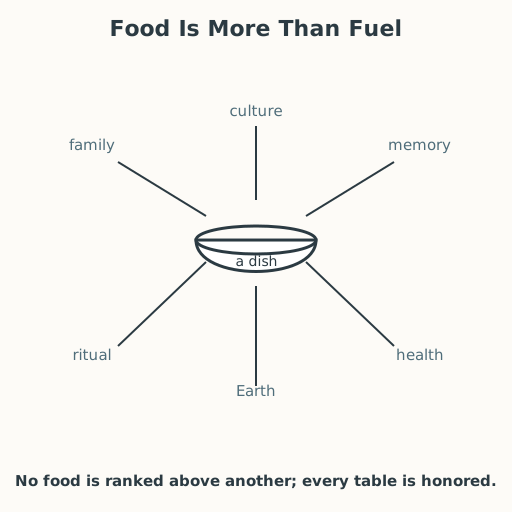
- Food-is-more-than-fuel web sheet · 1 per learner A plate at center with labeled threads out to culture, family, memory, ritual, health, and Earth, each with a blank
- Health & care journal · 1 per learner The unit-long notebook for reflections and portfolio artifacts
Low-tech / no-cost
- Paper and any writing tool A hand-drawn plate-with-threads works identically
- A remembered dish One dish with a story — a holiday food, a family recipe, a food of home — named, drawn, or described
Enriched / lab & device
- A shared meal or potluck item · optional If culturally and logistically appropriate, one dish learners or families share, treated with respect
Works in different contexts
- large-group Share foodways in a respectful circle (stories, not rankings); pairs then build their own web
- multi-age Younger learners tell the story of one dish; older learners also write the synthesis that holds science and culture together
- self-directed A learner builds their web from remembered dishes and writes the synthesis alone
- level-grouped A ready group also compares two foodways and names what each preserves that a nutrient list cannot
- outdoor-only Share a foodway tied to place — what grows or is gathered here, and what it means to the people who live here
Lesson 3 — Cultural Foodways and Lifelong Food Decisions
Summary
Learners hold food as culture, family, memory, and ritual — not only fuel. They explore foodways across cultures (what, how, when, and with whom people eat, and why), recognize that healthy traditional ways of eating exist in every region, and build the unit’s synthesis: a lifelong food decision honors nutrition science and culture, ethics, environment, and budget. Every family’s table is respected; no food is ranked above another.
Objectives
- Synthesize the science of nutrition with cultural considerations — and with ethics and the environment — to make lifelong food decisions. (D03.S3.12.01)
Connection
The dish your family makes for a holiday, a wedding, or a funeral is not just calories — it is who you are. Food carries memory, belonging, care, and identity: the smell of a kitchen, the hands that taught you to cook, the prayer or song or silence that surrounds a meal. A lifelong food decision keeps that meaning and adds what we now know about health and the Earth. The two do not fight; they belong to the same table.
Materials
- “Food-is-more-than-fuel” web sheet
- Health & care journal
- Low-tech: paper and any writing tool; a remembered dish
- Enriched: a shared meal or potluck item (optional, with respect)
Preparation
- Copy or draw the plate-with-threads sheet (culture / family / memory / ritual / health / Earth).
- Retrieval: from Grade 4 (D03.S3.04.02), how different families and cultures eat different healthy foods; from Grade 11 (D03.S3.11.02), honoring one’s own culture in a nutrition plan. Today we make that honoring central, not incidental.
- Prepare the worked example (one foodway traced across its threads) to model first (S-011).
Facilitator note
This lesson is written to the learner (“you”). The idea to land: food is culture, family, memory, and ritual — and a lifelong food decision holds that meaning alongside nutrition science without ranking any food above another. Teach the foodway-trace worked example explicitly, then let learners trace their own (S-011). This is the unit’s dignity anchor: never let a learner’s food be called “unhealthy” or “weird.” There is no single correct way to eat; there are many healthy tables (S-118).
The ethics lens: honoring someone’s food is honoring the person — a foodway is an inheritance, and we treat it with the same respect we owe any heritage. The egalitarianism lens: no cuisine is “backward” and none is “superior”; healthy traditional patterns exist in every region, and ranking them is a form of ranking people (S-118). The global lens: food traditions are living heritage, passed hand to hand — from Andean potato stews (S-054) to the many foodways UNESCO records as practices communities carry between generations (S-056). The technology lens: modern food systems can both preserve and erode foodways — refrigeration and migration carry dishes across the world, while mass-marketed convenience foods can crowd out local kitchens; both are worth naming. The environment lens: traditional foodways often encode deep ecological knowledge — what grows where, what the seasons offer — that industrial eating can forget. Preview: Lesson 4 steps back to the whole food system; Lesson 5 turns this respect into advocacy.
Procedure
- Recall (5 min). From Grade 4: name one way different families you know eat differently — and notice that all of them can be healthy. Today we make food-as-culture central.
- Meet the idea (8 min). Write it down: a foodway is the whole pattern of how a people eats — what they eat, how they prepare it, when and with whom they share it, and why it matters. Food is not only fuel; it is meaning made edible.
- Worked example — trace a foodway (15 min). Take one food tradition you know (or the Andean potato, domesticated in the Andes and carried across the world in thousands of varieties, S-054). Trace it across the threads: culture (what it means), family (who makes and shares it), memory (what it recalls), ritual (when it appears — feast, fast, funeral), health (what it provides a body), Earth (where it comes from). Write one note per thread.
- Name the move — hold both (8 min). Nutrition science tells you what a food provides; culture tells you what it means. A lifelong food decision holds both without letting either erase the other. Write that in one sentence.
- Guided practice (15 min). With a partner, trace a dish from your own life across the six threads. Then, if you are willing, share one thread’s story — not to rank, only to honor. Say — or write, sign, gesture, or use AAC to show — what your dish carries that a nutrient list could never capture.
- Write your synthesis (5 min). In your journal, complete the sentence: My lifelong food decision will honor _____ (a foodway) and _____ (a health or Earth truth), together.
- Close (2 min). Say — or write, sign, gesture, or use AAC to express — why “food is more than fuel” changes how you would talk about someone else’s food.
Differentiation
- Support: Use the foodway-trace pre-filled with one tradition; the learner adds a single thread of their own (e.g., “a food of home”) rather than building all six.
- Extension: Compare two foodways and write what each preserves that a nutrient list cannot, then name one way modern food systems could honor rather than erode them.
- Number access (dyscalculia): This lesson requires no arithmetic and no numerals; the six threads are handled by the pre-printed web sheet, and every thread may be completed in words, drawings, or gesture.
- Communication access: Every spoken step — saying, naming, reading aloud, sharing, or closing — can be done in writing, sign, gesture, or AAC instead. Learners who are non-speaking, d/Deaf, hard-of-hearing, or who use AAC complete every task in their preferred mode; no step requires producing or hearing sound. A dish may be drawn, shown, or signed rather than described aloud.
Assessment
- Formative (peer + self): Can the learner trace a foodway across the six threads, state why food is more than fuel, and write a synthesis that holds science and culture together without ranking any food?
- Portfolio artifact (unit): The completed “food is more than fuel” web plus the one-line synthesis, opened in the health & care journal.
Home connection
Ask someone at home to tell the story of one dish your family makes — when it appears, who first made it, what it means. Write one sentence recording the story and one sentence naming what the dish provides a body, held together without judgment.
Resources
- On worked examples and guided practice for a new concept: Kirschner, Sweller & Clark (2006) (S-011).
- On healthy traditional dietary patterns in every region: FAO — Food-based dietary guidelines (S-118).
- On food traditions as living heritage: UNESCO — Intangible Cultural Heritage (S-056).
- On the Andean potato as a foodway example: International Potato Center (S-054).
- On variety as a core principle of a healthy diet: WHO — Healthy diet fact sheet (S-038).