Lesson 04 — Food Systems: From Farm to Table
Learners trace a food system from farm to table to waste — production, processing, distribution, retail, consumption, disposal — and see who and what it touches: farmers, workers, transport, land, water, and climate. They analyze a local food system for where health, dignity, and the environment are helped or harmed, and locate the leverage points where a change would matter most. This is the descriptive ground on which Lesson 5's advocacy stands.
Objectives
Objectives
- D03.S3.12.02 Advocate for food systems and policies that support health and dignity for all people, linking individual and collective wellbeing.
Essential question
How does food actually get from farm to my table — and where, along that chain, are health, dignity, and the Earth helped or harmed?
Key vocabulary
Materials
Standard materials
- Farm-to-table chain sheet · 1 per learner Six stages in a row — seed/soil, farm, processing, transport, market, table, waste — each with a "who" line and a "what it touches" line
- Health & care journal · 1 per learner The unit-long notebook for analysis and portfolio artifacts
Low-tech / no-cost
- Paper and any writing tool A hand-drawn chain of stages works identically
- A single real food item One food whose journey the learner can retrace from memory or observation — no data or device needed
Enriched / lab & device
- A local-food-system map or article · 1 per pair A short account of how food reaches learners' own region, to ground the trace in place
Works in different contexts
- large-group Trace one food whole-class across all stages, then small groups each take a different food and report one finding
- multi-age Younger learners retrace "where did this food come from?"; older learners also map where dignity or the Earth is harmed and why
- self-directed A learner traces one food end to end and writes where health, dignity, and the Earth are helped or harmed
- level-grouped A ready group also identifies the leverage points — the stages where a change would make the biggest difference
- outdoor-only Trace a food grown or gathered locally; walk its route as far as you can see and name each stage you pass
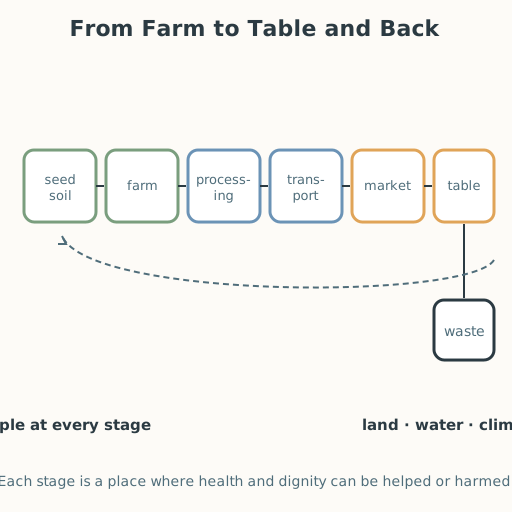
Lesson 4 — Food Systems: From Farm to Table
Summary
Learners trace a food system from farm to table to waste — production, processing, distribution, retail, consumption, disposal — and see who and what it touches: farmers, workers, transport, land, water, and climate. They analyze a local food system for where health, dignity, and the environment are helped or harmed, and locate the leverage points where a change would matter most. This is the descriptive ground on which Lesson 5’s advocacy stands.
Objectives
- Advocate for food systems and policies that support health and dignity for all, beginning by analyzing how a food system actually works. (D03.S3.12.02)
Connection
The meal at your table is the end of a long chain: a seed in soil, water and sun, hands that planted and picked, a truck or ship, a market or shop, a kitchen. When we see the whole chain, we can see where health, dignity, and the Earth are helped or harmed — and where a person, a community, or a policy could act. You cannot change a system you cannot see; today you learn to see it.
Materials
- Farm-to-table chain sheet
- Health & care journal
- Low-tech: paper and any writing tool; a single real food item
- Enriched: a local-food-system map or article
Preparation
- Copy or draw the chain sheet (seed/soil → farm → processing → transport → market → table → waste, each with a “who” and a “what it touches” line).
- Retrieval: from Grade 9 (D03.S3.09.01), analyzing a local food system from farm to table to waste; from Grade 11 (D03.S3.11.01), how policy shapes population nutrition. Today we build the descriptive map that advocacy needs.
- Prepare the worked example (trace one food across the chain) to model first (S-011).
Facilitator note
This lesson is written to the learner (“you”). The idea to land: a food system is a chain of stages — production, processing, distribution, retail, consumption, waste — and each stage touches people and the Earth, so each stage is a place where health and dignity can be helped or harmed. Teach the trace-the-chain worked example explicitly, then let learners trace a food of their own (S-011). Keep the frame descriptive and hopeful: we name harm in order to find the place to act, never to despair.
The ethics lens: mapping a system means noticing who is affected at each stage — the worker who is underpaid, the community whose water is used, the eater who cannot afford the result. The egalitarianism lens: food security has four pillars — availability, access, utilization, and stability — and “access” is where inequality bites: enough food can exist in a region while some people still go hungry (S-409). The global lens: the same food moves through very different systems in different places — a smallholder’s field, a vast export plantation, a neighborhood garden — and no one system is “the” system. The technology lens: refrigeration, roads, and processing lengthened the chain and lowered some prices while concentrating power in a few links; technology is a lever whose direction we choose. The environment lens: the chain ends in waste — about a fifth of food available to consumers is wasted, carrying the land, water, and energy that made it (S-410). Preview: Lesson 5 turns this map into a proposal for change.
Procedure
- Recall (5 min). From Grade 9: name one stage in the journey of the last food you ate. Today we name them all and ask what each stage does to people and the Earth.
- Meet the idea (8 min). Write it down: a food system is the whole chain that feeds people — production (growing and raising), processing (turning raw into edible), distribution (moving it), retail (selling it), consumption (eating it), and waste (what is thrown away). A food system is built by people and runs on land, water, and energy.
- Worked example — trace one food (15 min). Take one familiar food. Walk it stage by stage on the chain sheet, writing who does the work and what the stage touches. For example: a tomato is seeded and grown (a farmer, soil and water), packed and moved (workers and a truck, fuel), sold (a shopkeeper), eaten (a family), and partly wasted (a bin). Note where a person could be treated unfairly and where the Earth is drawn down.
- Name the move — leverage points (8 min). Some stages matter more than others. A leverage point is a place where a change would ripple through the whole system — the price a farmer is paid, the distance food travels, what a school or market chooses to buy. Circle one leverage point on your sheet.
- Guided practice (15 min). With a partner, trace a food from your own region across the chain. Exchange sheets and check each other: did you name a who and a what it touches at every stage? Say — or write, sign, gesture, or use AAC to show — the single stage where you think health or dignity is helped or harmed most, and why.
- Locate the lever (5 min). In your journal, write one sentence: The place I would change is ____, because ____. This is the seed of Lesson 5’s advocacy.
- Close (2 min). Say — or write, sign, gesture, or use AAC to express — why “from farm to table” is really “from farm to table and back” (to the soil, the water, the waste).
Differentiation
- Support: Use the chain sheet pre-filled with the worked-example food; the learner adds a single “who” or “what it touches” at one stage rather than tracing from scratch.
- Extension: Identify two leverage points and argue which would make the bigger difference for health and dignity, naming the trade-off between them.
- Number access (dyscalculia): This lesson requires no arithmetic; the stages are handled by the pre-printed chain sheet, and every stage may be completed in words, arrows, or drawings with no numerals at all. Any figures (a fifth of food wasted) are read as “a lot,” not computed.
- Communication access: Every spoken step — saying, naming, reading aloud, discussing, or closing — can be done in writing, sign, gesture, or AAC instead. Learners who are non-speaking, d/Deaf, hard-of-hearing, or who use AAC complete every task in their preferred mode; no step requires producing or hearing sound.
Assessment
- Formative (peer + self): Can the learner trace a food across the chain, name a “who” and a “what it touches” at each stage, and locate a leverage point with a reason?
- Portfolio artifact (unit): The completed farm-to-table chain sheet with one leverage point circled and the one-sentence “place I would change,” opened in the journal.
Home connection
Pick one food at home and, with someone there, retrace its journey backward from your table as far as you can. Write one sentence naming the stage you could see least clearly and one naming the stage where you think a change would matter most.
Resources
- On worked examples and guided practice for a new concept: Kirschner, Sweller & Clark (2006) (S-011).
- On food security and its four pillars: FAO — SOFI (S-409); FAO — Hunger and food security (S-119).
- On food waste in the chain: UNEP — Food Waste Index Report (S-410).
- On food-system data and who is affected: Our World in Data (S-006).