Lesson 05 — Advocating for Health and Dignity for All
Learners turn understanding into advocacy: they propose a change that widens access to healthy, dignified food, drawing on real levers — policy, community food programs, cooperatives, school meals, gardens. They hold the facts (hundreds of millions face hunger; access, not just availability, is the gap) alongside the value (everyone deserves enough to eat), and link individual wellbeing to everyone's. Hunger is framed as a systems condition, never a personal failing.
Objectives
Objectives
- D03.S3.12.02 Advocate for food systems and policies that support health and dignity for all people, linking individual and collective wellbeing.
Essential question
How do I turn what I now know into a change that widens access to healthy, dignified food — for me and for everyone?
Key vocabulary
Materials
Standard materials
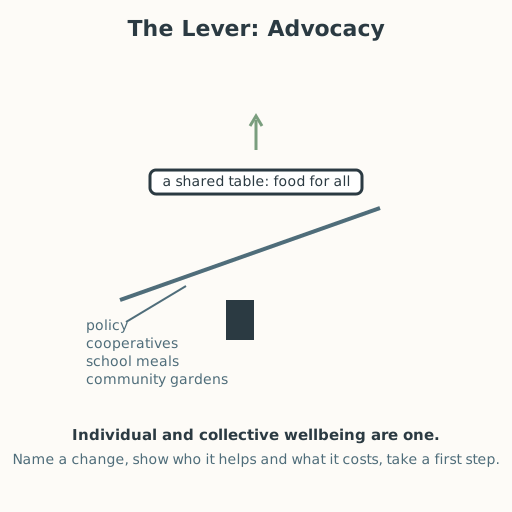
- Advocacy-lever sheet · 1 per learner A lever-and-table diagram with spaces for one change, who it helps, what it costs, and the first step to take
- Health & care journal · 1 per learner The unit-long notebook for proposals and portfolio artifacts
Low-tech / no-cost
- Paper and any writing tool A hand-drawn lever diagram works identically
- Voice, pen, or petition The advocacy itself — spoken, written, signed, or drawn — needs nothing beyond a person willing to speak up
Enriched / lab & device
- A short local example of food advocacy · 1 per class A community garden, food bank, school-meal program, or cooperative, described in an article or by a guest
Works in different contexts
- large-group Brainstorm change ideas whole-class, then small groups each develop one proposal and present it
- multi-age Younger learners name a change they want and one person who could help; older learners also weigh who benefits and what it costs
- self-directed A learner writes a one-page proposal — the change, who it helps, what it costs, and the first step
- level-grouped A ready group also names the counterargument and answers it with evidence and values, kept distinct
- outdoor-only Propose a change in the local place itself — a garden, a water point, a market stall — and name the first concrete step
Lesson 5 — Advocating for Health and Dignity for All
Summary
Learners turn understanding into advocacy: they propose a change that widens access to healthy, dignified food, drawing on real levers — policy, community food programs, cooperatives, school meals, gardens. They hold the facts (hundreds of millions face hunger; access, not just availability, is the gap) alongside the value (everyone deserves enough to eat), and link individual wellbeing to everyone’s. Hunger is framed as a systems condition, never a personal failing.
Objectives
- Advocate for food systems and policies that support health and dignity for all people, linking individual and collective wellbeing. (D03.S3.12.02)
Connection
Hunger is not a personal failing — it is a systems condition. Whether you can reach healthy food depends on where you live, what it costs, and how much money your family has — things no person chose. Advocacy is the move from “I wish this were fair” to “here is a change that would make it fairer.” It is something ordinary people do all over the world, and it is something you can already do.
Materials
- Advocacy-lever sheet
- Health & care journal
- Low-tech: paper and any writing tool; voice, pen, or petition
- Enriched: a short local example of food advocacy
Preparation
- Copy or draw the lever sheet (change / who it helps / what it costs / first step).
- Retrieval: from Grade 11 (D03.S3.11.01), proposing a change that widens access; from the unit’s own Lessons 1–4, the map and levers we built. Today we act on that map.
- Prepare the worked example (one advocacy proposal) to model first (S-011).
Facilitator note
This lesson is written to the learner (“you”). The idea to land: advocacy is a learnable move — name a change, show who it helps and what it costs, and take a first step — and it links my wellbeing to everyone’s. Teach one worked-example proposal explicitly, then let learners build their own (S-011). Keep facts and values cleanly separated: it is a fact that roughly 733 million people faced hunger in 2023 and about 2.33 billion faced moderate or severe food insecurity (S-409); it is a value that everyone deserves enough to eat. Both are true, and the second is what moves us to act.
The ethics lens: advocacy is the discipline of turning a value (dignity, fairness) into a concrete, accountable ask — and of listening to the people the change is for, not deciding for them. The egalitarianism lens: the right to food and health belongs to every child, every person, without exception (S-060); advocacy exists because that right is not yet honored equally. The global lens: advocacy takes many forms worldwide — Wangari Maathai’s Green Belt Movement began with tree-planting and grew into a movement for land, food, and peace (S-059); community gardens, food banks, and cooperatives are advocacy too. The technology lens: who controls the seeds, the data, and the distribution shapes who eats — and tools from open data to mobile markets can be turned either way (S-006). The environment lens: food advocacy and Earth advocacy are one fight — the same systems that leave people hungry also strain the land and water that feed us. Preview: Lesson 6 turns inward, to managing your own health independently.
Procedure
- Recall (5 min). From Grade 11: name one change you proposed that would widen access to food. Today we make that proposal real: specific, evidence-backed, and actionable.
- Meet the idea (8 min). Write it down: advocacy is speaking or acting for a change that should happen, so that it does. It has four parts: the change, who it helps, what it costs, and a first step. It links your wellbeing to everyone’s.
- Worked example — one proposal (15 min). Model all four parts on a real lever. For example: change — a school or neighborhood garden plus a meal program; who it helps — families who cannot reliably afford fresh food; what it costs — land, time, and a small budget, which a cooperative or local program can share; first step — find one ally and one place, and ask. Write the four parts on your sheet as the model.
- Name the move — fact and value, kept straight (8 min). Your proposal rests on a fact (food insecurity is real and uneven, S-409) and a value (everyone deserves enough, S-060). Name both, separately, so your advocacy is honest: the fact is why it is true, the value is why it matters.
- Guided practice (15 min). With a partner, build your own proposal using the four-part sheet. Exchange and check each other: is the change concrete, the “who it helps” real, the cost honest, the first step small enough to actually take? Say — or write, sign, gesture, or use AAC to show — your first step and who you would take it with.
- Make it shareable (5 min). Write your proposal as one short paragraph — the kind you could read to a neighbor, a student council, or a local official. Keep it in your journal.
- Close (2 min). Say — or write, sign, gesture, or use AAC to express — why “my wellbeing” and “everyone’s wellbeing” are not two separate things but one.
Differentiation
- Support: Use the worked-example proposal pre-filled; the learner changes one part (the “first step” or “who it helps”) rather than building all four from scratch.
- Extension: Name the strongest counterargument to your proposal and answer it, keeping facts and values clearly labeled, then state the single most persuasive line of your case.
- Number access (dyscalculia): This lesson’s figures (millions who face hunger) are read as “a very large number of people,” never computed; provide the four-part sheet pre-printed, and allow the proposal to be written entirely in words with no numerals at all.
- Communication access: Every spoken step — saying, naming, reading aloud, discussing, or closing — can be done in writing, sign, gesture, or AAC instead. Learners who are non-speaking, d/Deaf, hard-of-hearing, or who use AAC complete every task in their preferred mode; no step requires producing or hearing sound. A proposal may be drawn, signed, or shown rather than spoken.
Assessment
- Formative (peer + self): Can the learner build a four-part proposal (change, who it helps, what it costs, first step), keep a fact and a value distinct, and link individual to collective wellbeing?
- Portfolio artifact (unit): The completed advocacy-lever sheet plus the one-paragraph proposal, opened in the health & care journal.
Home connection
At home, talk with someone about one change that would make healthy food easier to reach where you live. Write one sentence naming the change and one naming the first step you could take together.
Resources
- On worked examples and guided practice for a new concept: Kirschner, Sweller & Clark (2006) (S-011).
- On food insecurity and hunger figures: FAO — SOFI (S-409); FAO — Hunger and food security (S-119).
- On the right to food and health: UN Convention on the Rights of the Child (S-060).
- On advocacy as a worldwide practice: Wangari Maathai and the Green Belt Movement (S-059); on who is affected by food systems: Our World in Data (S-006).